The Delta Dispatch
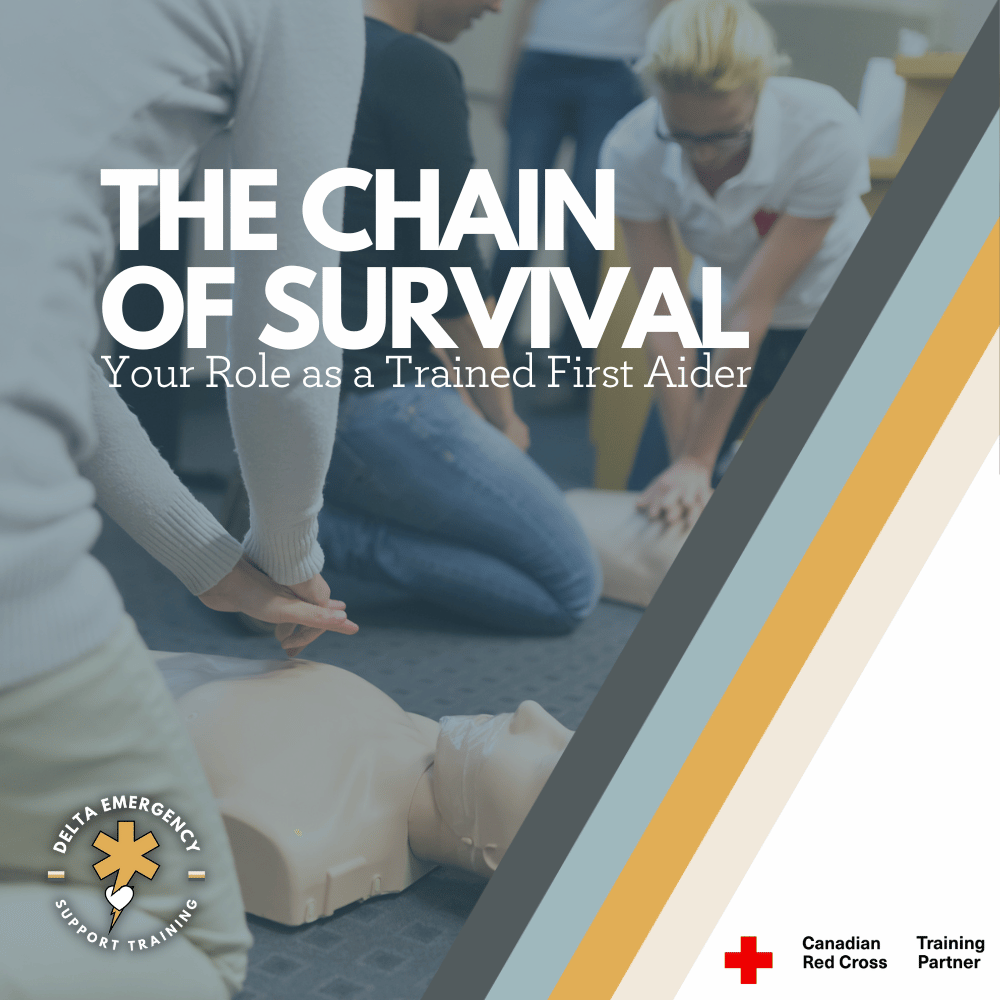
The Chain of Survival: Your Role as a Trained First Aider
First aid isn’t just about bandages—it’s about recognizing emergencies, acting quickly, and providing care until professional help arrives. Explore the key responsibilities of a first aider and understand why these skills are essential for every workplace and community.
When someone collapses, chokes, or stops breathing, every second counts. Whether you're a parent, a coach, a security guard, or someone who’s recently completed your Standard First Aid certification, you are a vital link in what’s known as the Chain of Survival—a model that outlines the critical steps needed to give someone the best chance of survival in a life-threatening emergency.
This blog explores what the Chain of Survival is, how first aiders fit into it, and why quick, confident action truly saves lives.
🔗 What Is the Chain of Survival?
The Chain of Survival is a concept developed by the American Heart Association and supported by the Canadian Red Cross. It identifies five key links in responding to sudden cardiac arrest or other life-threatening emergencies:
Early recognition and activation of EMS (calling 911)
Early CPR with an emphasis on high-quality chest compressions
Rapid defibrillation (AED use)
Advanced resuscitation by paramedics or emergency healthcare professionals
Post-cardiac arrest care at the hospital
🧠 Why the First Three Links Depend on You
Before paramedics arrive, the first three links are in your hands. This is where Standard First Aid and CPR trainingcomes in.
✅ 1. Early Recognition & Calling 911
You are the first person on scene—whether at home, at work, or in a public space. Recognizing when something is wrong (unresponsiveness, abnormal breathing, signs of a stroke or heart attack) and calling 911 starts the entire chain. Don’t wait. Early recognition can prevent the situation from getting worse.
✅ 2. Early CPR
If the person is not breathing or has no pulse, you need to start CPR immediately. High-quality chest compressions maintain blood flow to the brain and organs, buying time until help arrives. Studies show that bystander CPR can double or triple a person's chances of survival.
✅ 3. Early Defibrillation
An AED (automated external defibrillator) can shock the heart back into a normal rhythm. These are often available in schools, gyms, offices, and malls. Your Standard First Aid training gives you the confidence to use one correctly—and without hesitation.
🚑 Where EMS and Hospitals Take Over
Once paramedics arrive, they begin advanced care: administering medications, airway management, and transport to the hospital. But without your initial response—those first few minutes—their efforts may come too late. Survival rates drop 7–10% for every minute defibrillation is delayed. That’s why your actions matter so much.
👣 Your Role as a Trained First Aider
By taking a Red Cross Standard First Aid course, you’ve become more than just a witness to emergencies—you’ve become someone who can act. You’ve learned to:
Assess the scene and ensure safety
Check for responsiveness and breathing
Call for help and provide clear information to dispatch
Start CPR and use an AED
Support someone through shock, bleeding, or trauma
Recognize and manage common medical emergencies
You’re not a bystander. You are the beginning of the Chain of Survival.
🛠️ Want to Be Even More Prepared?
Whether you’ve taken first aid before or are due for a recertification, refreshing your skills ensures you stay sharp and confident. At Delta Emergency Support Training in Calgary, Alberta, our first aid programs are taught by experienced paramedics and firefighters who know what it’s like to respond in real life.
Be Ready for the Unexpected: First Aid Skills Every Hunter Should Know
Hunting is a beloved Canadian tradition, but heading into the bush without first aid training puts you and your group at risk. Learn the importance of being prepared with skills like bleeding control, wound care, and shock management. Whether you hunt with family, friends, or solo—make sure you're ready to protect what matters most.
Why You Should Learn First Aid Before Hunting Season
Be Prepared for the Unexpected in Canada’s Wilderness
Father and son hunting
As the crisp fall air rolls in and leaves begin to turn, thousands of Canadians prepare for one of the most anticipated times of the year—hunting season. For many, it’s more than a pastime. It’s a family tradition, a weekend with friends, or time spent in the backcountry with loved ones—passing down skills, telling stories around the fire, and enjoying the stillness of nature. Hunting is deeply woven into Canadian culture, a proud part of our heritage from coast to coast.
But no matter how experienced or well-prepared you are, the wilderness comes with real risks. And when something goes wrong, you're often far from help, without cell service, and hours from emergency responders.
That’s why first aid training isn’t just helpful—it’s essential.
Whether you’re a weekend hunter or a guide, learning Red Cross-certified First Aid, Advanced First Aid (AFA), Wilderness First Aid, or Emergency Medical Responder (EMR) skills can make all the difference in an emergency. It means being ready—not just for yourself, but for the people who matter most.
At Delta Emergency Support Training, we believe that part of keeping these traditions alive means learning how to protect them.
Hunting Safety in Canada: Know the Risks
Hunting is generally safe when done responsibly, but accidents still occur. According to the Canadian Firearms Program and provincial wildlife agencies:
Most firearm-related hunting injuries involve accidental discharges or poor handling technique.
Tree stand falls are one of the most common hunting injuries, often resulting in fractures or spinal trauma.
Hunters often travel to remote areas with no cell service, delaying access to emergency care.
In some provinces, hypothermia is the leading non-injury emergency reported during hunting season.
Each year, hundreds of injuries are reported across the country—many of which are preventable with basic training and better preparation.
🏹 Common Hunting Injuries and Medical Situations
Understanding potential emergencies helps you prepare properly. Here are the most common situations faced in the field:
Gunshot wounds or impalement from firearm mishandling or accidents.
Knife cuts and lacerations during field dressing or gear use.
Falls from tree stands or rocky/uneven ground, resulting in broken bones or head injuries.
Cold exposure: frostbite, hypothermia, or trench foot.
Heat stress in early season hunts.
Allergic reactions to insect stings, animal bites, or plants.
Getting lost or separated from your group, increasing the risk of panic, exposure, or dehydration.
🧠 First Aid Skills Every Hunter Should Know
Here’s what every hunter—beginner or seasoned—should know:
Bleeding control: How to apply direct pressure, pack a wound, or use a tourniquet.
Managing broken bones: Stabilizing with splints and slings.
Shock treatment: Recognizing and managing pale, cold, clammy symptoms.
CPR and AED use: Cardiac arrest can happen in any setting.
Anaphylaxis care: Recognizing severe allergic reactions and administering an EpiPen.
Basic wound care: Cleaning and dressing wounds to prevent infection.
Spinal motion restriction: Important if someone falls from a height or hits their head.
These lifesaving skills are taught in Red Cross First Aid and Wilderness First Aid programs and are enhanced further in EMR-level training.
🎒 Essential First Aid Items to Pack for the Field
Your hunting first aid kit should be compact, durable, and versatile. Pack:
Tourniquet (e.g., CAT or SOFTT models)
Gauze pads, trauma dressings, adhesive tape
SAM splint and triangular bandage
Antiseptic wipes, tweezers, antibiotic ointment
Antihistamines and pain relievers
CPR mask, gloves, emergency blanket
Water purification tablets or filter
Whistle, signal mirror, and flashlight
Personal locator beacon (PLB) or satellite communicator
Pack gear—but more importantly, know how to use it.
🏔️ Why Location Matters: The Reality of Remote Response
In urban areas, EMS might reach you in under 10 minutes. In the wilderness, it could be hours—or days. Even when you can call 911, delays are common due to:
No cell service
Impassable terrain
Poor visibility or weather conditions
Long distances from the nearest ambulance or search-and-rescue base
That’s why wilderness preparedness and basic medical self-reliance are key. The Red Cross Wilderness First Aid program focuses specifically on prolonged care and making decisions when help is hours away.
🧭 Preventing Emergencies: Smart Safety Tips for Hunters
Avoiding an emergency is the best-case scenario. Here’s how to minimize risk:
Take a buddy—never hunt alone if you can avoid it.
File a trip plan: Leave your route and return time with someone you trust.
Carry emergency communication (PLB, satellite text device, or two-way radio).
Inspect your gear, especially firearms, knives, and tree stands.
Dress appropriately in layers, blaze orange, and waterproof gear.
Know the weather and avoid risky conditions (fog, snowstorms, extreme cold).
Stay hydrated and take regular breaks.
Stay sober while handling firearms—alcohol and hunting don’t mix.
📚 Which First Aid Training Is Right for You?
At Delta Emergency Support Training, we help hunters, outdoor workers, and future first responders get the skills they need. We offer:
Standard and Advanced First Aid (AFA) – Learn bleeding control, airway management, CPR, and trauma care.
Wilderness First Aid – Specialized for remote environments and delayed help.
Emergency Medical Responder (EMR) – For guides, professionals, or those planning a career in emergency services.
All courses follow Red Cross Emergency Care for Professional Responders guidelines.
Conclusion: Be the One Who’s Ready
Hunting isn’t just a hobby—it’s a cherished Canadian tradition, often passed down through generations. Whether you’re heading into the woods with your father, sister, best friend, or your own kids, you’re not just out for the harvest—you’re making memories. You're sharing laughter around the campfire, waking up at dawn with excitement, and carrying on a way of life that means something deeply personal.
But with that comes responsibility.
If something goes wrong—and it can—you want to be the one who knows what to do. Whether it’s treating a serious injury, spotting early signs of hypothermia, or managing an allergic reaction, your actions can save the life of someone you care about.
At Delta Emergency Support Training, we’re here to make sure you’re ready. Our Red Cross-certified Advanced First Aid, Emergency Medical Responder, and Wilderness First Aid programs prepare you not just for emergencies—but for protecting what matters most: your family, your friends, and the memories you’re out there to create.
Let’s keep hunting a safe, proud tradition—for this season, and every season to come.
Mastering Entonox: Drug Monograph
Uncover the versatile role of Entonox, commonly known as 'laughing gas,' as a rapid analgesic in emergency response. Delve into the indications for swift pain relief, including its reversible effects and safety advantages. This guide introduces the acronyms DIVINE and SADMC to navigate contraindications and cautions, ensuring precise administration in diverse medical scenarios.
Introduction:
Entonox, colloquially known as "laughing gas" is a valuable tool in the first responder's arsenal, offering rapid analgesic.
In guide, we'll delve into both contraindications and cautions associated with Entonox, using the acronyms DIVINE and SADMC.
How Entonox Works:
When inhaled, Entonox takes approximately 3 to 5 minutes to initiate pain relief, reaching its maximum effect within 5 to 10 minutes. A notable feature of Entonox is its rapid excretion from the body via the lungs upon cessation of inhalation, leading to a prompt reversal of the analgesic effect.
Key Benefits of Entonox:
Rapid Analgesic Effect:
Entonox provides swift pain relief, making it an invaluable tool in emergency situations where quick intervention is paramount.
Reversible Analgesic Effect:
The rapid reversal of the analgesic effect ensures that symptoms are not masked, allowing healthcare providers to assess patients accurately.
Cardiac and Respiratory Safety:
When used properly, Entonox demonstrates no adverse effects on the cardiovascular or respiratory systems, enhancing its safety profile in diverse medical and trauma conditions.
Self-Administration Capability:
Patients can self-administer Entonox, offering a sense of control over their pain management, particularly in situations where immediate assistance may be limited.
Oxygen Enrichment:
With a 50% oxygen concentration, Entonox proves valuable in various medical and trauma scenarios where supplemental oxygen is beneficial, ensuring optimal oxygenation for patients.
Contraindications Acronym
Decompression Sickness (D):
Do not give Entonox to anyone who has recently dived as the nitrous oxide is highly soluble and will increase the inert gas load, making the symptoms of DCI (Decompression Illness) much worse.
Inability to Comply (I):
Patient cooperation is vital; those unable to hold the bite stick and inhale or someone who is in and out of consciousness are not suitable for Entonox
Ventable Space (V):
Proper ventilation is key to prevent gas concentration buildup, ensuring safety in various environments.
Inhalation Injury (I):
Burns to the mouth or throat, or recent exposure to fire and irrigation, warrant avoiding Entonox to prevent respiratory complications.
Nitroglycerin (N):
Caution is needed with recent nitroglycerin use, as combining it with Entonox may lead to fainting.
Embolism/Pneumothorax (E):
Entonox should be avoided with suspected pneumothorax or head injury, given its potential impact on pressure in the body.
Cautions (SADMC):
Shock (S):
Monitor for shock, as Entonox may not work optimally in such cases. It is important to give high flow O2 to a patient with suspected shock.
Abdominal Distention (A):
Similar to concerns with intercranial pressure and pneumothorax, avoid pressurized gas in patients with distended abdomens.
Depressant (D):
Exercise caution when combining Entonox with other depressants like alcohol, ketamine, marijuana, benzodiazepines, or opioids. Synergistic effects can lead to increased depression.
Maxillofacial Injury (M):
Patients with jaw injuries may struggle with the bite stick used in Entonox delivery. Adaptations may be needed for proper administration.
COPD (C):
For patients with COPD that may have alveolar bullae (air pockets or blebs) as nitrous oxide may cause bullae rupture since nitrous oxide enters that closed space more quickly than nitrogen can escape.
Scope of Practice Awareness:
Being attuned to regional scope of practice guidelines is essential for first responders. Variations exist among provinces and private emergency response agencies, emphasizing the need for ongoing education and communication within your team. Stay informed to ensure Entonox is administered safely and effectively, adhering to your specific guidelines.
Practical Application in Training:
As part of our commitment to excellence, our Advanced First Aid courses include practical training in Entonox use. This hands-on experience allows first responders to familiarize themselves with the administration of Entonox in a controlled environment, ensuring confidence and competence in the field.
Conclusion:
By understanding both contraindications and cautions and staying abreast of regional scope of practice guidelines, first responders can navigate the complexities of Entonox administration with precision.
Eye Injury Prevention and Management in the Workplace: A First Aider's Guide
Eye injuries are a common occurrence in the workplace, particularly in industries that involve manual labor or the use of heavy machinery. As a first aider, it's important to be able to recognize common types of eye injuries and provide appropriate care to those in need. By taking steps to prevent eye injuries, employers can help to ensure the safety and well-being of their workers, and reduce the risk of workplace accidents. Here's what you need to know as a first aider about responding to workplace eye injuries.
Eye injuries can range from minor irritations to serious injuries that can cause vision loss or other complications. As a first aider, it's important to be able to recognize common types of eye injuries and provide appropriate care to those in need.
a first aid kit with eye supplies specifically for eye emergencies.
Workplace eye injuries are common, particularly in industries that involve manual labor or the use of heavy machinery. These injuries can often be prevented by taking simple precautions, such as wearing appropriate eye protection, conducting regular safety audits, and providing training and education on eye safety. Other factors that can contribute to workplace eye injuries include poor lighting, clutter and debris, and working with hazardous materials or power tools. By taking steps to prevent eye injuries, employers can help to ensure the safety and well-being of their workers, and reduce the risk of workplace accidents. As a first aider, it's important to be prepared to respond to eye injuries in the workplace and provide appropriate care to those in need.
Common Types of Eye Injuries
Foreign Bodies:
Foreign bodies are small objects or debris that enter the eye, such as dust, dirt, or metal shavings. They can cause irritation, redness, and discomfort. If a foreign object enters the eye, it's important not to rub or touch the eye, as this can push the object further in and cause more damage. Instead, cover the eye with a sterile gauze pad or cloth and seek medical attention. Do not attempt to remove the foreign object, as this can cause further damage or push the object deeper into the eye.
Chemical Burns:
Exposure to chemicals, such as acids or alkalis, can cause severe eye damage and should be treated as an emergency. If a person's eye comes into contact with a chemical, it's important to immediately flush the eye with clean water or saline solution for at least 20 minutes. Continue flushing the eye while seeking medical attention.
Corneal Abrasions:
A corneal abrasion is a scratch or cut on the cornea, which can cause pain, sensitivity to light, and tearing. If someone has a corneal abrasion, it's important to cover the injured eye with a sterile gauze pad or cloth and seek medical attention. Do not attempt to rub the eye or remove any foreign objects, as this can cause further damage.
Blunt Trauma:
Blunt trauma to the eye, such as from a ball or fist, can cause swelling, bleeding, or even vision loss. If someone has experienced blunt trauma to the eye, it's important to cover the injured eye with a sterile gauze pad or cloth and seek medical attention immediately.
Penetrating Injuries:
Penetrating Injuries: Penetrating injuries to the eye occur when an object, such as a piece of metal or glass, enters the eye and penetrates the eyeball. These injuries can be very serious and require immediate medical attention. If someone has experienced a penetrating eye injury, it's important to cover the injured eye with a sterile gauze pad or cloth, stabilize the object in place, and cover the other eye with a cloth or eye shield to prevent any movement. Seek emergency medical attention immediately. It's important not to remove the object, as this can cause further damage or bleeding.
Dealing with Eye Injuries
If you encounter someone with an eye injury, it's important to take immediate action to prevent further damage or complications. Here are some steps you can take:
Remain calm and reassure the person that help is on the way.
Encourage the person to keep their eyes closed to prevent further damage.
Assess the injury by looking for signs of bleeding, swelling, or foreign objects in the eye.
If both eyes are injured or there are signs of a head injury, call for emergency medical services right away.
Preventing Eye Injuries on Work Sites
Eye injuries are a common occurrence on work sites, particularly in industries that involve manual labor or the use of heavy machinery. These injuries can often be prevented by taking simple precautions, such as:
Wearing appropriate eye protection:
Eye protection should be worn by all workers who may be exposed to hazards such as flying debris, chemicals, or radiation. Employers should provide workers with appropriate eye protection and ensure that it meets safety standards.
Conducting regular safety audits:
Regular safety audits can help to identify potential hazards and ensure that safety measures are being followed. Employers should conduct regular safety audits to identify potential hazards and take steps to eliminate or minimize them.
Providing training and education:
Workers should be trained on the importance of eye safety and provided with the knowledge and skills necessary to identify potential hazards and take appropriate precautions.
Using caution when working with hazardous materials:
Workers should use caution when working with hazardous materials, such as chemicals or biological agents. Protective eyewear should be worn when working with these materials, and proper ventilation should be provided to minimize exposure.
Using caution when working with power tools:
Power tools can cause flying debris and other hazards that can cause eye injuries. Workers should always wear appropriate eye protection when working with power tools.
Ensuring that work sites are well-lit:
Poor lighting can increase the risk of eye injuries, as workers may not be able to see potential hazards. Employers should ensure that work sites are well-lit and that workers have adequate visibility.
Removing clutter and debris:
Clutter and debris on work sites can increase the risk of eye injuries. Employers should ensure that work sites are free from clutter and debris, and that workers have clear paths of travel.
As a first aider, it's important to be able to recognize common types of eye injuries and provide appropriate care to those in need. By taking steps to prevent eye injuries, employers can help to ensure the safety and well-being of their workers, and reduce the risk of workplace accidents. Remember to always wear appropriate eye protection when working in hazardous environments, and to seek medical attention for serious or potentially serious eye injuries.
First Aid
Enroll in our first aid course in Calgary today and learn the skills you need to protect your vision and help others in any emergency situation. Visit us at deltaemergency.com to register for our course and take the first step towards becoming a confident and effective first aider.
Get Hired as a Childcare Provider in Calgary: How Childcare First Aid Training Can Boost Your Resume
Training with Delta Emergency Support Training for Red Cross Childcare First Aid and CPR Level B is a valuable investment in the safety and well-being of children. By equipping individuals with the skills and knowledge needed to respond to emergencies in a childcare setting, this training ensures that children receive the best possible care in emergency situations. This is an essential course for anyone who works with children or is responsible for the safety of children.
If you're considering a career change in Calgary and are interested in working as a childcare provider, then completing Red Cross Childcare First Aid training with Delta Emergency Support Training can be an excellent way to prepare for this new career path.
In addition to learning the essential first aid skills needed to respond to medical emergencies and provide immediate care to children, there are several other skills that you can develop during this training to make you the best caretaker for a high paying job.
Communication Skills
One of the most important skills that you can develop as a childcare provider is strong communication skills. This includes being able to communicate effectively with children, their parents, and other caregivers. During the Red Cross Childcare First Aid course, you will learn how to communicate with children in a way that is age-appropriate and easy to understand. You will also learn how to communicate with parents and other caregivers in emergency situations, including how to provide updates on the child's condition and how to work together to provide the best possible care.
Organizational Skills
Another important skill for a childcare provider is strong organizational skills. This includes being able to manage multiple tasks and activities, keep track of important information, and prioritize tasks effectively. During the Red Cross Childcare First Aid course, you will learn how to manage emergency situations and stay calm under pressure. You will also learn how to keep accurate records of the child's medical history and emergency contact information, which is essential for providing the best possible care.
Observation Skills
Observation skills are also critical for a childcare provider. This includes being able to recognize changes in a child's behavior or physical condition and respond appropriately. During the Red Cross Childcare First Aid course, you will learn how to recognize the signs and symptoms of common medical emergencies, such as choking, allergic reactions, and seizures. You will also learn how to monitor a child's vital signs, including their pulse and breathing rate, which is essential for identifying changes in their condition.
Patience and Empathy
Finally, a successful childcare provider needs to be patient and empathetic. This includes being able to understand the child's needs and emotions, and to provide comfort and support when needed. During the Red Cross Childcare First Aid course, you will learn how to provide emotional support to children in emergency situations, including how to reassure them and help them feel safe and secure.
At Delta Emergency Support Training, we dedicate our Childcare courses to Childcare! We don’t make you join a regular First Aid course for adult patient skills, and “tack-on” Childcare information/skills at the end in a hurry (as every other provider does in Calgary).
We are a Canadian Red Cross training provider based in Calgary that offers a wide range of emergency response courses, including Red Cross Childcare First Aid and CPR Level B. The Red Cross Childcare First Aid course covers a range of topics, including how to recognize and respond to emergency situations, providing care for children who are choking, bleeding, or experiencing allergic reactions, and how to perform CPR on infants and children. Participants also learn about injury prevention, basic child development, and the importance of emergency preparedness.
CPR Level B is a component of the Red Cross Childcare First Aid course that focuses on teaching participants how to perform CPR on infants and children, as well as how to use an automated external defibrillator (AED) in emergency situations. Participants are trained to respond to cardiac emergencies, including when a child is not breathing or their heart has stopped.
Training with Delta Emergency Support Training provides a hands-on, interactive learning experience that enables participants to practice their skills and gain confidence in their ability to respond to emergencies. The training is conducted by experienced instructors who are certified by the Alberta College of Paramedics and are committed to providing high-quality, engaging training to participants.
Upon completion of the Red Cross Childcare First Aid and CPR Level B course, participants receive a certification that is valid for three years. This certification is recognized across Canada and is a valuable addition to any resume for those seeking employment in childcare, education, or other industries that involve working with children.
Training with Delta Emergency Support Training for Red Cross Childcare First Aid and CPR Level B is a valuable investment in the safety and well-being of children. By equipping individuals with the skills and knowledge needed to respond to emergencies in a childcare setting, this training ensures that children receive the best possible care in emergency situations. This is an essential course for anyone who works with children or is responsible for the safety of children. The course provides participants with the knowledge and skills necessary to respond to medical emergencies and provide immediate care to children in need. By completing this training, individuals can help ensure the safety and well-being of children in their care.
Delta Emergency Support Training is committed to providing high-quality training that meets the needs of individuals and organizations in Calgary. They offer flexible training options, including on-site training and evening and weekend courses, to accommodate busy schedules.
In conclusion, completing Red Cross Childcare First Aid training with Delta Emergency Support Training can be an excellent way to prepare for a career as a childcare provider. In addition to learning the essential first aid skills needed to provide immediate care to children in emergency situations, you can also develop a range of other skills, including communication, organization, observation, and empathy, which can make you the best caretaker for a high paying job.
First Aid Providers pay for Google Reviews?
5 Stars!: When a company has only 5-star reviews, that’s a red flag. Every company, no matter how good, is likely to have a few negative reviews. Elevate your career with honesty. Are the reviews spread over a considerable amount of time or are they compressed in a very short period of time?
Is this review for real?
You’re about to click the “Buy” button, but before you open your wallet, it’s probably a good idea to read some online consumer reviews, right? Whether it's booking a vacation, buying an audiobook or hiring a contractor, many of us look to online reviews to help us with our buying decisions. Online consumer reviews help both consumers and businesses – they provide a wealth of “unbiased” product information to help you shop smart, and they reward businesses that provide a great product or service.
Companies may encourage their employees to post reviews, they might give customers incentives to leave positive reviews, and they can even hire a firm to post fake reviews for them.
Consumer reviews often strike at the heart of a consumer’s buying decision. Shoppers trust that these reviews are from real customers, just like them. Posting fake reviews online can damage that trust and seriously erode consumer confidence.
And the scope is wide -- if you shop online, you’re a potential victim.
So, here are some ways to help you recognize, reject and report fake reviews and protect your pocket book.
How to recognize fake reviews:
Sudden spike or dip: Watch out for a sudden spike in very positive reviews or a sudden dip in very bad reviews. Are the reviews spread over a considerable amount of time or are they compressed in a very short period of time?
New reviewer: Be on the lookout for reviewers who have only recently created a user profile or have been providing positive feedback on select products or services over a short period of time. These reviewers may work for the company and they may be getting reimbursed for posting fake reviews.
Beware when a reviewer says, “It’s the best ever!!!”: Don’t always trust reviews with an overly positive or gushing tone, especially if the review does not offer specific details about why it’s so good. If a review claims a service or product is “the best ever,” the review may be fake.
And beware when a reviewer says, “It’s the worst ever!!!”: You also shouldn’t always trust very negative reviews. These could be fake reviews from a competitor, discouraging shoppers from buying one product or service and suggesting another.
5 Stars!: When a company has only 5-star reviews, that’s a red flag. Every company, no matter how good, is likely to have a few negative reviews.
Does this sound familiar? Watch out for multiple different reviewers using the same language to describe how good or bad something is. Some companies provide scripts to reviewers with suggested phrases and key words. Be cautious if you see the same buzz words coming up over and over again in reviews.
How to reject fake reviews:
Shop around: Just like you shopped for the right product or service, you should also consult several sources for independent, unbiased reviews.
Go back in time: Be sure to look at reviews over a long period of time. This will help you to spot potential patterns like a spike in positive or negative reviews.
The meat is in the middle: Read the 2-, 3- and 4-star reviews too. Someone writing a fake review is more likely to assign a rating of 1 or 5 stars, meaning you’re more likely to find balanced critique in the middle range.
Diversify: Online reviews are just one way to assess a product or service. Branch out -- ask trusted friends and family about their experiences. Consider asking the company for references.
How to report fake reviews
If you believe you have come across fake online reviews, report them to the Competition Bureau.
Source: The Government of Canada.
elevate your career with honesty. Learn babysitting, take standard first aid, certify in advanced first aid, train to be a first responder, become an emr with a real emergency medical services instructors.
Calgary and Edmonton Fire Applications Opening in 2022 and 2023!
So you meet the minimum requirements to apply for Calgary and Edmonton Fire. What certifications do you need before you’re given a job offer? Canadian Red Cross Advanced First Aid is one of the certification requirements, and at Delta Emergency, we fully certify you to Alberta Fire Department standards.
Are you looking to change careers and apply with Calgary Fire or Edmonton Fire? Calgary Fire opened their recruitment on November 1, 2022 and it closes on November 30, 2022! Edmonton Fire will be opening their recruitment process from January 1-31, 2023.
If you haven’t taken Advanced First Aid (AFA) within the last 3 years, you will need to certify in an AFA course prior to a conditional job offer from either fire department. Here at Delta Emergency Support Training, we certify you as a Canadian Red Cross Advanced First Aider with Basic Life Support (BLS CPR) in one course.
Our AFA course is a hybrid version, perfect for individuals with full-time jobs, families, or busy schedules. There are 40 hours of online virtual sessions/online work to complete, and 40 hours of in-person skill days.
We typically run an AFA Cohort over the course of 4-6 weeks, and you attend 2 Friday nights and 2 weekends with our full-time active duty Advanced Care Paramedic instructors. We have real experience, real equipment, and exceptional student feedback.
Be one of our next students and become a Professional Responder.
Calgary Fire: Do you meet the minimum requirements to apply?
Be 18 years of age or older
Be a Canadian citizen or permanent resident
Have a high school diploma or equivalency
Have a valid Class 5 driver's license or provincial/territorial equivalent without a Graduated Driver’s License (GDL) status and with less than 7 demerit points
Have been granted a pardon or record suspension for any criminal convictions.
Meet all immunization requirements
Have a maximum of one illegal soft drug use in the past year and a maximum of three illegal soft drug uses in the past 3 years. Candidates must have had zero hard drug use in the past three years.
Edmonton Fire: Do you meet the minimum requirements to apply?
Applicant must be at least 18 years of age
Applicant embraces and actively promotes the behaviour and values of an inclusive, diverse and respectful work environment.
It is a requirement to obtain and maintain a City Driver's permit.
An overall satisfactory driver's record is required upon hire.
Hire is dependent upon a satisfactory Vulnerable Sector Police Information Check.
Good physical fitness is required and is evaluated at the fitness test stage.
Ability to understand and communicate clearly and concisely in English under stressful conditions.
Delta Emergency Hybrid Red Cross Advanced First Aid
We started teaching this new version of Hybrid Advanced First Aid in June 2021. Every student has rated our program with 5 stars and they all recommend it to their peers. 60 hours of at home learning and 24 hours in-class over 1 Friday night, Saturday and Sunday. Certify as an Advanced First Aider through online content such as videos, skill sheets, quizzes, written group discussions, 1:1 video instructor video sessions, weekly workbooks - more than multiple choice questions, games and repeatable tests to test your comprehension. Real instructors with real emergency experience. Skill sessions that deliver quality scenarios. Group scenarios to develop real world teamwork.
Delta Emergency Canadian Red Cross Hybrid Advanced First Aid
We started teaching this new version of Hybrid Advanced First Aid in June 2021. Every student has rated our program with 5 stars and they all recommend it to their peers. 60 hours of at home learning and 24 hours in-class over 1 Friday night, Saturday and Sunday. Certify as an Advanced First Aider through online content such as videos, skill sheets, quizzes, written group discussions, 1:1 video instructor video sessions, weekly workbooks - more than multiple choice questions, games and repeatable tests to test your comprehension. Real instructors with real emergency experience. Skill sessions that deliver quality scenarios. Group scenarios to develop real world teamwork. We’re a smaller business of like-minded emergency professionals and we’re not listed on Google, yet.
Traditional Canadian Red Cross Advanced First Aid
What does 80 hours in the classroom look like? Sitting in a classroom for 10 days straight. Taking vacation days or quitting your job. Past Red Cross Advanced First Aid students with other providers have let us know they feel they're being kept in class just to hit that 80 hour requirement and feel the in-person course is too long. The other downside is that the first 5-6 hours of each day are focused on the didactic training and PowerPoint, then you practice 1 or 2 skills at the end of the day. Traditional classroom works for some people. We are here to accommodate the people that need a true Hybrid Learning Format with 1 weekend of in-person skills.
Friday Night Session
Here's how Friday looks:
Arrive at weekend training facility. Give an overview of classroom setup. Student and instructor introductions.
Review quizzes, exams, answer questions from online course. Jeopardy style game for course content review.
Review any skills sheets that were unclear. Speak about skill indications + contraindications.
Practice taking vital signs - pulse, blood pressure, respiratory rate, lung sounds, SpO2, etc.
Discuss Week 3 verbal scenario, verbal scenario performed as a group.
Saturday + Sunday Session
Here’s a brief overview of Saturday:
All other AFA skills are demonstrated by the instructor and then performed by each student.
Individual and group scenarios are given throughout the day.
Group skills such as spinal motion restriction will require the student the participate in the skill at least 4 times.
Once to run the skill, and other times being part of a team member running the skill.
Every skill learned is applied to scenarios on Sunday.
Here’s a brief overview of Sunday:
Scenario day. Every scenario is graded. You need 1 successful scenario where you are the primary attendant to pass the course.
Scenarios will build in complexity. Basic ones at first to solidify the Scene/Primary assessments. Memorization of Assessment Acronyms is key.
Scenarios then progress in patient severity, where all team members work together to apply skills/equipment.
You will use more than 1 piece of equipment and skill as scenarios progress. The goal is to use the equipment realistically every single time.
You will be asked key knowledge points about each piece of equipment when you utilize them.
Key points were taught through the online course, textbook reading, the workbooks, quizzes, skill sheets, and Friday/Saturday.
Private Video Session with an Instructor
Does every student recommend the video session? Yep.
Does any other AFA provider offer 1:1 video sessions with their students? Nope, just Delta Emergency.
There are virtual time-slots for everyone to have a 1+ hour session with an instructor prior to the in-person course. It is capped at 1 student per session. It is not required, but recommended. Sometimes they go to 90+ minutes, but we've had great feedback from students that have signed up for the video session. In the session, we can review your course progress, review mid-terms/quizzes, and clarify any questions.
Then, we review how in-person scenarios are structured and we give you a basic verbal scenario during the hour. It will help you understand the format of what we are looking for during your scenarios. Availability will be on weeknights after 18:00. The online scheduler for this will be available within the online course. There will be as many spots open as there are students in each cohort.
Weekly Written Scenarios
At the start of Week 1 and Week 2 we release a scenario writeup that describes an emergency call and some basic scene and patient information.
All students will read the scenario and reply to the scenario. Students think about the first steps they would take and their initial treatments. They type what they would do from Scene Assessment -> Treatments.
Students write their own reply, can format is however they like, and do not reply with "I'd do what she did, and add..."
Instructors will read each students answer but not reply until everyone has completed the assignment. Students have 1 week to writeup a reply to each week.
The goal is to see what you prioritize and what you visualize as potential treatment/patient pathways. We give feedback on what you wrote. It doesn't matter if you forgot C-Spine, or didn't think about shock, etc. It is used as a learning tool and is a great way to see the priorities you fellow classmates think about.
We release a formal writeup and answer to the scenario 10 days after one is posted. It contains all the things a student could consider with that particular emergency. There are actually some key points to take away as you work in the real world and encounter similar patients.
The Future
We want to be the first Red Cross provider that stays connected to their past students. Delta Emergency Professional Responder Community Forum. The goal is to make it a space for students to connect, make a concise list of emergency medical pathways for programs/colleges/provinces, share volunteering opportunities, career postings, first responder discounts, real-call talk, scenarios, etc. It will be a place that only past students can access, so there won't be any internet trolls - unless you are one. We just wanted to make a dedicated training spot for you to come and reflect on different emergency calls.
Want to use a BVM again? SMR a patient to a backboard? The Delta Community Forum will also keep you informed of joining in-person skill days. There will be a small fee to cover some basic costs, but it will allow you to come for the full weekend, or just 1 day of scenarios on Sunday. After class registration closes for a cohort we will contact past students through our LMS and invite them to come back for some risk-free, stress-free training.
The Delta Community Forum will also be a perfect way to introduce yourself to other students, network, and possibly exchange information about training, volunteering, or job opportunities. It's up to you. A network of Professional Responders lifting one another up. What could be better?
Update Nov 19, 2021: We are currently modifying our format and more details will be released in January 2022.
Pocket Mask Requirements: First Aid Program Standards in 2021
All participants attending classroom training are required to have their own pocket resuscitation mask with single-use one-way valve.
Important changes to program standards
In the interest of public health during COVID-19 and beyond, please be advised the Canadian Red Cross program standards have been updated with respect to pocket masks in Red Cross First Aid training. All participants attending classroom training are required to have their own pocket resuscitation mask with single-use one-way valve.
Pocket masks must be new (if provided by the Training Partner) or previously owned by the participant only. While pocket masks are already used in training, they are typically decontaminated and reused along with a new one-way valve.
Purchase here: Pocket Mask
With this revised standard, the practice of decontaminating pocket resuscitation masks will be discontinued as masks may not be reused.
To ensure the safety of all students, course participants can bring their own pocket mask with a one-way valve, or they may opt to purchase one as an add-on item prior to class. Masks can be shipped to your home, or picked up on class day.
This new standard begins on March 31, 2021. Delta Emergency will adopt this new standard today, December 17, 2020. All courses that require mask ventilation training will be required to add a pocket mask at time of course purchase. If you choose not to buy a mask and do not have one on class day, you will be required to purchase one from your trainer in person before training can commence. If you refuse to purchase a mask in class, your participation will be marked as incomplete. We appreciate your understanding of this transition and we believe this will greatly reduce the risk of disease transmission for course participants.
Resources
Our COVID-19 protocols for classroom training have been revised to reflect this change. The courses this training will affect are:
Emergency First Aid
Standard First Aid
CPR A, CPR C, BLS, AED
Oxygen Therapy
Airway Management
Advanced First Aid
Please contact the Canadian Red Cross at 1-877-356-3226 with any questions regarding this new training standard.
As always, the health and safety of our partners, Instructors, and course participants is our first priority. Thank you for your support in ensuring a safe training environment.

