
The Delta Dispatch
Overcoming the Bystander Effect: How to Encourage Action in Emergencies
Even when help is needed most, many people hesitate to act. The bystander effect explains why witnesses freeze during emergencies, but simple strategies, like assigning tasks, giving clear instructions, and staying calm can empower anyone to make a difference.
Emergencies can happen anywhere—on the street, at home, or even at work. Yet, despite being physically present, many people fail to act when someone needs help. This phenomenon, known as the bystander effect, can mean the difference between life and death. Understanding why it happens and how to empower witnesses is critical for building safer communities.
At Delta Emergency Support Training, we focus on equipping both first responders and everyday people with the knowledge and confidence to act when it matters most.
What Is the Bystander Effect?
The bystander effect occurs when individuals are less likely to help someone in need because others are present. The presence of other witnesses can create diffusion of responsibility, where everyone assumes someone else will step in.
Common psychological reasons include:
Diffusion of responsibility: “Someone else will call 911.”
Fear of doing harm: Worry about making the situation worse.
Social influence: Looking at others to see how they react.
Evaluation apprehension: Fear of judgment if they act incorrectly.
Canadian Statistics on the Bystander Effect
According to a 2022 survey by the Canadian Red Cross, over 40% of Canadians have witnessed a medical emergency but did not intervene.
Studies show that in public settings, only 1 in 3 people will offer assistance during emergencies if others are present.
Time is critical: In cardiac arrests, survival decreases by 7–10% per minute without intervention, making bystander action essential.
Why People Freeze
People don’t always refuse to help out of selfishness—they freeze due to a combination of fear, uncertainty, and social cues. Examples include:
Witnessing someone collapse in a crowd and assuming another bystander has already called for help.
Seeing a car accident and being unsure whether it’s safe to approach.
Feeling overwhelmed by the severity of the situation.
Understanding these psychological barriers is the first step in overcoming them.
How to Encourage Action
Assign Responsibility
If you see an emergency, point to someone specifically and instruct them to call 911 or get help.
Example: “You in the red jacket, call 911 and get a first aid kit!”
Provide Clear Instructions
Direct instructions reduce hesitation and increase confidence.
Telling someone exactly what to do—“Check for breathing,” “Begin CPR”—reduces uncertainty.
Model Calm Leadership
Calm, confident action encourages others to help rather than freeze.
Speak clearly and remain composed to inspire others to step in.
Educate Communities
Promote first aid and CPR training for the public.
Awareness campaigns and workshops increase willingness to act.
Normalize Small Actions
Even simple actions—calling 911, providing basic first aid, or comforting the patient—can save lives.
Emphasize that any response is better than none.
The Role of First Aiders
First aiders are often the bridge between bystanders and professional care. By stepping in, first aiders not only provide life-saving support but also encourage others to assist safely, creating a ripple effect in emergencies.
Training in scene assessment, ABCs (airway, breathing, circulation), and communication ensures first aiders are confident, safe, and able to direct others effectively.
Final Thoughts
The bystander effect is a real psychological phenomenon—but it can be overcome. Understanding why people freeze, educating communities, and empowering witnesses to act are key steps in building safer environments. Every action counts. Every second matters.
At Delta Emergency Support Training, we teach Canadians how to respond with confidence, whether it’s performing first aid, calling for help, or guiding bystanders. Together, we can turn hesitation into lifesaving action.
Check, Call, Care: The First Aid Formula That Saves Lives
Emergencies happen fast. Learn how to act quickly and safely using the Red Cross Check, Call, Care model. From assessing scene safety to checking ABCs and calling 911, this guide breaks it down step-by-step.
A Red Cross-aligned guide to recognizing and responding to medical emergencies with clarity and confidence
In a real emergency, adrenaline kicks in. You may feel frozen or overwhelmed—but a simple, proven three-step approach helps cut through the chaos:
🟥 Check
🟧 Call
🟩 Care
This method, taught by the Canadian Red Cross, provides a clear framework that anyone—whether trained in basic or advanced first aid—can follow. At Delta Emergency Support Training, we use this model to help our learners build real-world readiness in life’s most urgent moments.
Let’s break down each step, including when and how to act, what to say to 911, and how to begin providing lifesaving care.
🔴 STEP 1: CHECK
Scene Safety Comes First—Always
Before you rush in to help, pause and assess the scene. Why? Because your safety matters, too.
Ask yourself:
Is the scene safe for me?
What hazards might be present? (e.g., live wires, traffic, aggressive individuals, hazardous materials)
What happened here? Can I tell how the person got injured?
Are there other people hurt? Do I need more help?
You can't help anyone if you become the second victim. Scene safety isn't optional—it’s essential.
Example: If someone has collapsed on the sidewalk near a construction site, your first thought might be “Help them!” But first, ask: Could there be falling debris? Is it safe to approach?
Check the Person
Once the scene is safe, approach the person from the side and check for responsiveness.
Start by speaking to them:
“Hi, can you hear me?”
“My name is ____. I’m trained in first aid. I’m here to help.”
No response? Try physical stimulation:
Tap them firmly on the shoulder and ask, “Are you okay?”
If they do not respond to voice or touch, they are unconscious.
At this point, it's time to move to step two: CALL 911.
🟧 STEP 2: CALL
Calling for Help: Alone or With Others
Your next move depends on your situation.
If you’re alone:
For an unresponsive person, call 911 immediately before starting care.
If you don’t have a phone and you can safely move the person, take them with you. If not, leave briefly to call for help.
If someone is with you:
Assign them directly: “You, in the blue shirt—call 911 now and come back to tell me what they say.”
This direct command avoids the bystander effect and ensures help is on the way.
What to Tell the Dispatcher
Stay calm and provide the following:
Your exact location (address, landmarks, GPS if possible)
What happened (e.g., “A person collapsed and is unresponsive.”)
The condition of the person (conscious? breathing?)
Any care you are providing (e.g., “I’m starting CPR.”)
Your phone number in case the call drops
Follow their instructions and do not hang up until told to.
🟩 STEP 3: CARE
Now it’s time to help.
Check ABCs – Airway, Breathing, Circulation
Kneel beside the person. Begin your primary assessment:
🔹 Airway
If the person is unresponsive, assume their airway could be blocked.
Perform a head-tilt, chin-lift:
Place one hand on the forehead, two fingers under the chin, and gently tilt the head back.
This opens the airway unless a spinal injury is suspected.
🔹 Breathing
Place your ear close to their mouth and nose, facing their feet.
Look for chest movement, listen for breath sounds, and feel for breath on your cheek.
Check for 5 to 10 seconds.
If they are not breathing normally, prepare to begin CPR.
🔹 Circulation
As you check breathing, scan the body for major bleeding.
Look under the body if safe to do so.
Severe, visible bleeding must be addressed immediately—use direct pressure with gloved hands or a clean dressing.
Provide Appropriate Care Based on the Assessment
Depending on what you discover:
If unresponsive and not breathing:
Start CPR (30 compressions, 2 breaths) immediately.If unresponsive but breathing normally:
Place the person in the recovery position to keep their airway clear and continue to monitor them.If responsive and bleeding heavily:
Apply direct pressure, use a dressing if available, and keep them calm and still.If a spinal injury is suspected:
Do not move the person unless they are in immediate danger. Support their head and neck in the position foundand wait for EMS.
🔁 Continue to Monitor and Support
Stay with the person until EMS arrives. Provide emotional support if they’re conscious. If their condition changes, recheck ABCs and adjust your care.
🧠 Final Thoughts
"Check, Call, Care" isn’t just a slogan—it’s a lifesaving sequence that gives ordinary people the power to respond to emergencies with clarity and confidence.
At Delta Emergency Support Training, we teach this model as the foundation of all our Red Cross-aligned courses—from Standard First Aid and CPR/AED Level C to Advanced First Aid / EMR.
📣 Take Action
🩺 Ready to learn more than just theory?
🧰 Want real skills from experienced paramedics and certified Red Cross instructors?
Enroll in a Standard First Aid course with Delta Emergency Support Training and be prepared to step up—safely, smartly, and confidently.
The Most Overlooked First Aid Skills—And Why They Matter in Real Emergencies
First aid isn’t just CPR and bandages. Learn why overlooked skills like scene assessment, gaining consent, and offering emotional support are often the most important actions in an emergency—and how they can save lives before you even touch a patient.
It's not just about CPR and bandages—it's about what you do before you even touch the patient.
When people think of first aid, they often imagine chest compressions, gauze pads, or applying a splint. And yes—those technical skills matter. But the truth is, some of the most important first aid actions happen before any physical care begins. Whether you're a parent, a coach, a bystander, or someone with formal training, these lesser-known skills can make all the difference in how well an emergency is handled.
At Delta Emergency Support Training, we teach more than just the hands-on techniques. We train you to think, assess, and respond with confidence, clarity, and care—because the decisions you make in the first 30 seconds often shape the entire outcome.
Let’s talk about the three most overlooked first aid skills—and why every responder, no matter their experience level, should master them.
1. 🧠 Scene Assessment: The First Skill That Saves Lives
Before you rush to help, you need to stop, look, and listen.
Scene assessment is the skill of surveying your environment quickly and safely. It's the very first step in the Check, Call, Care model taught by the Canadian Red Cross, and it can prevent you from becoming the next casualty.
Why it matters:
Hazards like live wires, traffic, fire, or aggressive animals can put you in danger.
Understanding what happened helps determine what kind of help the person may need (e.g., fall, electrocution, overdose).
Identifying how many people are involved helps you plan your next steps.
What to look for:
Is it safe for me to enter?
What caused the injury or illness?
How many people are hurt?
Are there bystanders who can help?
Real-world example:
A lineman falls from a bucket after being electrocuted. Before you touch him, you need to consider: Is the power line still live? Is there a risk of arc flash or fire? Should you wait for the utility crew? Your instinct to help is noble—but your ability to pause and assess might be what truly saves lives.
2. 🗣️ Consent: The Ethical and Legal Foundation of First Aid
You might be surprised to learn that you can't legally just walk up and start treating someone—even if they're bleeding or unconscious. Consent is critical. It protects the rights of the injured person and the legal liability of the responder.
Types of consent:
Expressed consent: The person says yes or nods when you ask, “Can I help you?”
Implied consent: If the person is unconscious, confused, or unable to respond—and a reasonable person would accept help—you are legally allowed to proceed.
Why it matters:
It respects the autonomy and dignity of the patient.
It builds trust between you and the injured person.
It protects you under Canadian Good Samaritan laws.
Teaching tip: Always introduce yourself with your level of training:
“Hi, my name is Alex. I’m trained in first aid. Can I help you?”
In a crisis, this calm, respectful approach can lower panic and allow better cooperation.
3. 🤝 Emotional Support: The Human Side of First Response
First aid isn’t just physical. Emergencies can be terrifying, disorienting, and traumatic—for both the injured person and those around them. Your ability to provide calm, emotional reassurance is just as important as your ability to stop bleeding.
What emotional support looks like:
Making eye contact and speaking in a calm, steady voice.
Acknowledging the person’s fear: “I know this is scary, but you’re not alone. I’m here to help.”
Guiding them through what’s happening: “I’m checking your breathing. Help is on the way.”
Why it matters:
It reduces panic and shock, which improves outcomes.
It builds trust between the patient and responder.
It helps you stay calm and focused.
Bonus: This is especially important with children, elderly individuals, or people with cognitive or language barriers. A calm presence can make all the difference.
💡 So Why Are These Skills Overlooked?
Because they aren’t flashy. They’re not on TV dramas. They don’t involve gadgets or gear. But these are the moments that create safety, consent, and connection. These are the skills that turn someone with training into someone truly effective.
👩⚕️ Want to Learn These Skills—and So Much More?
At Delta Emergency Support Training, we believe first aid training should be real, relatable, and relevant. Whether you're taking Standard First Aid, Advanced First Aid / EMR, or Basic Life Support, you’ll gain both the clinical and human skills needed to respond with confidence.
We train with current Red Cross standards, and our instructors include experienced Advanced Care Paramedics who share what actually happens in the field.
🧭 Final Takeaway
It’s not just what you do—it’s how you do it.
Scene safety, consent, and emotional support might not be the first skills you think of—but they’re often the first ones that count.
📅 Ready to learn? Register for a course today and start your journey as a confident, capable responder.
First Aid 101: Mastering the Check, Call, Care
Emergencies happen when we least expect them. The Check, Call, Care method is a simple yet vital approach to handling medical crises. Learn how to assess the scene, contact emergency services, and provide immediate first aid. Delta Emergency Support Training, a Red Cross Training Partner, offers Standard First Aid training to help you be ready for any emergency.
Check, Call, Care: The Lifesaving Steps of First Aid
Emergencies can happen anytime, anywhere. Whether it’s a car accident, a sudden collapse, or a choking incident, knowing how to respond can mean the difference between life and death. This is where the Check, Call, Care method, endorsed by the Red Cross, comes into play. It provides a simple yet effective framework for bystanders to take action in an emergency.
In this blog, we will break down the three essential steps—Check, Call, and Care—so you can feel confident in responding to emergencies and potentially saving lives.
Step 1: Check the Scene and the Person
The first step in any emergency situation is checking the scene and the individual in distress.
Why Check the Scene?
Before rushing to help, you must ensure that it’s safe for you to do so. If the scene is dangerous, you could put yourself at risk and become a second victim. Here’s what to look for:
Hazards – Fire, water, live electrical wires, falling debris, or violent individuals.
Number of Victims – Are there multiple injured people who need assistance?
Bystanders – Can someone else help call 911 or assist you?
Checking the Person
Once you determine that it’s safe to approach, check the individual:
Tap and Shout – Tap the person’s shoulder and ask, "Are you okay?" If there’s no response, they may be unconscious.
Check for Breathing – Look, listen, and feel for breathing for no more than 10 seconds.
Identify Life-Threatening Conditions – Severe bleeding, trouble breathing, or unresponsiveness require immediate action.
If the person is unconscious or experiencing a medical emergency, move on to the next step: Call 911.
Step 2: Call for Emergency Help
When a person is in distress, time is critical. Calling 911 connects you to professional emergency responders who can provide further instructions and dispatch medical personnel.
When Should You Call 911?
The person is unconscious or unresponsive.
They are not breathing or gasping for air.
They have severe bleeding that won’t stop.
They have symptoms of a stroke (facial drooping, slurred speech, arm weakness).
They are experiencing chest pain or signs of a heart attack.
You suspect a head, neck, or spinal injury.
What to Say to the Dispatcher
Location – Give the exact address or describe the surroundings.
Nature of the Emergency – Explain what happened and the condition of the victim.
Number of Victims – Let them know if more than one person needs help.
Follow Instructions – The dispatcher may provide instructions, such as how to perform CPR.
After calling, return to the injured person and begin providing care until professional help arrives.
Step 3: Care for the Injured Person
After checking the scene and calling for help, it’s time to provide immediate care. Your actions can keep the person stable and improve their chances of survival.
Caring for an Unresponsive Person
If Breathing: Place them in the recovery position (on their side) to keep their airway open and prevent choking.
If Not Breathing: Begin CPR immediately – 30 chest compressions followed by 2 rescue breaths, repeating until help arrives.
Caring for Severe Bleeding
Apply direct pressure with a clean cloth or bandage.
If the bleeding doesn’t stop, add more dressing without removing the first one.
If necessary and trained, use a tourniquet on limb injuries.
Caring for a Suspected Head, Neck, or Spinal Injury
Do not move the person unless they are in immediate danger.
Place your hands on both sides of their head to keep them still.
Encourage them to remain calm and wait for emergency responders.
Delta Emergency Support Training – A Red Cross Training Partner
At Delta Emergency Support Training, we are proud to be a Red Cross Training Partner offering Standard First Aid training. Our courses teach essential lifesaving skills, including CPR, AED use, and first aid techniques, ensuring that you are fully prepared to respond in an emergency.
If you’re interested in learning these skills in a hands-on environment, contact us today to sign up for a course! Being trained means being ready to save a life.
Conclusion: Anyone Can Be a Lifesaver
The Check, Call, Care method is a simple but powerful way to respond to emergencies. By taking a few minutes to check the scene, call for help, and provide basic first aid, you can make a life-saving difference.
Want to learn more? Consider taking a certified first aid and CPR course through Delta Emergency Support Trainingor another accredited Red Cross partner. Being prepared means having the confidence and skills to step up in an emergency!
What’s your experience with first aid? Have you ever had to use these steps in real life? Share your thoughts in the comments below!
Essential Skills for Everyone: The Canadian Red Cross First Aid and CPR Textbook
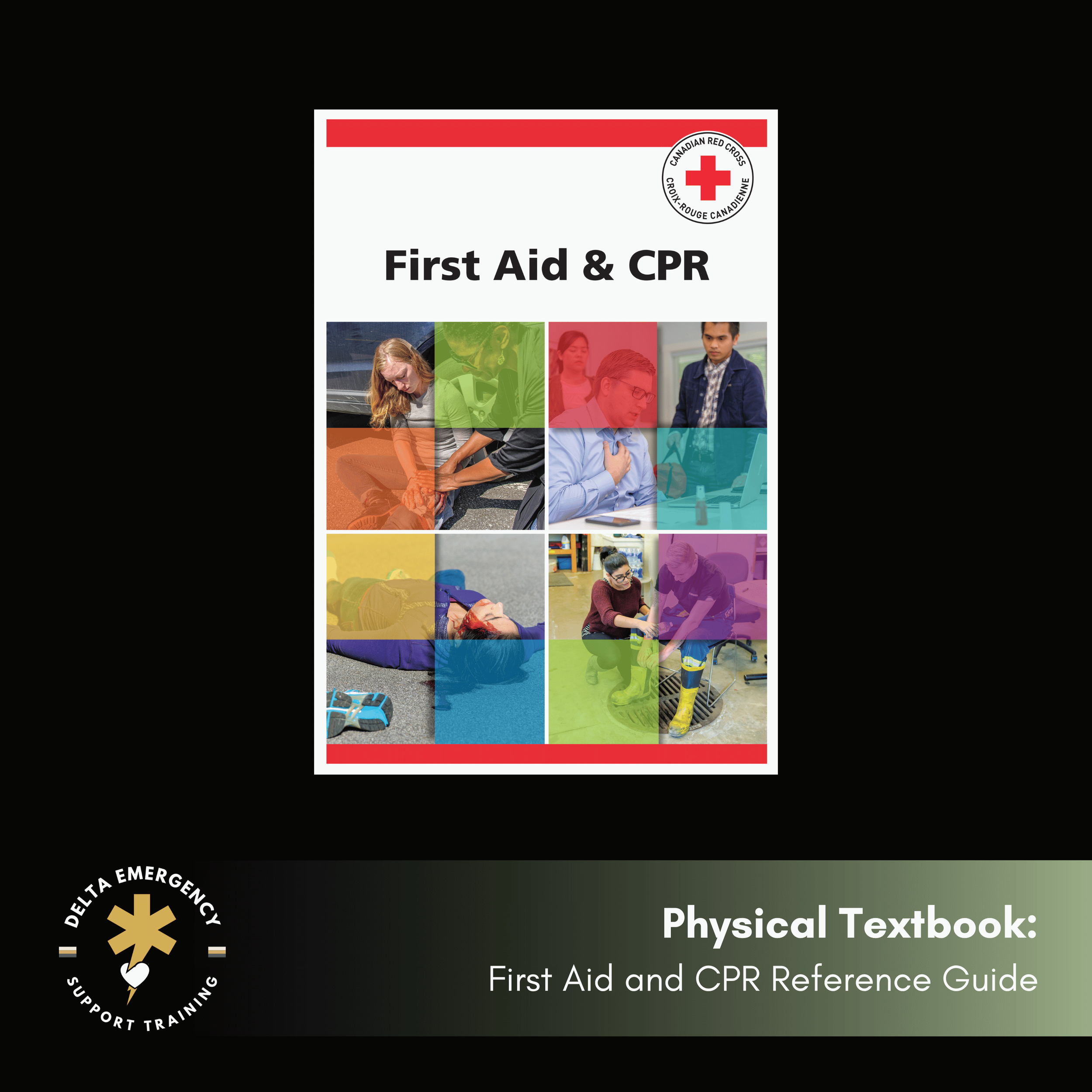
Emergencies can happen anywhere—at home, at work, or in public spaces. Being prepared is key, and the Canadian Red Cross: First Aid and CPR textbook is the essential guide for anyone who wants to gain that preparedness.
The Ultimate Guide to Lifesaving Techniques
Emergencies can happen anywhere—at home, at work, or in public spaces. Being prepared is key, and the Canadian Red Cross: First Aid and CPR textbook is the essential guide for anyone who wants to gain that preparedness. Whether you're a family looking to enhance home safety, an educator responsible for students, or a business ensuring workplace readiness, this textbook is your comprehensive resource for learning how to handle common medical emergencies and perform lifesaving CPR.
Comprehensive Coverage of First Aid and CPR
This manual covers a wide range of topics crucial for effective emergency response, including:
Techniques for performing CPR on adults, children, and infants
Step-by-step guidance on dealing with choking, burns, fractures, bleeding, and more
Strategies for responding to emergencies involving poisoning, stroke, and heart attacks
Preventative measures to maintain safety in homes and workplaces
Each topic is presented with clear, concise instructions and supported by high-quality illustrations and diagrams that make learning both easy and effective.
Designed for Quick Access in Emergency Situations
One of the standout features of this textbook is its design for quick access:
Tabbed sections allow for fast navigation to the needed information during an emergency.
Durable, spill-proof pages ensure the book can be used in a variety of settings, including during actual emergency situations where quick reference is vital.
A Reliable Resource at Your Fingertips
The physical format of the First Aid and CPR textbook offers several advantages over digital alternatives, especially in emergency scenarios:
No dependency on electronic devices or internet access, which might be unavailable or unreliable during emergencies.
Easier to handle, especially for those who are less comfortable with technology, which can be an added stressor in a high-pressure situation.
Ideal for a Wide Audience
This textbook isn't just for medical professionals—it's designed for anyone who wants to have lifesaving knowledge. It's an excellent resource for:
Families wanting to ensure a safe home environment
Teachers and school staff responsible for the well-being of students
Corporate health and safety officers tasked with workplace safety training
Community centers and non-profit organizations providing health and safety education
Conclusion
Prepare yourself to respond confidently to medical emergencies with the Canadian Red Cross First Aid and CPR Textbook. Available now at Delta Emergency Support Training, this guide is an invaluable addition to any home, school, or workplace.
Secure your copy today from Delta Emergency Support Training and empower yourself with the skills to save lives and maintain safety, wherever you are.
First Aid and CPR Manual
Empowering Learning Through Essential Textbooks: Continuing Education
Discover a World of Learning with Our Essential Textbooks
At Delta Emergency, we're thrilled to present our diverse collection of textbooks, each crafted to meet unique learning needs. Whether you're embarking on wilderness adventures, nurturing young minds as a babysitter, mastering life-saving techniques, or aiming to elevate your emergency care skills, our textbooks are here to empower and educate. The tactile pleasure of flipping through the pages of our physical copies enhances the learning experience, making each topic come to life. Dive into our range and unlock a wealth of knowledge today.
At Delta Emergency Support Training, we're excited to offer a versatile collection of textbooks that cater to a wide array of learning needs. Whether you're a wilderness explorer, an aspiring babysitter, a medical professional, or someone seeking vital lifesaving skills, our textbooks are thoughtfully designed to impart knowledge and empower individuals.For those who appreciate the feel of physical paper copies, we have just the thing for you. Let's dive into our selection:
Woman using a textbook to take notes and study.
Wilderness First Aid: Navigating Nature's Challenges with Confidence
Embark on outdoor adventures fully equipped with our "Wilderness First Aid" textbook. Priced at CA$74.97, this guide not only covers emergency response but also emphasizes safeguarding patients from the elements. From creating basic shelters to regulating body temperature, this resource ensures patient well-being in harsh environments. Learn to assess the ABCs (Airway, Breathing, Circulation) and identify and treat life-threatening emergencies. With a focus on both patient safety and effective response, this guide prepares you for the unexpected challenges of the wild.
Babysitter First Aid: Nurturing Safety and Confidence
Designed for young caregivers, our "Babysitter First Aid" textbook is a crucial resource that is a great tool for babysitters. Priced at CA$31.45 (Original Price: CA$34.95), this guide empowers budding babysitters with engaging activities, game ideas, and practical checklists. It equips you with the confidence and knowledge necessary to ensure children's safety and well-being. Not only does it cover babysitting essentials, but it also imparts vital babysitter first aid skills, expanding your capabilities and making you a trusted and reliable caregiver.
Basic Life Support: Mastering Lifesaving Techniques
BLS goes beyond the basics, offering practical insights such as oxygen flow rates for different levels of hypoxia, airway adjunct techniques, and CPR rates and compression depths. Whether you're familiarizing yourself with ventilation devices or learning the intricacies of CPR, this guide provides invaluable information to ensure your readiness in critical situations. Priced at CA$31.45, this comprehensive guide delves into the art of preserving life.
Professional Responder: Elevate Your Emergency Care Skills
Tailored for First Responders, Advanced First Aid, and Emergency Medical Responder courses, this comprehensive resource leaves no stone unturned. This textbook will give you the knowledge, skills and confidence to pursue your career as a firefighter, paramedic or any other professional responder. Encompassing topics from anatomy to physiology, this guide equips you with real-life scenarios, intricate charts, diagrams, and photographic illustrations. Designed to elevate your capabilities, it readies you for a gamut of challenging scenarios, ensuring your competence in emergency situations. Elevate your expertise with the "Professional Responder" textbook, available for CA$212.35 (Original Price: CA$235.95).
The Power of Knowledge
At Delta, we recognize the power of a physical textbook in an increasingly digital era. Our textbooks are carefully curated to enrich your understanding, bolster your skills, and guide you toward mastery. Seize the opportunity to learn, grow, and excel. Your transformative journey starts here.
Heat Emergencies: First Aid Tips for Heat-Related Illnesses
With summer comes the risk of heat-related illnesses like heat exhaustion and heat stroke. Anyone can experience these conditions when exposed to high temperatures for extended periods. Certain groups, such as infants, the elderly, and those with chronic medical conditions, are at higher risk. Taking steps like staying hydrated, avoiding prolonged sun exposure, and taking breaks in cool or shaded areas can help prevent heat emergencies. In this post, we'll cover the differences between heat exhaustion and heat stroke, the groups most vulnerable, and first aid measures for managing heat emergencies.
The arrival of summer often means fun outdoor activities like beach trips, barbecues, and adventures. However, it's important to be mindful of the potential health risks associated with the high temperatures that come with the season. Heat-related illnesses like heat exhaustion and heat stroke can be serious, but being able to recognize the signs and knowing how to manage these conditions can help prevent them from escalating and causing harm to ourselves and others.
A man is standing outside in the sun on a hot day, holding a water bottle and taking a sip to cool down and prevent heat exhaustion.
Most vulnerable groups
Certain groups of people are at a higher risk for heat-related illnesses like heat exhaustion and heat stroke. These groups include:
Infants and young children:
Their bodies are less efficient at regulating temperature, making them more susceptible to heat-related illnesses.
Elderly people:
They are more likely to have pre-existing medical conditions that can affect their ability to regulate temperature and may take medications that can impair their ability to sweat and cool down.
People with chronic medical conditions:
Individuals with heart, lung, or kidney diseases, as well as those with diabetes or obesity, are more susceptible to heat-related illnesses due to their bodies' difficulty regulating temperature.
Outdoor workers:
People who work outside, especially in the construction or agricultural industries, are at high risk for heat exhaustion and heat stroke due to prolonged exposure to high temperatures.
Athletes:
Individuals who engage in strenuous physical activity, particularly in hot and humid conditions, are at risk for heat exhaustion and heat stroke.
It's important for individuals in these high-risk groups to take extra precautions when spending time in hot weather, including staying hydrated, taking breaks in cool or shaded areas, and wearing appropriate clothing.
Heat Exhaustion
Heat exhaustion is a condition that occurs when the body becomes dehydrated and overheated, and cannot regulate its temperature properly. This can happen when someone is exposed to high temperatures, especially when they're combined with high humidity. Heat exhaustion can progress quickly to heat stroke, which is a more severe and potentially life-threatening condition.
Symptoms of Heat Exhaustion:
Dizziness or lightheadedness
Nausea or vomiting
Headache
Rapid heartbeat
Cool, moist skin with goosebumps despite the heat
Heavy sweating
Muscle cramps or weakness
First Aid for Heat Exhaustion:
If someone is showing signs of heat exhaustion, it's important to take action quickly. Here are some steps to take:
Move the person to a cooler location, preferably indoors with air conditioning or at least shade.
Loosen tight clothing and remove any unnecessary layers.
Provide cool water or a sports drink with electrolytes.
Apply cool, wet towels or cloths to the skin or fan the person to help cool them down.
Encourage them to rest and take it easy for the rest of the day.
Heat Stroke
Heat stroke is a more severe form of heat illness that occurs when the body's core temperature reaches 40°C or higher. It's a medical emergency that requires immediate attention as it can be fatal.
Symptoms of Heat Stroke:
Confusion or disorientation
Seizures or convulsions
Loss of consciousness
Rapid, shallow breathing
Dry, hot skin
Rapid, strong pulse
High body temperature (above 104°F)
First Aid for Heat Stroke:
If someone is showing signs of heat stroke, it's crucial to act quickly. Call emergency services right away and take these steps while waiting for medical help:
Move the person to a cooler location, preferably indoors with air conditioning.
Remove tight clothing and any unnecessary layers.
Use cool water or ice packs to cool the person down, especially on the neck, armpits, and groin area.
Fan the person or use a cool, wet cloth to help cool them down.
If the person is conscious and able to swallow, offer small sips of cool water or a sports drink.
The Differences and Severity:
Heat exhaustion is considered less severe than heat stroke, but it can progress quickly to heat stroke if left untreated. Heat exhaustion is caused by dehydration and overheating, while heat stroke is caused by the body's inability to regulate its temperature due to prolonged exposure to high temperatures. The symptoms of heat exhaustion are similar to those of heat stroke, but heat stroke is much more serious and can result in long-term damage to the brain, other organs, and even death.
It's important to take heat-related illnesses seriously and to take steps to prevent them from occurring in the first place. Stay hydrated, avoid prolonged exposure to the sun, and take frequent breaks in the shade or air conditioning when spending time outdoors in high temperatures. If you or someone you know is showing signs of heat exhaustion or heat stroke, take action quickly to prevent the condition from worsening and seek medical attention if necessary.
First Aid Providers pay for Google Reviews?
5 Stars!: When a company has only 5-star reviews, that’s a red flag. Every company, no matter how good, is likely to have a few negative reviews. Elevate your career with honesty. Are the reviews spread over a considerable amount of time or are they compressed in a very short period of time?
Is this review for real?
You’re about to click the “Buy” button, but before you open your wallet, it’s probably a good idea to read some online consumer reviews, right? Whether it's booking a vacation, buying an audiobook or hiring a contractor, many of us look to online reviews to help us with our buying decisions. Online consumer reviews help both consumers and businesses – they provide a wealth of “unbiased” product information to help you shop smart, and they reward businesses that provide a great product or service.
Companies may encourage their employees to post reviews, they might give customers incentives to leave positive reviews, and they can even hire a firm to post fake reviews for them.
Consumer reviews often strike at the heart of a consumer’s buying decision. Shoppers trust that these reviews are from real customers, just like them. Posting fake reviews online can damage that trust and seriously erode consumer confidence.
And the scope is wide -- if you shop online, you’re a potential victim.
So, here are some ways to help you recognize, reject and report fake reviews and protect your pocket book.
How to recognize fake reviews:
Sudden spike or dip: Watch out for a sudden spike in very positive reviews or a sudden dip in very bad reviews. Are the reviews spread over a considerable amount of time or are they compressed in a very short period of time?
New reviewer: Be on the lookout for reviewers who have only recently created a user profile or have been providing positive feedback on select products or services over a short period of time. These reviewers may work for the company and they may be getting reimbursed for posting fake reviews.
Beware when a reviewer says, “It’s the best ever!!!”: Don’t always trust reviews with an overly positive or gushing tone, especially if the review does not offer specific details about why it’s so good. If a review claims a service or product is “the best ever,” the review may be fake.
And beware when a reviewer says, “It’s the worst ever!!!”: You also shouldn’t always trust very negative reviews. These could be fake reviews from a competitor, discouraging shoppers from buying one product or service and suggesting another.
5 Stars!: When a company has only 5-star reviews, that’s a red flag. Every company, no matter how good, is likely to have a few negative reviews.
Does this sound familiar? Watch out for multiple different reviewers using the same language to describe how good or bad something is. Some companies provide scripts to reviewers with suggested phrases and key words. Be cautious if you see the same buzz words coming up over and over again in reviews.
How to reject fake reviews:
Shop around: Just like you shopped for the right product or service, you should also consult several sources for independent, unbiased reviews.
Go back in time: Be sure to look at reviews over a long period of time. This will help you to spot potential patterns like a spike in positive or negative reviews.
The meat is in the middle: Read the 2-, 3- and 4-star reviews too. Someone writing a fake review is more likely to assign a rating of 1 or 5 stars, meaning you’re more likely to find balanced critique in the middle range.
Diversify: Online reviews are just one way to assess a product or service. Branch out -- ask trusted friends and family about their experiences. Consider asking the company for references.
How to report fake reviews
If you believe you have come across fake online reviews, report them to the Competition Bureau.
Source: The Government of Canada.
elevate your career with honesty. Learn babysitting, take standard first aid, certify in advanced first aid, train to be a first responder, become an emr with a real emergency medical services instructors.

