The Delta Dispatch
Intravenous Therapy for Beginners: Placement, Gauges & Medications
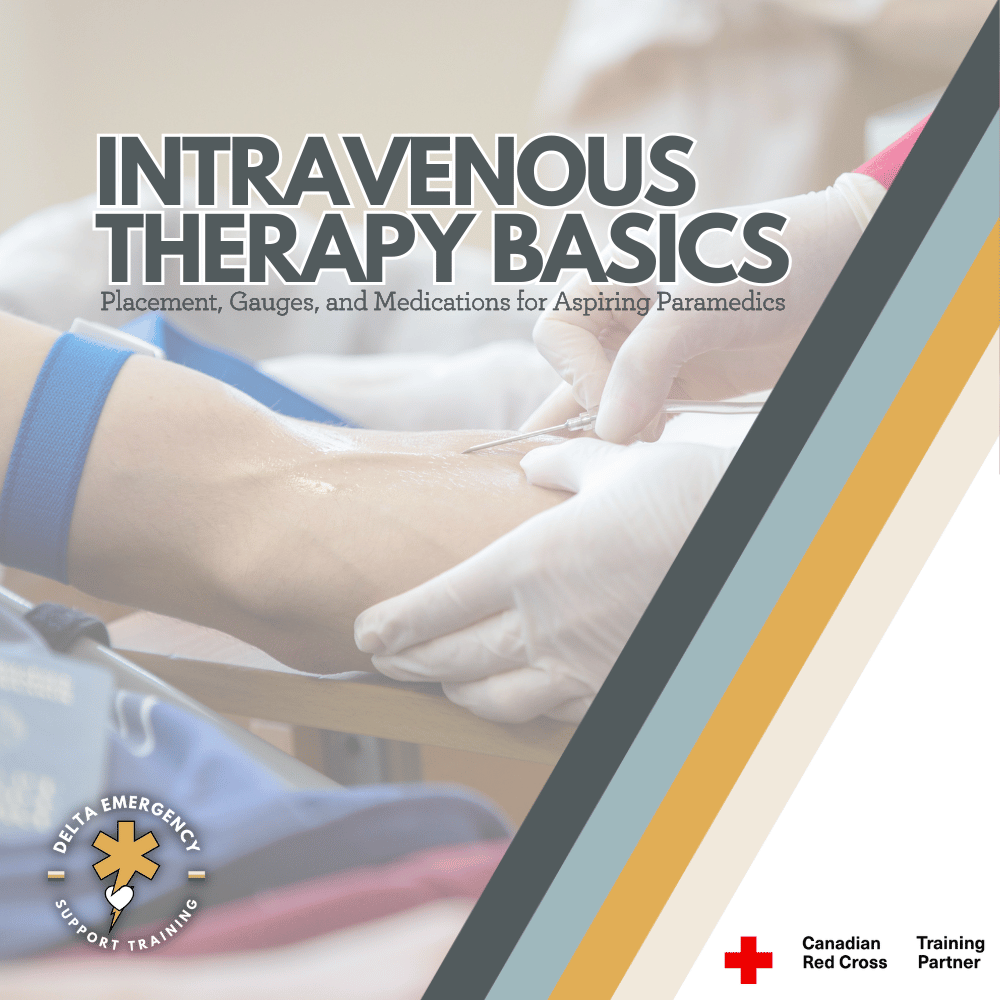
Intravenous (IV) therapy is a key skill for future paramedics and advanced responders. This beginner’s guide covers vein selection, catheter sizes, and common medications, helping you prepare for PCP training and real-world prehospital care.
For many first responders, advancing from Advanced First Aid or Emergency Medical Responder certification to Primary Care Paramedic training is an exciting milestone. It’s where your skills evolve from basic emergency management to a more advanced approach to prehospital medical care.
One of the essential new skills taught in PCP programs is intravenous (IV) therapy, a procedure that allows responders to deliver fluids and medications directly into the bloodstream for rapid, controlled treatment.
While IV initiation is not within the EMR or AFA scope of practice, understanding what it involves — and how it supports patient care — gives you a valuable head start.
What Is IV Therapy?
IV therapy involves inserting a sterile catheter into a patient’s vein to establish direct access to the circulatory system. This line can then be used to deliver fluids, medications, or draw blood samples. IV access is one of the fastest, most reliable ways to stabilize a patient in critical or emergent situations.
When Are IVs Needed?
Paramedics and advanced responders use IVs in a wide range of medical and trauma calls, such as:
Fluid resuscitation: Treating dehydration, burns, or blood loss
Medication delivery: For cardiac, allergic, or diabetic emergencies
Pain or nausea management: In controlled, monitored settings
Cardiac arrest care: To administer life-saving drugs quickly
Trauma management: When oral or intramuscular routes aren’t viable
Learning to Start an IV in PCP School
During PCP training, students learn the anatomy of veins, infection control, and catheterization techniques through classroom instruction, practice labs, and clinical placements. You’ll first work on training arms to master vein palpation, needle handling, and aseptic technique before performing supervised IV starts in clinical settings.
The process includes:
Gathering and preparing sterile equipment
Identifying a suitable vein
Cleansing the site
Inserting the catheter bevel-up
Confirming flashback and advancing the catheter
Securing the line and beginning the infusion
Common IV Insertion Sites (and Why They’re Chosen)
Vein selection is critical. Choosing the right site helps reduce complications, ensures proper flow, and keeps the patient comfortable.
Here are the most common IV entry sites used in prehospital and clinical settings:
1. Dorsal Hand Veins
These include the cephalic, basilic, and dorsal metacarpal veins on the back of the hand.
Pros: Easy to visualize and access; great for smaller catheters.
Cons: More sensitive; can be uncomfortable during movement or fluid administration.
Common Uses: General medication or fluid delivery when other veins are less accessible.
2. Forearm Veins
The cephalic and basilic veins along the forearm are often the first choice for IV starts.
Pros: Straight path, good flow rate, and easier stabilization with tape.
Cons: May roll or collapse if dehydrated; limited space for reattempts.
Common Uses: General medical and trauma patients, fluid resuscitation, medication administration.
3. Antecubital Fossa (Inner Elbow)
The median cubital, cephalic, and basilic veins in the crook of the arm are popular for rapid access.
Pros: Large veins, high flow rates — ideal for trauma or blood draws.
Cons: Restricts arm movement; prone to kinking if patient bends the elbow.
Common Uses: Emergency IV access, large-bore lines, or when rapid administration is needed.
4. External Jugular Vein (Neck)
Used in some prehospital or critical care settings when peripheral access isn’t possible.
Pros: Easy to locate in patients with difficult peripheral veins; high flow.
Cons: Requires skill and patient cooperation; greater risk if improperly managed.
Common Uses: Trauma, shock, cardiac arrest, or situations where arm veins are inaccessible.
5. Lower Extremity Veins (Dorsal Foot or Great Saphenous)
Used mainly when upper extremities are unavailable.
Pros: Alternative access in infants or patients with poor upper body veins.
Cons: Slower flow, higher infection risk, limited mobility.
Common Uses: Pediatrics, last-resort adult IV access.
Understanding IV Gauge Sizes
The gauge of an IV catheter refers to its diameter. Smaller numbers mean larger catheters.
14–16G: For trauma or massive fluid resuscitation
18G: For blood administration or major fluid replacement
20G: General adult use; medications and moderate fluid therapy
22–24G: Pediatrics, elderly, or fragile veins
Gauge choice depends on patient size, vein condition, and the urgency of the situation.
Common IV Medications in Paramedic Practice
While specific drug use depends on provincial protocols, IV therapy often supports:
Normal Saline (0.9% NaCl) – Fluid replacement or line maintenance
Dextrose (D10, D50) – Hypoglycemia management
Epinephrine – Cardiac arrest or anaphylaxis (specific concentrations)
Morphine / Fentanyl – Pain management (under standing orders)
Ondansetron – Nausea control
Nitroglycerin (IV form) – Chest pain management (advanced protocols)
Each medication requires strict dosage control, monitoring, and adherence to medical direction — something you’ll master in paramedic pharmacology.
Why IV Skills Matter
For professional responders, starting an IV isn’t just about inserting a catheter — it’s about stabilizing patients efficiently, safely, and confidently. In trauma, shock, or medical crises, IV access can mean the difference between life and death.
If you’re currently an EMR or AFA graduate considering the PCP path, familiarizing yourself with IV principles now will make your transition smoother and your training easier.
Final Thoughts
Learning to start an IV marks a major step forward in your responder journey. Though outside the AFA and EMR scope, it’s a skill that defines advanced prehospital care. As you move toward your Primary Care Paramedic program, understanding IV therapy — from vein anatomy to gauge selection — gives you a solid foundation for success.
How Paramedic Training Strengthens Your Firefighter Application
Firefighting is no longer just about fire suppression. With most calls now medical in nature, departments seek applicants with paramedic training. Here’s how your Primary Care Paramedic certification can make your firefighter application stand out.
The Modern Firefighter: More Than Fire Suppression
Today’s firefighter is far more than fighting fires. Across Canada, most fire departments respond to far more medical emergencies than structure fires — in many regions, medical calls make up 80% of total responses.
This shift means departments are looking for applicants who can do more than handle a nozzle. They need people trained in patient care, triage, and prehospital decision-making — skills that come directly from Primary Care Paramedic (PCP) training.
Whether you’re pursuing municipal, industrial, or wildland fire service, holding your PCP license can dramatically strengthen your application, credibility, and readiness for the role.
1. Understanding the Overlap: Fire and EMS
The reality of modern fire service is that medical response is integrated into daily operations. Many calls involve:
Cardiac arrests
Motor vehicle collisions
Respiratory emergencies
Overdoses and poisonings
Falls and traumatic injuries
Medication administration
These situations require rapid assessment, airway management, and patient stabilization — core skills of a Primary Care Paramedic.
When fire departments deploy first, a firefighter with PCP training doesn’t just stand by until EMS arrives — they become a vital asset in those first minutes, providing interventions that can mean the difference between life and death.
2. How PCP Training Sets You Apart in the Hiring Process
Fire departments receive hundreds of applications for a handful of positions. Holding your Primary Care Paramedic certification immediately tells recruiters you’re invested, skilled, and capable of independent medical decision-making.
It demonstrates:
Commitment to emergency services as a career, not just a job.
Medical competency beyond AFA & EMR levels.
Ability to handle high-stress environments and maintain composure during critical incidents.
Strong understanding of patient care, communication, and documentation.
Departments see PCPs as well-rounded responders — individuals who understand not only rescue operations, but also the continuum of care from the moment of injury to hospital transfer.
3. Bridging Knowledge: Why Paramedic Training Translates So Well
The PCP curriculum goes far beyond what’s taught in AFA or fire recruit programs. It builds:
Assessment skills – Scene safety, mechanism of injury, and systematic patient evaluation.
Decision-making – When to move, when to treat, and when to call for advanced support.
Anatomy and physiology knowledge – Understanding what’s happening inside the body, not just what you see externally.
Communication and teamwork – Effective coordination with dispatch, partners, and hospital staff.
Leadership under pressure – Taking control when seconds matter.
Every one of these skills directly applies to fireground operations, rescue scenarios, and community medical calls.
When a firefighter-paramedic arrives on scene, they’re already equipped with the mindset of “scene control, patient stabilization, and structured response.”
4. Increased Employability Across Canada
Many fire departments in Canada — including Toronto Fire, Calgary Fire, Edmonton Fire, and Vancouver Fire Rescue Services — now strongly prefer or require applicants to have medical certification at the EMR or PCP level.
Holding your PCP license not only makes you a stronger candidate but also broadens your career options. You can work in EMS while waiting for fire openings, gain field experience, and keep your medical skills sharp.
It also signals to hiring panels that you’re operationally ready, physically prepared, and understand the realities of shift work, patient care, and emergency response culture.
5. Professional Credibility and Community Trust
Firefighters are often the first on scene — before ambulances, before police. The public doesn’t separate the fire service from medical response; they expect competence in both.
Having PCP-level training builds confidence in your peers, your officers, and the community. It shows that you’re not just trained to react, but to think critically and intervene effectively under pressure.
This credibility extends into leadership — many captains, chiefs, and training officers have paramedic backgrounds. Understanding that language early gives you a career-long advantage.
6. The Pathway Forward
If your goal is to become a firefighter, enrolling in a Primary Care Paramedic program is one of the most strategic steps you can take.
Here’s how to integrate it into your career plan:
Earn your EMR or Advanced First Aid certification to build foundational knowledge.
Enroll in an accredited PCP program through a recognized college or training institution.
Register and license through your provincial regulatory body.
Maintain active status — through continuing education and clinical practice hours.
Highlight your PCP credentials in your fire service application and interviews.
By doing this, you’re not only meeting the evolving expectations of the fire service — you’re proving you already live and breathe emergency response.
Final Thought
Firefighting has evolved — and so have the expectations of those who wear the uniform.
Holding a Primary Care Paramedic license shows that you understand that evolution. It proves that you can respond, treat, and think critically in the same high-pressure environments firefighters face daily.
When it comes down to competitive hiring, paramedic training doesn’t just help your chances — it defines them.
Becoming a Paramedic in Canada: How EMR Training Fits Into the Bigger Picture
Thinking about becoming a paramedic in Canada? It starts with understanding the paramedicine pathway. This blog explains where EMR training fits into the journey and why it’s a key first step toward a rewarding career in emergency services.
Across Canada, the demand for trained paramedics continues to rise. Communities rely on first responders not only for life-threatening emergencies but also for urgent care, transport, and support in times of crisis. If you’ve ever thought about a career in emergency services, you may be wondering: where do I start?
The answer for many is Emergency Medical Responder (EMR) training. This entry-level program provides the essential skills you need to help patients and also acts as a stepping stone into the professional paramedicine pathway. To understand why EMR is such a valuable first step, it helps to look at how the paramedicine system is structured in Canada.
1. The Paramedicine Ladder in Canada
In Canada, paramedicine is organized into different levels of training and certification. Each step builds on the one before it, adding more advanced knowledge, clinical skills, and responsibilities.
Emergency Medical Responder (EMR)
Entry-level certification recognized across many provinces.
Focuses on patient assessment, CPR and AED use, airway management, bleeding control, and trauma care.
EMRs may work in industrial safety, event medical services, rural response, and are often a requirement for admission into Primary Care Paramedic programs.
Training is usually short and focused, making it an accessible first step.
Primary Care Paramedic (PCP)
The first professional paramedic level in Canada.
PCPs are qualified to work on ambulances and provide advanced pre-hospital care.
Skills include medication administration, advanced airway management, and cardiac monitoring.
Typically requires 1–2 years of college-level education, depending on the province.
Advanced Care Paramedic (ACP)
Builds on the PCP scope of practice with advanced skills.
Includes procedures such as intubation, IV therapy, advanced cardiac interventions, and expanded medication options.
Training usually takes an additional 1–2 years beyond PCP.
Critical Care Paramedic (CCP)
The highest level of paramedic training in Canada.
Specializes in transporting and treating critically ill or injured patients, often by air ambulance or in hospital transfer situations.
CCPs provide intensive care support outside the hospital environment.
This tiered approach means that every paramedic, no matter how advanced, started with the same fundamentals—and that usually begins with EMR.
2. Why EMR Training Matters
Even though EMR is the entry-level program, it’s far more than a “basic” course. Here’s why it matters:
Foundational Skills: You’ll learn how to assess patients systematically, manage airways, perform CPR, use AEDs, and provide lifesaving first aid for medical and trauma emergencies.
Confidence in Emergencies: EMR training prepares you to step into real-world situations calmly and effectively, whether you’re responding at work, volunteering, or helping in your community.
A Career Sampler: Many people use EMR training as a way to “test drive” paramedicine before committing to the longer PCP or ACP programs. It’s a great way to discover if this career path is right for you.
Admission Requirement: In several provinces, completion of an EMR program is a mandatory prerequisite for applying to PCP programs.
In short, EMR is both a valuable certification on its own and a launching pad for more advanced paramedic training.
3. Career Opportunities After EMR
Some students complete EMR training because they want to work right away, while others use it as preparation for PCP school. Either way, opportunities exist.
Industrial and Remote Work: Oil and gas sites, mining operations, and construction companies often employ EMRs to provide on-site medical support.
Event Medical Services: Concerts, festivals, and sporting events need trained responders to manage emergencies on the ground.
Volunteer Roles: Many communities welcome EMRs as part of first responder programs, especially in rural or remote areas.
Pathway to PCP: EMR graduates have the foundation to move directly into Primary Care Paramedic education, making it a strategic step toward a long-term career.
4. The Canadian Context
Paramedicine is provincially regulated in Canada, which means that the scope of practice and educational requirements vary depending on where you live. For example:
In British Columbia and Alberta, EMR certification is a recognized entry point for working in certain EMS systems.
In Ontario, EMR may not be a licensed level, but training still provides an advantage for those entering PCP programs.
Across the country, EMR certification is widely respected as a sign of commitment to the field and readiness to pursue paramedic studies.
Regardless of the province, EMR training signals that you’ve mastered essential lifesaving skills and are prepared for the next step.
5. A Pathway, Not a Shortcut
One of the most important things to understand about paramedicine in Canada is that there are no shortcuts. Every level of training is rigorous and builds on the last. But EMR offers a pathway—an accessible starting point that opens doors, whether you want to work immediately or advance further.
By taking EMR, you’re not just learning a skillset. You’re joining a community of first responders who play a vital role in Canada’s healthcare system.
Conclusion
Becoming a paramedic in Canada is a journey. It starts with building a solid foundation—and for most students, that foundation is Emergency Medical Responder training. EMR equips you with lifesaving skills, gives you real-world confidence, and provides the stepping stone needed for higher levels of paramedicine like PCP, ACP, and CCP.
If you’re considering a career in emergency services, EMR training is the best way to begin. It’s the first step on a ladder of learning that leads to one of the most rewarding careers in healthcare.
👉 Ready to start your journey? Enroll in our EMR program today and take the first step toward becoming a paramedic in Canada.
Why Advanced First Aid Is a Must-Have for Future Firefighters: Prepare for Firefighter Recruitment with the Right Medical Training
Thinking of applying to a fire department? Start with Advanced First Aid. Learn how Red Cross-certified training builds your emergency response skills and prepares you for a first responder career.
Firefighter in training.
If you're thinking about becoming a firefighter in Canada, you already know it's more than just battling flames. Firefighters are often the first on scene at medical emergencies, and in many departments, having Advanced First Aid certification is not just helpful—it’s required. As recruitment becomes more competitive, one of the best ways to stand out is to complete your Advanced First Aid training before you apply.
Why Medical Training Matters for Firefighters
Modern firefighting isn’t just fire suppression—it's rescue, emergency medical care, and community safety. Many calls involve:
Motor vehicle collisions
Cardiac arrests
Trauma from falls or accidents
Overdoses and breathing emergencies
In these cases, the ability to perform high-quality medical support can mean the difference between life and death.
What You’ll Learn in Advanced First Aid
Advanced First Aid (AFA), based on the Canadian Red Cross Emergency Care for Professional Responders, teaches you skills like:
Patient assessment and scene safety
Airway management and oxygen administration
CPR/AED for all age groups
Spinal motion restriction
Wound care, bleeding control, and shock management
Triage and emergency scenario response
This course gives you the tools to act confidently in real emergencies—a critical part of your firefighter toolkit.
Stand Out in the Hiring Process
Many fire departments prefer or require AFA (or higher-level training) as part of their application process. Having it shows that:
You’re serious about the job
You understand the physical and mental demands
You can contribute on Day 1
It also prepares you for future paramedic training or Primary Care Paramedic (PCP) certification, which many firefighters go on to pursue.
Train with Real Firefighters and Paramedics
At Delta Emergency Support Training, our instructors are experienced firefighters and paramedics who know exactly what departments are looking for. We don’t just teach you how to pass—we prepare you for what it’s really like out in the field.
What’s Next After AFA?
If you're planning your next steps, here’s a path many successful applicants follow:
Complete Advanced First Aid
Start physical fitness prep (like CPAT)
Take a Firefighter Pre-Academy Program or Fire School
Prepare for interviews and aptitude testing
Apply
Final Thoughts
Getting your Advanced First Aid certification isn’t just checking a box—it’s building your confidence and skills to save lives. Whether you’re planning to fight fires in a city or on the front lines of a wildfire, your first aid skills are your foundation.
Want to become a firefighter? Start here. Join one of our Red Cross certified AFA courses and get trained by the professionals who do this work every day.

