Is Advanced First Aid Worth the Cost?
Short answer: if you're taking it for the right reasons, yes — and I say that as someone who has spent the last 20 years in EMS and the last 13 years training people in this exact course.
I'm an Advanced Care Paramedic registered in Alberta, and I run Delta Emergency Support Training, a Canadian Red Cross training partner. I'm also an instructor trainer for professional responder programs like Emergency Medical Responder and Advanced First Aid, and I sit on the Canadian Red Cross advisory board for professional responder programming. I've personally trained hundreds of people in Advanced First Aid, many of whom went on to apply to Calgary Fire, Edmonton Fire, and other departments, and ultimately, get hired. So when I talk about whether this course is "worth it," I'm not guessing — I'm looking at two decades of watching people go through it and seeing what happens afterward.
What Advanced First Aid Actually Gives You
More Hours, More Skills, More Confidence
The biggest difference between Advanced First Aid and Intermediate First Aid (formerly Standard First Aid) or Basic First Aid (formerly Emergency First Aid) isn't just the certificate — it's the depth. Intermediate First Aid is 16 hours. Basic First Aid is even less. Advanced First Aid is 80 hours of in-class training, plus your own home study time on top of that. You're looking at well over 100 hours of investment to come out the other side as what I'd call an "A and B" professional — someone with both the knowledge base and the skill set to actually function in an emergency.
That knowledge piece matters more than people expect. In Intermediate First Aid, you learn steps. In Advanced First Aid, you learn why those steps work, how to take vital signs, and how to properly assess whether someone is genuinely in an emergency state. That's a completely different level of capability.
Real-Life Moments Where It Mattered
I've had students come back to me a week or two after finishing the course and tell me they saw someone in distress — on the road, on the street, wherever — and they felt confident stepping in. They knew what to do, what to ask, and how to actually assess the person. I've also had people use these skills with their own kids and family members, including choking emergencies. That's the kind of return on investment that doesn't show up on a resume but matters just as much.
Breaking Down the Cost
What You're Paying For
At Delta Emergency Support Training, our Advanced First Aid course in Calgary runs $1,300 for 80 hours — that's 10 full days in class. Compare that to our Intermediate First Aid course at $160 for two days, or Basic First Aid at $120 for one day. If you do the math, an eight-hour day of training generally lands in the $130–$160 range across providers. Ten days of that adds up, and that's exactly why Advanced First Aid costs what it does.
Part of that price also includes your textbooks, which on their own are worth over $200. As of 2026, providing textbooks is now a standard requirement for this course — if a provider isn't including them, that's a problem.
Comparing to Intermediate and Basic First Aid
This isn't a course you take to save money. It's a course you take because you need to move to the next stage of your career, meet a job requirement, or be genuinely ready to help people in a professional setting. Intermediate First Aid and Basic First Aid simply don't cover the same ground, and they're priced — and structured — accordingly.
A Red Flag to Watch For
When you're comparing providers, here's what to watch out for:
Price under $1,000. That price point usually means less instructor time, lower-quality instruction, and often no textbooks included. Given the new 2026 textbook standard, that alone should raise questions about what else is being cut.
Course length of 3-5 days. To be blunt, that's not the certification standard. Advanced First Aid through the Canadian Red Cross is an 80-hour program, roughly 10 full days of in-class training, plus your own home study time. Anything less will not give you the certificate you need.
Only 2-3 days listed as in-person. A skills-heavy program like this can't be properly delivered in 2-3 in-person days; there simply isn't enough time to practice and be evaluated on the full scope of skills involved.
Who's actually teaching it. Ask about your instructor's real-world experience. There's a big difference between someone who read a book on how to throw a punch and someone who's been boxing for 20 years and has the awards to show for it. The same goes for first aid instructors. You want someone who has actually worked in emergency response, not just someone who passed an instructor course and is reading from a slide deck. But hey, that's just my two cents. You do you.
If you come across a course listing that doesn't match this, ask the provider exactly what's being covered, how many in-person hours are included, and what certificate you'll actually receive. A lot of what's online about course pricing and timelines right now reads like it was written without anyone checking it against the actual certification requirements, so it's worth confirming directly with the provider rather than taking a blog post at face value. A shorter course might still be useful for something, but it may not be the same credential, and if you need it for a fire department application or similar, that distinction matters.
Who Should (and Shouldn't) Take Advanced First Aid
When It's Not Worth It
If you work in an office, or your job only requires you to be a basic first aider on-site, Advanced First Aid probably isn't necessary. Whether you actually need it comes down to OHS regulations for your workplace — things like how far you are from a hospital, how many people are on-site, and how hazardous the work is. In a lot of these cases, Intermediate First Aid is genuinely sufficient.
If You're Headed Toward EMS
If your end goal is to become a Primary Care Paramedic or Advanced Care Paramedic, you don't actually need Advanced First Aid to get there — you need Emergency Medical Responder (EMR) certification first. That said, there's a useful shortcut: if you've already taken Advanced First Aid, you can complete an EMR Bridge in just two days to get that EMR certificate and move forward into PCP or ACP programs. So it's not wasted — it just isn't the direct path.
The Self-Study Commitment
This course is not a sit-back-and-collect-a-certificate program. You need to be willing to study on your own time, practice skills, and run through scenarios. If you're not willing to put in that personal effort outside of class, this course isn't a good fit for you — and honestly, you won't get much out of it even if you complete it.
A Real Success Story: Stephen's Path to Calgary Fire
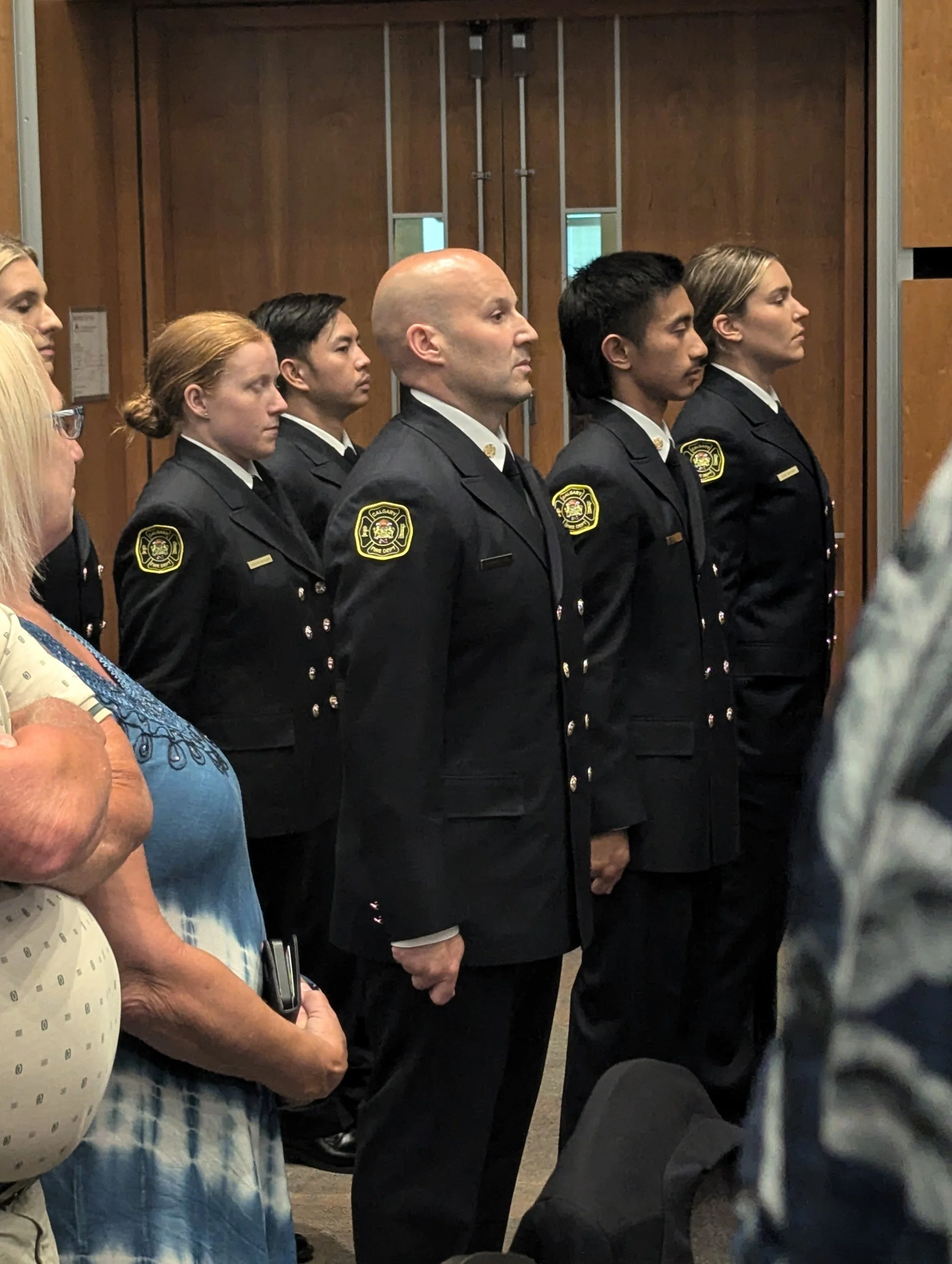
One of the best examples I can point to is a student of ours — Stephen Mayall. He took Advanced First Aid with us starting in December 2022 and finished in early 2023, at 40 years old. His goal was to apply to Calgary Fire, which involves about nine stages, including a document review where Advanced First Aid is a required credential.
With that requirement checked off, the rest of his application came together — strong resume, good interviews, polygraph cleared — and he got hired. While he was waiting through that process, he also came back to us and completed our Advanced First Aid Instructor course. Now, at 44, he teaches Advanced First Aid for us, including classes for Calgary Fire recruits and recertifications, and he's positioned for further education and instruction opportunities within the department.
That's a career change in his early forties, sparked by one course.
Stephen Mayall
Steve at his Calgary Fire Department recruit graduation in July 2024 - proud to have trained him in Advanced First Aid years before this moment.
My Verdict
If you're paying $1,000 to $1,300 for Advanced First Aid because it's a stepping stone toward the career you actually want — whether that's a fire department, oil field work, film set standby, wildfire response, or emergency medicine — it's worth it. It often won't be the only requirement (you might also need a Class 3 license, additional fire courses, volunteer hours, or set-etiquette courses for film work), but it's frequently the turning point.
Over the years, we've trained people who are now firefighters in Edmonton and Calgary, who teach for us, and who keep coming back for skills refreshers and recommend us to others. That's not a coincidence — it's a pattern of people using this course to get exactly where they wanted.
Have Questions? Let's Talk
If you're trying to figure out whether Advanced First Aid is the right move for your situation, I'm happy to talk it through. I'm a working paramedic who understands this industry from the inside, and I've been to graduations and watched students get hired by fire departments after going through this exact course. I can help you figure out what you actually need versus what's just being marketed at you.
Give me a call at 825-883-3582.