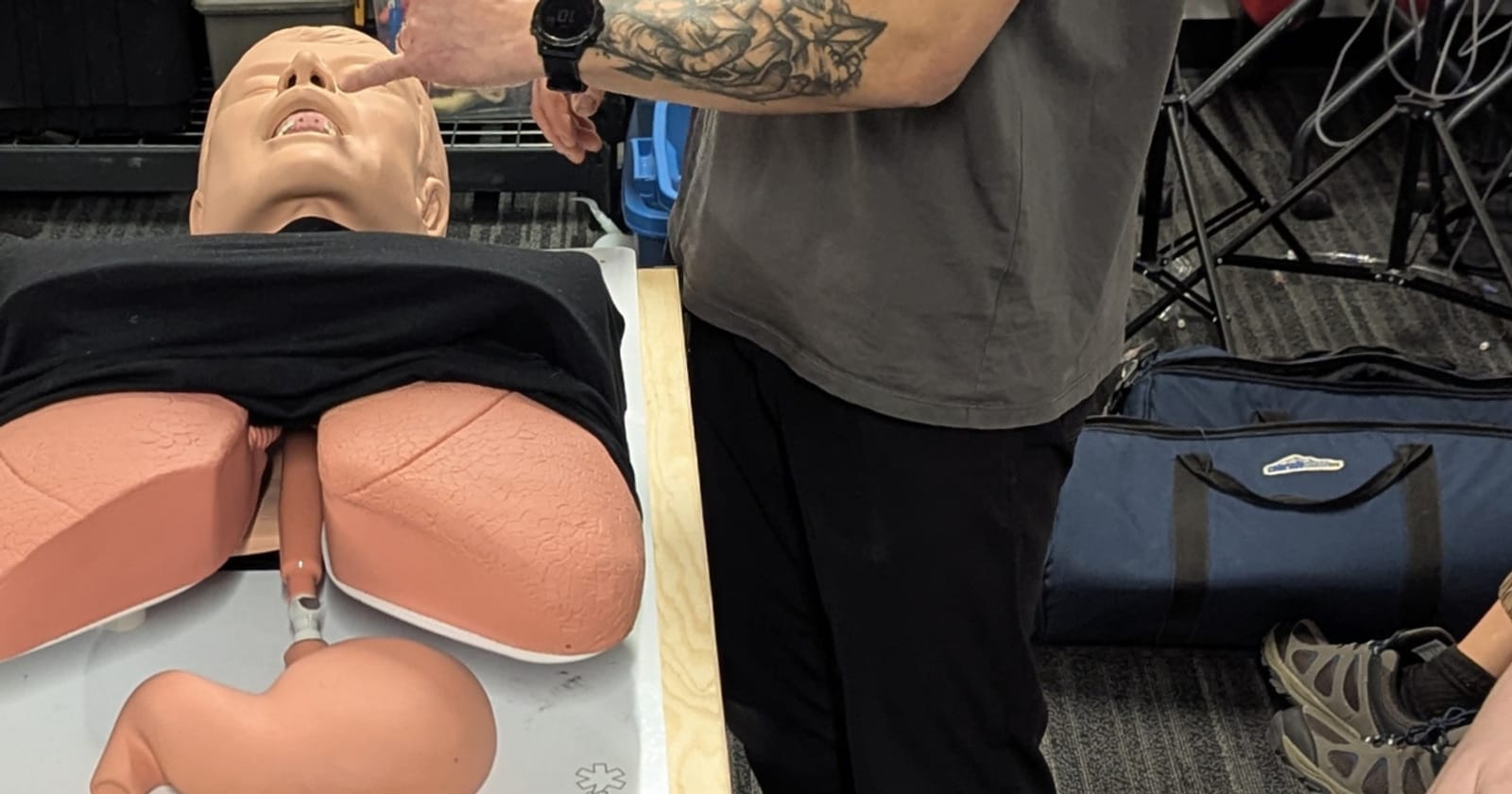

Airway Management is a one-hour, hands-on evening skills class built around one problem: a patient who cannot move air on their own.
Read more about this courseShow less
We run it in Calgary, add dates for the Leduc and greater Edmonton region, and deliver it onsite at client worksites across Alberta, elsewhere in Canada, and internationally on request for an additional fee. There is no prerequisite to register, though the session is built to sharpen skills you already have rather than to teach responder training from scratch.
Course details
- Certificate
- Canadian Red Cross Airway Management
- Certificate valid for
- Per Canadian Red Cross standard, confirmed at registration
- Issued by
- Canadian Red Cross
- Duration
- Approx. 1 hour
- Prerequisites
- None
- Locations
- Leduc, AB, 4810 50th Ave, Calgary, AB, 1550 5 St SW #300
- Price
- $130.00 + GST & applicable taxes (charged at checkout for your province)
How this course runs
- In person: one or two days at our location. Nothing to do online beforehand.
- How it runs
- One day in class. Nothing online.
- Whole course
- 1 hour
Upcoming dates, choose your cohort
Edmonton regionNov 15, 2026 · Leduc, AB, 4810 50th Ave
- Sun, Nov 15 · 9:00 a.m. to 10:00 a.m.in class
Registration closes November 14, 2026.
November 2026
SMTWTFS123456789101112131415161718192021222324252627282930In person: 1 class day, nothing online
In person(no online sessions)
- 1 full day in class
Edmonton regionIn person: one or two days at our location. Nothing to do online beforehand.CalgaryNov 22, 2026 · Calgary, AB, 1550 5 St SW #300
- Sun, Nov 22 · 6:30 p.m. to 7:30 p.m.in class
Registration closes November 21, 2026.
November 2026
SMTWTFS123456789101112131415161718192021222324252627282930In person: 1 class day, nothing online
In person(no online sessions)
- 1 full day in class
CalgaryIn person: one or two days at our location. Nothing to do online beforehand.Edmonton regionNov 30, 2026 · Leduc, AB, 4810 50th Ave
- Mon, Nov 30 · 6:30 p.m. to 7:30 p.m.in class
Registration closes November 29, 2026.
November 2026
SMTWTFS123456789101112131415161718192021222324252627282930In person: 1 class day, nothing online
In person(no online sessions)
- 1 full day in class
Edmonton regionIn person: one or two days at our location. Nothing to do online beforehand.Edmonton regionDec 6, 2026 · Leduc, AB, 4810 50th Ave
- Sun, Dec 6 · 6:30 p.m. to 7:30 p.m.in class
Registration closes December 5, 2026.
December 2026
SMTWTFS12345678910111213141516171819202122232425262728293031In person: 1 class day, nothing online
In person(no online sessions)
- 1 full day in class
Edmonton regionIn person: one or two days at our location. Nothing to do online beforehand.Edmonton regionJan 4, 2027 · Leduc, AB, 4810 50th Ave
Waitlist only- Mon, Jan 4, 2027 · 6:30 p.m. to 7:30 p.m.in class
Registration is closed for these dates.
January 2027
SMTWTFS12345678910111213141516171819202122232425262728293031In person: 1 class day, nothing online
In person(no online sessions)
- 1 full day in class
Edmonton regionIn person: one or two days at our location. Nothing to do online beforehand.Waitlist only. Join the waitlist and we’ll email you the moment a seat is available.
CalgaryJan 25, 2027 · Calgary, AB, 1550 5 St SW #300
- Mon, Jan 25, 2027 · 6:30 p.m. to 7:30 p.m.in class
Registration closes January 24, 2027.
January 2027
SMTWTFS12345678910111213141516171819202122232425262728293031In person: 1 class day, nothing online
In person(no online sessions)
- 1 full day in class
CalgaryIn person: one or two days at our location. Nothing to do online beforehand.CalgaryJan 31, 2027 · Calgary, AB, 1550 5 St SW #300
- Sun, Jan 31, 2027 · 9:00 a.m. to 10:00 a.m.in class
Registration closes January 30, 2027.
January 2027
SMTWTFS12345678910111213141516171819202122232425262728293031In person: 1 class day, nothing online
In person(no online sessions)
- 1 full day in class
CalgaryIn person: one or two days at our location. Nothing to do online beforehand.Edmonton regionFeb 14, 2027 · Leduc, AB, 4810 50th Ave
Waitlist only- Sun, Feb 14, 2027 · 9:00 a.m. to 10:00 a.m.in class
Registration is closed for these dates.
February 2027
SMTWTFS12345678910111213141516171819202122232425262728In person: 1 class day, nothing online
In person(no online sessions)
- 1 full day in class
Edmonton regionIn person: one or two days at our location. Nothing to do online beforehand.Waitlist only. Join the waitlist and we’ll email you the moment a seat is available.
CalgaryFeb 16, 2027 · Calgary, AB, 1550 5 St SW #300
- Tue, Feb 16, 2027 · 6:30 p.m. to 7:30 p.m.in class
Registration closes February 15, 2027.
February 2027
SMTWTFS12345678910111213141516171819202122232425262728In person: 1 class day, nothing online
In person(no online sessions)
- 1 full day in class
CalgaryIn person: one or two days at our location. Nothing to do online beforehand.Edmonton regionFeb 21, 2027 · Leduc, AB, 4810 50th Ave
Waitlist only- Sun, Feb 21, 2027 · 6:30 p.m. to 7:30 p.m.in class
Registration is closed for these dates.
February 2027
SMTWTFS12345678910111213141516171819202122232425262728In person: 1 class day, nothing online
In person(no online sessions)
- 1 full day in class
Edmonton regionIn person: one or two days at our location. Nothing to do online beforehand.Waitlist only. Join the waitlist and we’ll email you the moment a seat is available.
CalgaryMar 7, 2027 · Calgary, AB, 1550 5 St SW #300
- Sun, Mar 7, 2027 · 9:00 a.m. to 10:00 a.m.in class
Registration closes March 6, 2027.
March 2027
SMTWTFS12345678910111213141516171819202122232425262728293031In person: 1 class day, nothing online
In person(no online sessions)
- 1 full day in class
CalgaryIn person: one or two days at our location. Nothing to do online beforehand.Edmonton regionMar 8, 2027 · Leduc, AB, 4810 50th Ave
Waitlist only- Mon, Mar 8, 2027 · 6:30 p.m. to 7:30 p.m.in class
Registration is closed for these dates.
March 2027
SMTWTFS12345678910111213141516171819202122232425262728293031In person: 1 class day, nothing online
In person(no online sessions)
- 1 full day in class
Edmonton regionIn person: one or two days at our location. Nothing to do online beforehand.Waitlist only. Join the waitlist and we’ll email you the moment a seat is available.
CalgaryMar 28, 2027 · Calgary, AB, 1550 5 St SW #300
- Sun, Mar 28, 2027 · 6:30 p.m. to 7:30 p.m.in class
Registration closes March 27, 2027.
March 2027
SMTWTFS12345678910111213141516171819202122232425262728293031In person: 1 class day, nothing online
In person(no online sessions)
- 1 full day in class
CalgaryIn person: one or two days at our location. Nothing to do online beforehand.Edmonton regionApr 11, 2027 · Leduc, AB, 4810 50th Ave
Waitlist only- Sun, Apr 11, 2027 · 6:30 p.m. to 7:30 p.m.in class
Registration is closed for these dates.
April 2027
SMTWTFS123456789101112131415161718192021222324252627282930In person: 1 class day, nothing online
In person(no online sessions)
- 1 full day in class
Edmonton regionIn person: one or two days at our location. Nothing to do online beforehand.Waitlist only. Join the waitlist and we’ll email you the moment a seat is available.
CalgaryApr 26, 2027 · Calgary, AB, 1550 5 St SW #300
- Mon, Apr 26, 2027 · 6:30 p.m. to 7:30 p.m.in class
Registration closes April 25, 2027.
April 2027
SMTWTFS123456789101112131415161718192021222324252627282930In person: 1 class day, nothing online
In person(no online sessions)
- 1 full day in class
CalgaryIn person: one or two days at our location. Nothing to do online beforehand.Edmonton regionMay 2, 2027 · Leduc, AB, 4810 50th Ave
Waitlist only- Sun, May 2, 2027 · 9:00 a.m. to 10:00 a.m.in class
Registration is closed for these dates.
May 2027
SMTWTFS12345678910111213141516171819202122232425262728293031In person: 1 class day, nothing online
In person(no online sessions)
- 1 full day in class
Edmonton regionIn person: one or two days at our location. Nothing to do online beforehand.Waitlist only. Join the waitlist and we’ll email you the moment a seat is available.
CalgaryMay 16, 2027 · Calgary, AB, 1550 5 St SW #300
- Sun, May 16, 2027 · 6:30 p.m. to 7:30 p.m.in class
Registration closes May 15, 2027.
May 2027
SMTWTFS12345678910111213141516171819202122232425262728293031In person: 1 class day, nothing online
In person(no online sessions)
- 1 full day in class
CalgaryIn person: one or two days at our location. Nothing to do online beforehand.Edmonton regionMay 31, 2027 · Leduc, AB, 4810 50th Ave
Waitlist only- Mon, May 31, 2027 · 6:30 p.m. to 7:30 p.m.in class
Registration is closed for these dates.
May 2027
SMTWTFS12345678910111213141516171819202122232425262728293031In person: 1 class day, nothing online
In person(no online sessions)
- 1 full day in class
Edmonton regionIn person: one or two days at our location. Nothing to do online beforehand.Waitlist only. Join the waitlist and we’ll email you the moment a seat is available.
CalgaryJun 6, 2027 · Calgary, AB, 1550 5 St SW #300
- Sun, Jun 6, 2027 · 9:00 a.m. to 10:00 a.m.in class
Registration closes June 5, 2027.
June 2027
SMTWTFS123456789101112131415161718192021222324252627282930In person: 1 class day, nothing online
In person(no online sessions)
- 1 full day in class
CalgaryIn person: one or two days at our location. Nothing to do online beforehand.CalgaryJun 14, 2027 · Calgary, AB, 1550 5 St SW #300
- Mon, Jun 14, 2027 · 6:30 p.m. to 7:30 p.m.in class
Registration closes June 13, 2027.
June 2027
SMTWTFS123456789101112131415161718192021222324252627282930In person: 1 class day, nothing online
In person(no online sessions)
- 1 full day in class
CalgaryIn person: one or two days at our location. Nothing to do online beforehand.Edmonton regionJun 27, 2027 · Leduc, AB, 4810 50th Ave
Waitlist only- Sun, Jun 27, 2027 · 6:30 p.m. to 7:30 p.m.in class
Registration is closed for these dates.
June 2027
SMTWTFS123456789101112131415161718192021222324252627282930In person: 1 class day, nothing online
In person(no online sessions)
- 1 full day in class
Edmonton regionIn person: one or two days at our location. Nothing to do online beforehand.Waitlist only. Join the waitlist and we’ll email you the moment a seat is available.
CalgaryJul 11, 2027 · Calgary, AB, 1550 5 St SW #300
- Sun, Jul 11, 2027 · 6:30 p.m. to 7:30 p.m.in class
Registration closes July 10, 2027.
July 2027
SMTWTFS12345678910111213141516171819202122232425262728293031In person: 1 class day, nothing online
In person(no online sessions)
- 1 full day in class
CalgaryIn person: one or two days at our location. Nothing to do online beforehand.Edmonton regionJul 26, 2027 · Leduc, AB, 4810 50th Ave
Waitlist only- Mon, Jul 26, 2027 · 6:30 p.m. to 7:30 p.m.in class
Registration is closed for these dates.
July 2027
SMTWTFS12345678910111213141516171819202122232425262728293031In person: 1 class day, nothing online
In person(no online sessions)
- 1 full day in class
Edmonton regionIn person: one or two days at our location. Nothing to do online beforehand.Waitlist only. Join the waitlist and we’ll email you the moment a seat is available.
Edmonton regionAug 8, 2027 · Leduc, AB, 4810 50th Ave
Waitlist only- Sun, Aug 8, 2027 · 9:00 a.m. to 10:00 a.m.in class
Registration is closed for these dates.
August 2027
SMTWTFS12345678910111213141516171819202122232425262728293031In person: 1 class day, nothing online
In person(no online sessions)
- 1 full day in class
Edmonton regionIn person: one or two days at our location. Nothing to do online beforehand.Waitlist only. Join the waitlist and we’ll email you the moment a seat is available.
Edmonton regionAug 22, 2027 · Leduc, AB, 4810 50th Ave
Waitlist only- Sun, Aug 22, 2027 · 6:30 p.m. to 7:30 p.m.in class
Registration is closed for these dates.
August 2027
SMTWTFS12345678910111213141516171819202122232425262728293031In person: 1 class day, nothing online
In person(no online sessions)
- 1 full day in class
Edmonton regionIn person: one or two days at our location. Nothing to do online beforehand.Waitlist only. Join the waitlist and we’ll email you the moment a seat is available.
CalgaryAug 29, 2027 · Calgary, AB, 1550 5 St SW #300
- Sun, Aug 29, 2027 · 9:00 a.m. to 10:00 a.m.in class
Registration closes August 28, 2027.
August 2027
SMTWTFS12345678910111213141516171819202122232425262728293031In person: 1 class day, nothing online
In person(no online sessions)
- 1 full day in class
CalgaryIn person: one or two days at our location. Nothing to do online beforehand.CalgaryAug 30, 2027 · Calgary, AB, 1550 5 St SW #300
- Mon, Aug 30, 2027 · 6:30 p.m. to 7:30 p.m.in class
Registration closes August 29, 2027.
August 2027
SMTWTFS12345678910111213141516171819202122232425262728293031In person: 1 class day, nothing online
In person(no online sessions)
- 1 full day in class
CalgaryIn person: one or two days at our location. Nothing to do online beforehand.Edmonton regionSep 7, 2027 · Leduc, AB, 4810 50th Ave
Waitlist only- Tue, Sep 7, 2027 · 6:30 p.m. to 7:30 p.m.in class
Registration is closed for these dates.
September 2027
SMTWTFS123456789101112131415161718192021222324252627282930In person: 1 class day, nothing online
In person(no online sessions)
- 1 full day in class
Edmonton regionIn person: one or two days at our location. Nothing to do online beforehand.Waitlist only. Join the waitlist and we’ll email you the moment a seat is available.
CalgarySep 26, 2027 · Calgary, AB, 1550 5 St SW #300
- Sun, Sep 26, 2027 · 6:30 p.m. to 7:30 p.m.in class
Registration closes September 25, 2027.
September 2027
SMTWTFS123456789101112131415161718192021222324252627282930In person: 1 class day, nothing online
In person(no online sessions)
- 1 full day in class
CalgaryIn person: one or two days at our location. Nothing to do online beforehand.
What you’ll be able to do
- Recognize a failing airway early, including the quiet patient who is moving no air at all
- Open and hold an airway manually, using a jaw thrust when you suspect a spinal injury
- Size, insert and troubleshoot OPA and NPA adjuncts, and judge when not to use one
- Practise clearing vomit, blood and secretions with rigid suction without making things worse
- Practise bag-valve-mask ventilation solo and, preferably, as a two-person team
- Tell from chest rise, resistance and patient response whether your ventilations are working
- Review the choking sequence for an adult, child or infant through to unresponsiveness
- Hand over to arriving EMS with a clear account of what you found, did and saw change
Ready to take this course?$130.00 + GST & applicable taxes
What the airway management course actually covers
One hour, almost all of it hands-on, aimed at the minutes between the moment you find a patient in trouble and the moment a transport crew takes over. It runs as an evening class in Calgary, typically 18:30 to 19:30, which means a shift worker can fit it in without giving up a day. Delta Emergency Support Training is a Canadian Red Cross Training Partner, and this course is taught by working paramedics, firefighters and emergency professionals who manage airways on real calls.
The hour opens with recognition, because that is where time gets lost, and it is a few minutes of talk rather than a lecture. You will work through the difference between a patient breathing badly and a patient not moving air at all: what snoring, gurgling and a high-pitched noise on inhalation each tell you, why a silent airway can be the most dangerous one in the room, and why a pulse oximeter reading lags behind the problem and should never be the thing that decides your next move.
From there the equipment is in your hands for the rest of the session, and the pace stays quick because the clock is short. Manual positioning, including head-tilt/chin-lift and a jaw thrust when you suspect a spinal injury, and how to hold an unresponsive patient's airway open while you deal with everything else happening around you. Sizing and inserting oropharyngeal and nasopharyngeal airways (OPA and NPA), plus the judgment call about when an adjunct helps and when it provokes a gag and a vomit you now have to manage. Rigid suction: how deep, how long, and under what view. Choking in adults, children and infants, including what changes the moment the person goes unresponsive. The drills are short and repeated rather than drawn out; you are here for reps, not a leisurely walk-through.
The single biggest share of the hour goes to bag-valve-mask ventilation. BVM looks simple written down and rarely is on a floor: mask seal, thumbs-down versus two-person technique, rate and volume, and how to tell your ventilations are reaching the lungs rather than inflating the stomach. Be honest with yourself about what an hour buys: enough time to have your technique corrected and to feel the difference between a seal that works and one that does not, but not enough to make the skill permanent, which is why this is a sharpening session that rewards repeating. Be clear on scope too. This is manual and basic-adjunct airway management, not an intubation or advanced-airway-device course. If your site protocol includes a device beyond that scope, tell us in advance and we will tell you honestly whether it is in scope for this session and whether it belongs under your medical director rather than in a public class.
Who this course suits, and who should take something else first
Airway Management was written for people who may have to hold a patient's breathing together with their hands. Industrial and oilfield medics working remote Alberta sites a long way from the nearest ambulance. Event and mass-gathering medical staff covering Calgary venues, races and festivals. Corporate emergency response teams, mine rescue members, and camp or rural clinic staff around Leduc and greater Edmonton. Working responders whose airway skills have gone quiet between calls and who would rather find the rust in a classroom than on a driveway.
It also suits people about to start a longer course. An hour will not front-load an entire Advanced First Aid (AFA) or Emergency Medical Responder (EMR) intake, and we will not pretend it does. What it buys is first contact: if you have handled an OPA, run suction and squeezed a bag once already, the airway block of that course is not the first time you touch the equipment, and you can spend that block refining technique instead of learning where your hands go. For one hour of one evening, that is a cheap head start.
There is a group we would rather send elsewhere first. If you hold no current first aid or CPR training at all, a one-hour airway class is the wrong starting point: it moves fast by design and assumes you can already assess a patient, recognize cardiac arrest and start compressions. There is no time in the hour to build that underneath you. Basic First Aid, Basic Life Support or Advanced First Aid gives you that foundation, and airway management then lands on something solid rather than on nothing. Tell us where you are starting from and we will point you at the right course, including the one that is not ours to sell you.
How the session runs and how you are assessed
Expect almost no lecture. We spend a minute or two on why a skill works, then put the equipment in your hands and let you repeat it until it stops feeling awkward. You will size and place adjuncts on manikins, run suction, and ventilate with a BVM both alone and with a partner, because the two-person seal is what you should be reaching for whenever a second set of hands exists. Group sizes are kept small for exactly this reason: in a one-hour class, waiting your turn is time you do not get back.
There is no separate scenario block at the end. An hour does not have room for one, and we would rather you spend that time on repetitions than on staging. The pressure is built into the drills instead: your patient vomits while you are ventilating, or the airway has to be held open while a partner keeps compressions going. Our instructors take those complications from calls they have actually run, which is why the awkward details show up.
Assessment is continuous and practical. Your instructor watches you demonstrate the skills and coaches on the spot rather than saving feedback for the end, which is the only way it fits inside an hour. Be clear on this point: completing the session is not the same as being certified. Certification requires full attendance and successful evaluation of your skills. If a skill is not there yet, we will work it with you during the session rather than quietly signing you off, and if it needs more time than the hour allows we will tell you that and book you back in. Ask us which certificate is issued and how long it is valid when you register, and we will give you the current wording rather than a guess.
Where it fits with oxygen therapy, AFA and EMR
Airway management and oxygen therapy are two halves of the same job, which is why we run them back-to-back on the same evening and why most people book the pair. Airway runs first, typically 18:30 to 19:30, with Oxygen Therapy following it from 19:30 to 20:30, so both skills cost you a single evening rather than a working day. Opening and protecting an airway without knowing how to deliver oxygen appropriately leaves the work unfinished, and delivering oxygen to a patient whose airway you have not secured is worse than unfinished. If you are buying training for a site medical kit that includes suction, adjuncts, a BVM and cylinders, take both.
Understand the relationship to full responder training. AFA and EMR are broad courses covering patient assessment, trauma, medical emergencies and documentation, with airway as one component. Airway Management deepens that one component for an hour. It supplements responder training, it does not replace it, and no one-hour class ever could. If your role is medic on site, a responder-level certificate is usually the credential an employer is looking for, confirm which one with them, and this course is how you keep the sharpest part of it sharp between recertifications.
On the EMR pathway specifically, we say the same thing on every page: a Canadian Red Cross EMR certificate is not an Alberta College of Paramedics-approved program, and it does not confer College registration or a practice permit. It may meet selected PCP-school admission requirements, but you must verify your exact school and intake before you spend money on that assumption.
Workplace requirements vary the same way. Many Alberta employers, prime contractors and site owners value supplementary skills such as airway and oxygen alongside a responder-level certification, but the specific requirement is written into your contract, your site's medical plan or your employer's policy, not into this course. Confirm your exact requirement with your employer or safety lead before booking, and send us the wording if you want help reading it.
Practical details: booking, onsite delivery and what to bring
Public sessions run in Calgary at 1550 5 St SW #300, scheduled in the evening so you do not have to give up a shift, with dates added for the Leduc and greater Edmonton region as demand supports them. Ask us what is currently on the calendar. For groups, we come to you. Onsite delivery is available at worksites across Alberta, elsewhere in Canada, and internationally on request; onsite carries an additional fee that depends on travel, group size and what equipment you want us to bring. Tell us your crew size, your shift pattern and your nearest airport or lease road and we will quote it properly.
Bring clothes you can kneel and work in, tie long hair back, and bring your glasses if you need them to see a mask seal properly. The hour is physical: you will spend most of it on the floor and holding sustained ventilation, with very little sitting down. If you have a mobility, back or shoulder limitation, tell us before the session and we will adapt what we reasonably can.
Arrive a few minutes early, because a one-hour class starts on time and there is no slack in it to catch a latecomer up. One other thing that makes a real difference: if your workplace stocks specific gear, bring it. A cleaned unit of your own portable suction, your BVM, your adjunct set. Training on the exact equipment in your kit is worth more than training on ours, and it regularly surfaces gaps such as a missing pediatric mask or an adjunct range that stops one size short.
A public seat is $130, in Canadian dollars, with GST added at checkout. That is the per-seat price for the one-hour session; Oxygen Therapy the same evening is priced separately, and the pair is the usual booking. Onsite and group training are quoted separately, so request a written quote for your crew and you will see the travel and equipment components broken out.
Who this course is for
- Oilfield and industrial medics on remote Alberta sites far from the nearest ambulance
- Event and mass-gathering medical staff covering Calgary venues, races and festivals
- Corporate emergency response team and mine rescue members with airway gear in the kit
- Working EMRs and first responders whose BVM and suction skills have gone rusty
- Firefighters, security officers and industrial first aiders wanting more than a card
- Care-home, clinic and dental staff who may be first to a patient who stops breathing
- Students with an AFA or EMR intake booked who want the airway content to feel familiar
- Camp, lodge and rural clinic staff around Leduc and the greater Edmonton region
English isn’t your first language?
Our instructors teach in English, with live-translated classroom text available in supported languages. You can follow explanations on screen while participating in the same hands-on training as the rest of the class.
Because translated explanations require additional reading and processing time, your instructor may occasionally pause before moving to the next topic. This can make the instructional pace slightly slower.
Optional preparation materials may also be available before class to help you become familiar with common English first aid terminology.
Languages are confirmed course by course, so none is guaranteed until we confirm it with you.
Contact us before registering to confirm that your preferred language is available for your course.
Related reading
- Smoke Inhalation: Why the Smoke Is the Real DangerIn a house fire the smoke usually reaches people before the flames do. What smoke does to the body, how to get out, and the signs that still need a hospital.
- When Oxygen Helps, and When It Does NotOxygen is not a general-purpose treatment. Here is the reasoning behind reaching for it, and the cases where it changes nothing.
- Partial Versus Complete Choking: The First Three SecondsA partly blocked airway and a completely blocked one need opposite responses. How to tell them apart in the first three seconds.
Where we teach this course
Public sessions run in Calgary, with dates in Leduc through the year.
We also deliver this course at your worksite for groups, useful for crews who can’t release staff to travel. Onsite delivery carries an additional fee on top of per-person pricing. Request an onsite quote.
We travel for private and group training across Canada, and internationally by arrangement. If you’re outside Alberta, tell us where you are and we’ll price it.
Ready to take this course?$130.00 + GST & applicable taxes
Common questions
- Do I need any training before taking this course?
- There is no formal prerequisite, so anyone can register. In practice the hour moves quickly and assumes you can already assess a patient and start CPR, because airway management sits inside those skills rather than beside them. If you hold no current first aid or CPR certification, start with Basic First Aid, Basic Life Support or Advanced First Aid and add this afterwards. Tell us your background and we will say plainly which one you should book.
- Does this teach intubation or supraglottic airway devices?
- No. This is manual airway management with basic adjuncts, suction and bag-valve-mask ventilation. Advanced airway devices belong to licensed clinicians working under medical direction and within an employer's protocols, and we will not imply otherwise. If your site protocol names a specific device, contact us before registering and we will tell you honestly whether it is in scope for this session.
- Will this satisfy my employer's or my site's first aid requirement?
- Do not assume so. Airway Management is a one-hour supplementary skill class, not a substitute for a workplace first aid or responder certification. Many Alberta employers and prime contractors value it alongside a responder-level certificate, but the actual requirement lives in your contract, your site medical plan or your company policy. Confirm your specific requirement with your employer or safety lead before booking; send us the wording and we will help you read it.
- How long is it, and what does it cost?
- One hour, and $130 per seat plus GST. It runs as an evening class in Calgary, typically 18:30 to 19:30, with Oxygen Therapy following from 19:30 to 20:30 if you want both in one evening. Exact times are published with each scheduled run, so confirm them for the date you are booking. Prices are in Canadian dollars and GST is added at checkout. Onsite delivery is quoted separately based on travel, group size and equipment.
- Am I certified just by attending?
- No. Attending and completing a session is not the same as being certified. Certification requires full attendance plus successful evaluation of your skills by the instructor. Assessment happens throughout the hour rather than as a single test at the end, and if a skill is not there yet we will work on it with you during the session or tell you plainly that it needs another sitting.
- Can you deliver this at our worksite?
- Yes. We deliver onsite at client worksites in Calgary, throughout the Leduc and greater Edmonton region, across Alberta and the rest of Canada, and internationally on request. Onsite delivery carries an additional fee based on travel, crew size and equipment. Because the class itself is only an hour, most sites book it alongside oxygen therapy or another course to make the visit worthwhile. Bringing your own suction units, BVMs and adjunct kits into the session is encouraged, because training on the gear you actually carry frequently exposes gaps in it.
- Can I take this course if English isn't my first language?
- Yes. Our instructors teach in English, and live-translated classroom text is available for this course in supported languages. Contact us before registering to confirm that your language is available for your course.
- Can I register on the same day as the course?
- Online registration closes at 11:59 PM the night before an in-person course. If you need training today, call or text 825-883-3582 before class starts. We may be able to fit you in, depending on space and the instructor's approval. It is not guaranteed.
- Online registration is closed. Does that mean the course is full?
- No. Closed online only means the online booking window has ended. A seat may still be open, or open up if someone cancels. Call or text 825-883-3582 to check.
- What if I arrive late?
- Certification needs full attendance and every required skill. Arriving late can mean we cannot certify you that day. If you are running late, call or text as early as you can so we can tell you what is possible.
Where to go next
Ready to register?
Pick your cohort above, or start here and choose your dates on the registration page.
Cancellation, transfer, and refund terms are shown before payment and confirmed at registration. Not sure which course fits? Email us and we’ll help.
Sources
- On successful completion you receive a Canadian Red Cross Airway Management certificate. Canadian Red Cross (verified 2026-07-23).
← All courses · Last reviewed 2026-07-23