
Intermediate First Aid with CPR-C is the general-purpose two-day first aid certificate people are usually asked to hold for work, school or volunteering.
Read more about this courseShow less
It is the same course many Calgarians still call Standard First Aid, or SFA, the Canadian Red Cross renamed it, and we list it under both names so you can actually find it. If your job also asks for BLS, the provider-level CPR course, book Basic Life Support as its own session. We run it in Calgary and in Leduc for the greater Edmonton region, offer a blended option if classroom time is hard to book, and travel to deliver it onsite at your worksite across Alberta and beyond for an additional fee.
Course details
- Certificate
- Canadian Red Cross Intermediate First Aid & CPR
- Certificate valid for
- 3 years
- Issued by
- Canadian Red Cross
- Duration
- 2 days (approx. 17 hours), or blended (approx. 8.5 hours in class)
- Prerequisites
- None
- CPR / BLS
- What is CPR-C?CPR-C covers adults, children and babies.Using an AED is part of it.It is the level most people are asked for, and the next one up from A.More about CPR levels
- Locations
- Calgary, AB, 1550 5 St SW #300
- Price
- $160.00 + GST & applicable taxes (charged at checkout for your province)
Ways to take this course
Choose one
- In person: one or two days at our location. Nothing to do online beforehand.
- How it runs
- Two days in class. Nothing online.
- Class times
- 9:00 a.m. to 5:30 p.m.
- Whole course
- 17 hours in total
or
Blended: online theory on your own first, then the class day in person. There is no live online session, and the online part must be finished before you arrive.- How it runs
- Online on your own first, then one day in class.
- Class times
- 9:00 a.m. to 5:30 p.m.
- Whole course
- About 8 hours online, then 8.5 hours in class
The same course, the same certificate and the same standards.
Upcoming dates, choose your cohort
Filter the dates: two full days in class with nothing to do at home, or one day in class after your online part (approx. 8 h online first).
The online part of the blended course must be finished before you come in.
CalgaryOct 19 – Oct 20, 2026 · Calgary, AB, 1550 5 St SW #300
- Two days in class, 9:00 a.m. to 5:30 p.m. each day, 17 hours in total
- Start: Mon, Oct 19 · 9:00 a.m. to 5:30 p.m.in class
- Finish: Tue, Oct 20 · 9:00 a.m. to 5:30 p.m.in class
Registration closes October 18, 2026.
October 2026
SMTWTFS12345678910111213141516171819202122232425262728293031In person: 2 class days, nothing online
In person(no online sessions)
- 2 full days in class
CalgaryIn person: one or two days at our location. Nothing to do online beforehand.CalgaryOct 31, 2026 · Calgary, AB, 1550 5 St SW #300
- About 8 hours online first, at your own pace
- In class Sat, Oct 31, 9:00 a.m. to 5:30 p.m., 8.5 hours
- Sat, Oct 31 · 9:00 a.m. to 5:30 p.m.in class
Registration closes October 30, 2026.
October 2026
SMTWTFS12345678910111213141516171819202122232425262728293031Blended: online at home first, then 1 class day
Blended course(online theory at home first, then in person)
- Online theory first, about 8 hours at home, finished before your class day.
- 1 full day in class
CalgaryBlended: online theory on your own first, then the class day in person. There is no live online session, and the online part must be finished before you arrive.CalgaryNov 28, 2026 · Calgary, AB, 1550 5 St SW #300
- About 8 hours online first, at your own pace
- In class Sat, Nov 28, 9:00 a.m. to 5:30 p.m., 8.5 hours
- Sat, Nov 28 · 9:00 a.m. to 5:30 p.m.in class
Registration closes November 27, 2026.
November 2026
SMTWTFS123456789101112131415161718192021222324252627282930Blended: online at home first, then 1 class day
Blended course(online theory at home first, then in person)
- Online theory first, about 8 hours at home, finished before your class day.
- 1 full day in class
CalgaryBlended: online theory on your own first, then the class day in person. There is no live online session, and the online part must be finished before you arrive.Unsure if Intermediate First Aid is what you need?
Figure out what you need in under 30 seconds, with these simple questions.
- Answer a few questions
- See the course that fits and why
- Pick a date and register
- Become certified
I’m taking the training myselfFor my job, a job I want, school, or my own life.I’m arranging training for my staff or workplaceSee what your workplace needs, and the course for it.Basic and Intermediate First Aid both include CPR. A CPR course on its own does not include first aid.
CalgaryDec 5, 2026 · Calgary, AB, 1550 5 St SW #300
- About 8 hours online first, at your own pace
- In class Sat, Dec 5, 9:00 a.m. to 5:30 p.m., 8.5 hours
- Sat, Dec 5 · 9:00 a.m. to 5:30 p.m.in class
Registration closes December 4, 2026.
December 2026
SMTWTFS12345678910111213141516171819202122232425262728293031Blended: online at home first, then 1 class day
Blended course(online theory at home first, then in person)
- Online theory first, about 8 hours at home, finished before your class day.
- 1 full day in class
CalgaryBlended: online theory on your own first, then the class day in person. There is no live online session, and the online part must be finished before you arrive.
What you’ll be able to do
- Take charge of an emergency scene safely and direct bystanders to useful tasks
- Recognize quickly whether a person is critically unwell and needs 911 now
- Perform CPR at level C on adults, children and infants, and operate an AED
- Clear an airway obstruction in a choking adult, child or infant
- Control serious bleeding and manage a patient who is going into shock
- Recognize and respond to stroke, chest pain, seizures, diabetic emergencies and severe allergic reactions, including auto-injector use
- Support suspected head and spinal injuries, splint bone and joint injuries, and treat burns and wounds with what is on hand
- Hand over a clear, short patient report to arriving paramedics
Ready to take this course?$160.00 + GST & applicable taxes
Standard First Aid and Intermediate First Aid are the same course
The Canadian Red Cross renamed Standard First Aid to Intermediate First Aid when it restructured how it names its first aid levels. The course sits where it always did: the general-purpose, two-day certificate with CPR included, one step above the shorter Emergency First Aid course and one step below the longer responder-level programs.
The renaming matters more than a name change normally would, because the old name is still in wide use. Your employer's safety binder, the job posting you are applying to, your school's admission page or your volunteer coordinator's checklist may still say "Standard First Aid" or "SFA". The certificate you receive at the end of our course will say Intermediate First Aid.
Practical advice: if a form or a hiring manager asks specifically for Standard First Aid, send them the certificate and note that this is the current Red Cross name for the same level. If it is a formal prerequisite with a deadline attached, a licence application, a school intake, a contract requirement, get written confirmation from whoever set that requirement before you book, not after. We would rather sort that out up front than have you sit two days for a certificate that does not fit what someone needs.
We use both names on this page, because both are correct in ordinary conversation and because people search for both.
What you will actually be doing in the room
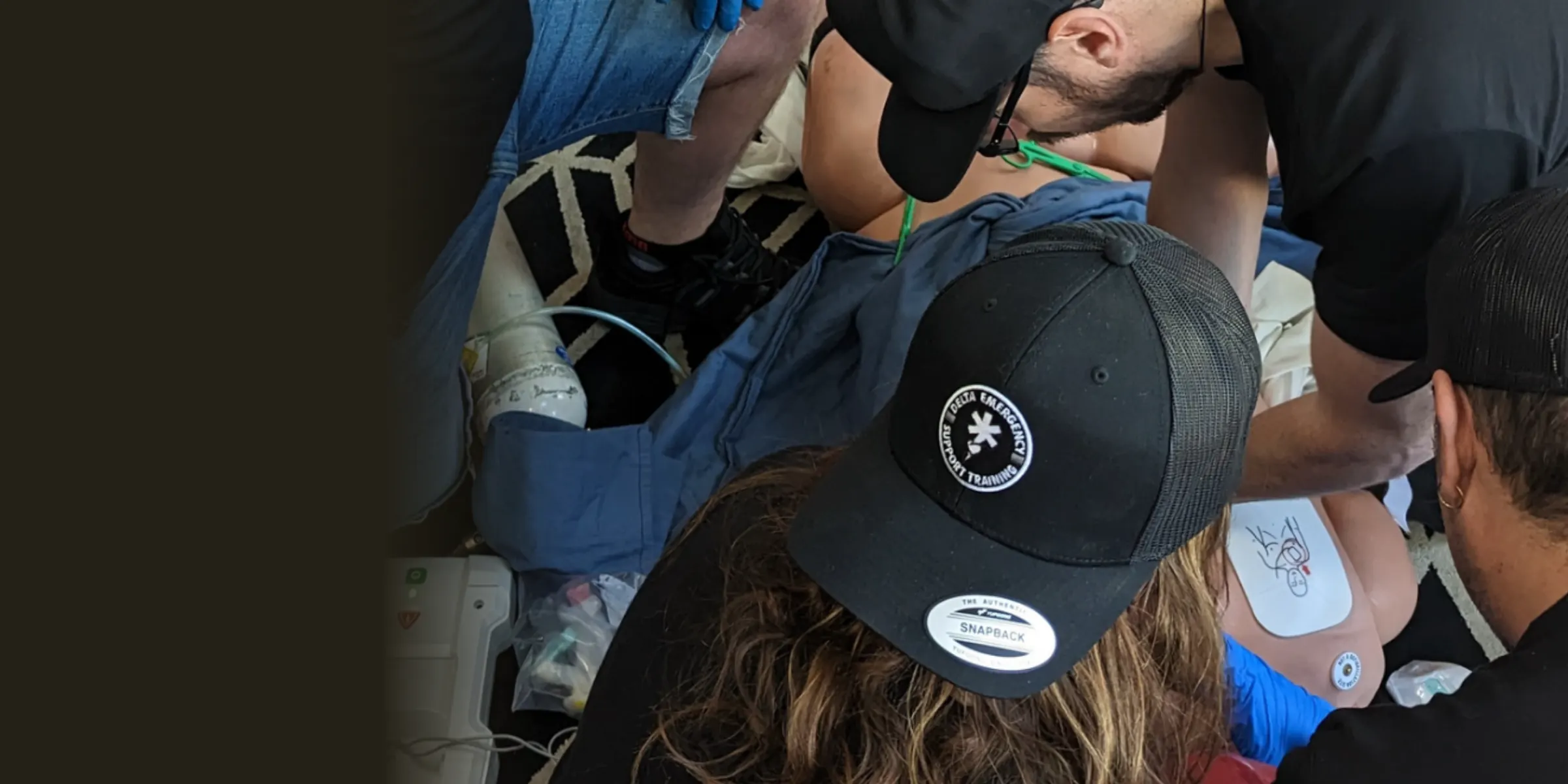
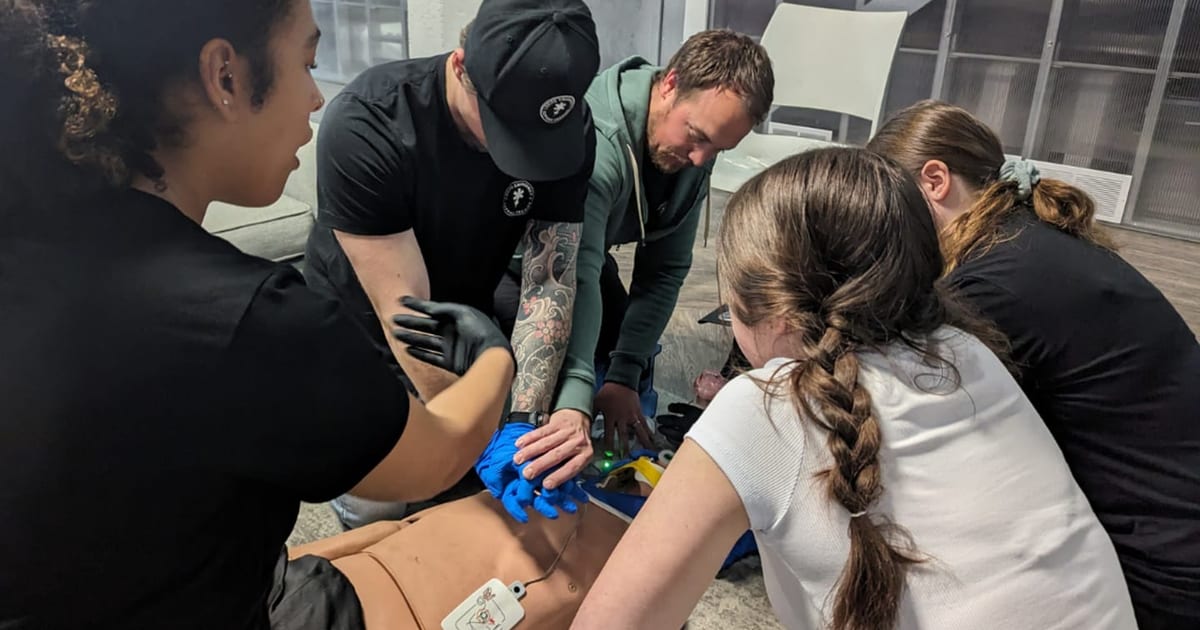
This is a hands-on course. Expect to spend most of it on the floor, on your knees, working on manikins and with your classmates rather than watching slides. The skills that matter in a real emergency are physical, and they do not survive being learned from a screen alone.
The core of the course is what you would need in the first few minutes: taking charge of a scene safely, deciding quickly whether someone is in real trouble, opening and protecting an airway, CPR at level C for adults, children and infants with an AED, choking, severe bleeding and shock. From there it widens into the situations you are more likely to meet at work or at home, chest pain and stroke, diabetic emergencies, seizures, severe allergic reactions and auto-injector use, suspected head and spine injuries, bone and joint injuries, burns and wounds, poisoning, and the heat and cold emergencies that come with an Alberta job site or an Alberta winter. The program content and its order are set by the Canadian Red Cross. We do not reproduce their course material here; you receive it as part of your registration.
What our instructors add is context. They work as paramedics, firefighters and emergency professionals, and they have run these calls for real. So when someone asks whether ribs really break during compressions, or what to do when the AED says no shock advised, or how an arriving crew wants to be met at the door, the answer comes from someone who does the job. Owner Jarrett Chisholm is an Advanced Care Paramedic, and that clinical standard runs through how we teach.
We also spend time on the parts that usually get skipped: what to say to the 911 dispatcher, how to keep a bystander useful instead of in the way, how to hand a patient over in fifteen seconds without losing the important detail, and what to do with yourself afterwards.
Who this course suits, and who should look at something else
Intermediate First Aid is the general-purpose level, and it suits most people. If you are the designated first aid attendant on a Calgary site, a childcare or education worker, a coach, a volunteer, a trades apprentice, a new hire whose offer depends on holding a current certificate, or simply the person in your family who would rather know what to do, this is the course you want. There is no prerequisite and no prior training assumed.
A few people should pause. If your role is clinical or care-facing and your employer's wording is "BLS" or "CPR for healthcare providers", you likely need Basic Life Support rather than a general first aid certificate, the two are not interchangeable, and booking the wrong one costs you a day and the fee. If you work in licensed child care, check whether the requirement names a child care specific first aid course, since that variant exists and some wording asks for it by name; confirm the exact wording with your licensing body or employer. And if you are heading toward industrial medic work, a fire application or a paramedic pathway, Advanced First Aid may be the better starting point, check what that service or program actually asks for before you book anything.
If you are not sure, send us the exact wording of what you have been asked for and we will tell you honestly which course fits, including when the answer is a course we are not running that week, or a cheaper one than the one you were about to book.
Formats, hours, and how you are assessed
There are two ways to complete Intermediate First Aid with us. The classroom option runs roughly fourteen to sixteen hours over two days, usually consecutive. The blended option splits it: a self-paced online theory portion you complete on your own schedule, followed by a single in-person skills day. Shift workers, parents and anyone who cannot give up two full weekdays tend to prefer blended. People who learn better with an instructor in front of them, and anyone who has been away from first aid for a long time, usually do better in the full classroom version.
If you choose blended, the online portion has to be finished before you arrive. Bring or forward your completion record. Turning up to the skills day with the online work half done means we cannot certify you that day, and that is a frustrating way to lose a Saturday.
Assessment is continuous rather than a single exam moment. Your instructor watches you perform each required skill and corrects you as you go, and there is a written evaluation as well. That is deliberate: it is closer to how competence actually works, and it means nobody is surprised at the end.
One point we make plainly, because it is occasionally misunderstood. Attending a course is not the same as being certified. Certification requires full attendance and a demonstrated, evaluated performance of the required skills. If you miss significant class time, or cannot yet demonstrate a skill, we will talk with you about how to finish properly. We will not sign off on something you did not do, a card that does not reflect real ability is no use to you, and less use to the person who needs you.
Workplace requirements and school prerequisites: check before you pay
We will not tell you that this course satisfies your particular legal, employer or school requirement, because we are not the authority on your requirement, and neither is any training provider that tells you otherwise. What we can say is that many Alberta employers accept Intermediate First Aid with CPR-C as general workplace first aid. Confirm your specific requirement with your employer, your safety officer or your school before you register.
When you ask them, ask for four specifics: the exact course name they will accept, the CPR level required, whether a particular certifying body is required, and how many hours or days it must be. What counts as adequate first aid coverage on a given Alberta worksite depends on the details of that site, and it is your employer or safety officer who determines it, not us. Get their answer in writing if a job offer or a contract depends on it.
Post-secondary programs are the same story. Some list a first aid certificate as an admission or first-day requirement, some specify a level, and some require the certificate to still be valid on a particular date. Check the intake page for your exact program and your exact year, and confirm with the admissions office, since these change.
As a pathway, Intermediate First Aid is a sensible first rung. Some people go on to Advanced First Aid for industrial, remote or fire-adjacent work, and some continue to Emergency Medical Responder. Be clear on one thing about EMR: a Canadian Red Cross EMR certificate is not an Alberta College of Paramedics approved program. It does not give you College registration, and it does not give you a practice permit in Alberta. It may meet selected PCP-school admission requirements, verify your exact school and your exact intake before you spend money on it.
Applying to Edmonton Fire?
Edmonton Fire Rescue Services has confirmed Intermediate First Aid as the minimum medical standard for its 2027 intake. It names Alberta OHS-approved Intermediate First Aid, or a provincial equivalent, and points applicants to the Government of Alberta's list of approved training agencies.
Our Intermediate First Aid meets Edmonton Fire's minimum medical standard for the 2027 intake, because it is the Canadian Red Cross Intermediate First Aid course and the Canadian Red Cross Society is on the Government of Alberta approved list. Your certificate has to be valid on the day you apply.
In November 2025, Edmonton Fire Rescue Services invited Delta, as one of the local first aid providers, to its recruitment information session at the EFRS Training Academy to talk with applicants.
Applicants often ask why Delta is not on the Government of Alberta list of approved first aid training agencies. The list names the agency, not each partner who teaches for it. The Canadian Red Cross Society is on it, and Delta teaches Canadian Red Cross courses as a Training Partner, on the Red Cross's behalf. Alberta's first aid training page says a provider that is not on the list can deliver an approved course for an agency that is. Your certificate is a Canadian Red Cross certificate, so where an application asks for the approved training agency, write the Canadian Red Cross Society.
Edmonton Fire describes its own process as highly competitive. If you want more training behind you than the minimum, see how Advanced First Aid compares for a fire applicant.
What to bring, how to prepare, and how to get the most out of two days
Wear clothes you can kneel, crouch and lie down in. Long pants you do not mind getting dusty are ideal, and closed shoes. You will spend real time on the floor. Bring a water bottle, a lunch or a plan for one, and layers, because training rooms run warm or cold depending on the venue.
Give us the correct spelling of your legal name and an email address you actually read, since that is where your certificate details go. The certificate is valid for three years. Put the expiry date in your calendar now with a reminder three months ahead, because it is easy to lose track of an expiry until the day someone asks to see your card. When it gets close, get in touch and we will tell you what the current renewal options are.
Tell us in advance about anything that affects how you take part: a back or knee injury, pregnancy, a mobility or hearing consideration, or if English is not your first language. We can adjust positioning, pace and demonstration methods within what the evaluation requires. CPR is genuinely physical work and the required skills do have to be demonstrated, but how we get you there is flexible, and it is far easier to plan for on day one than to improvise at three in the afternoon.
If you are booking for a group, ask about onsite delivery. We can bring the course to your worksite in Calgary, in the Leduc and Edmonton region, elsewhere in Canada, or internationally on request. Onsite carries an additional fee that covers travel and instructor time and is quoted separately, and for a full crew it removes the travel and the scheduling around it.
A pocket mask that goes home with you
Your fee includes a hard-shell pocket mask: the real clamshell mouth-to-mask device, with the one-way filter valve, the elastic strap and the case. It comes out of its packaging in class, you train with it on the manikins, and then it goes home with you.
Nobody hands you a mask another class used and wiped down. Yours is new, and after the course it lives wherever you might one day need it: the kitchen drawer, the glovebox, the first aid kit at work.
Who this course is for
- Designated first aid attendants on Calgary construction, warehouse and shop floors
- Daycare, out-of-school-care and preschool staff in Calgary and Leduc
- Teachers, educational assistants, coaches and camp leaders
- Trades apprentices and post-secondary applicants told to hold a current certificate
- Fitness, pool, arena and recreation staff
- Volunteer firefighters, search-and-rescue and event medical volunteers
- Office safety committee members, floor wardens and small-business owners
- Anyone starting a responder pathway toward Advanced First Aid or beyond
English isn’t your first language?
Our instructors teach in English, with live-translated classroom text available in supported languages. You can follow explanations on screen while participating in the same hands-on training as the rest of the class.
Because translated explanations require additional reading and processing time, your instructor may occasionally pause before moving to the next topic. This can make the instructional pace slightly slower.
Optional preparation materials may also be available before class to help you become familiar with common English first aid terminology.
Languages are confirmed course by course, so none is guaranteed until we confirm it with you.
Contact us before registering to confirm that your preferred language is available for your course.
Related reading
- Using an AED: What the Machine Does and What You DoAn AED talks you through every step and decides for itself whether a shock is needed. What happens when you open one, and the situations people worry about.
- Restart a Heart: Why the Bystander Decides Who SurvivesAbout 60,000 Canadians have a cardiac arrest outside hospital each year and most do not survive. Why the person nearby matters more than the ambulance.
- Check, Call, Care: What the Three Steps Actually MeanCheck, Call, Care is the emergency action framework taught in Canadian first aid. What each step really asks of you, in order, and why the order is the point.
Where we teach this course
Public sessions run in Calgary, with dates in Leduc through the year.
We also deliver this course at your worksite for groups, useful for crews who can’t release staff to travel. Onsite delivery carries an additional fee on top of per-person pricing. Request an onsite quote.
We travel for private and group training across Canada, and internationally by arrangement. If you’re outside Alberta, tell us where you are and we’ll price it.
Ready to take this course?$160.00 + GST & applicable taxes
Common questions
- Does this course meet Edmonton Fire's first aid requirement?
- Yes. Our Intermediate First Aid meets Edmonton Fire's minimum medical standard for the 2027 intake, because it is the Canadian Red Cross Intermediate First Aid course and the Canadian Red Cross Society is on the Government of Alberta approved list. Your certificate has to be valid on the day you apply. Edmonton Fire says more changes to its 2027 process are coming, so check its recruitment page before you apply.
- Why isn't Delta on Alberta's list of approved first aid training agencies?
- Because the list names the agency, not each partner who teaches for it. The Canadian Red Cross Society is on the Government of Alberta list, and Delta teaches Canadian Red Cross courses as a Training Partner, on the Red Cross's behalf. Alberta's first aid training page says a provider that is not on the list can deliver an approved course for an agency that is. Your certificate is a Canadian Red Cross certificate, so where an application, including a fire service application, asks for the approved training agency, write the Canadian Red Cross Society.
- Is Intermediate First Aid the same thing as Standard First Aid?
- Yes. The Canadian Red Cross renamed Standard First Aid to Intermediate First Aid. It is the same level of course: roughly two days, CPR included, three-year certificate. Your certificate will carry the new name, while many employers and schools still use the old one. If a formal requirement names Standard First Aid specifically, confirm with whoever set that requirement before you register.
- Will this certificate meet my employer's or my school's requirement?
- Many Alberta employers accept Intermediate First Aid with CPR-C as general workplace first aid, but we cannot confirm your particular requirement and no training provider honestly can. Ask your employer, safety officer or school for the exact course name, the CPR level, the required hours and whether a specific certifying body is needed, preferably in writing, especially if a job offer depends on it.
- Is CPR included, or do I need a separate CPR course?
- CPR-C and AED training are included, so you do not need a separate CPR course alongside it. That said, CPR-C is not the same as Basic Life Support. If your role is clinical, or your employer's wording says BLS or healthcare provider CPR, you likely need BLS instead. Send us the wording and we will tell you which one you need.
- What is the difference between the two-day class and the blended option?
- Content and certificate are the same. The classroom option is about fourteen to sixteen hours across two days with an instructor throughout. Blended replaces the theory portion with self-paced online work, followed by one in-person skills day. Blended suits shift workers and people who cannot free two weekdays; the full classroom version suits anyone who learns better with an instructor present or who has not done first aid in years. The online portion must be finished before your skills day.
- What happens if I miss part of the course?
- Certification requires full attendance and evaluated performance of the required skills, so missing significant class time means we cannot certify you that day. Tell us as early as you can and we will work out how you finish, usually by completing the missed portion with a later session, depending on what is scheduled. We will not issue a certificate for training someone did not complete.
- Do you come to our workplace, and how is that priced?
- Yes. We deliver onsite at client worksites in Calgary, in Leduc and the greater Edmonton region, across Canada, and internationally on request. Onsite delivery carries an additional fee covering travel and instructor time, and it is quoted per booking rather than per seat, since it depends on group size, location and dates. Contact us with your crew size and preferred window and we will put a quote together.
- What is the difference between CPR-A, CPR-B, CPR-C and BLS?
- The letter tells you which age groups you are trained on. CPR-A covers adults: the lowest level there is, which is why it pairs with the short entry-level workplace course. CPR-B covers children and infants: offered inside the child care first aid courses rather than on its own. CPR-C covers adults, children and infants: the level most people are asked for, and the next one up from A. BLS (Basic Life Support) covers adults, children, infants and neonates: Basic Life Support CPR, also known as Healthcare Provider CPR, a professional level CPR course used by firefighters, nurses, paramedics, doctors and other healthcare workers. Broader is not automatically better for you, though. If a form names a specific letter, the letter printed on your certificate is what the person checking it will be looking for, so match the wording you were handed rather than assuming a higher level will be accepted in its place. This course carries CPR-C, covering adults, children and infants.
- What counts as a baby, a child or an adult, and which ages does this course cover?
- This course carries CPR-C, which covers adults, children and infants. The Canadian Red Cross 2025 standards set the age groups this way. A baby is under 1 year old. A child is 1 year old up to the onset of puberty. An adult is anyone from the onset of puberty on. Puberty does not happen on a set birthday, so you judge it on the person in front of you. A 13 year old who has started puberty gets adult CPR, and one who has not is still a child. For an AED, use child pads on a child up to the onset of puberty or under 55 pounds (about 25 kg), and baby pads on a baby if the AED has them. If baby pads are not there, use child or adult pads. If child pads are not there, use adult pads. The Red Cross says adult pads are safe on a child or a baby, so do not wait for the right size. If you are training for a specific person, tell us their age and we will tell you which course fits.
- Can I take this course if English isn't my first language?
- Yes. Our instructors teach in English, and live-translated classroom text is available for this course in supported languages. Contact us before registering to confirm that your language is available for your course.
- Can I register on the same day as the course?
- Online registration closes at 11:59 PM the night before an in-person course. If you need training today, call or text 825-883-3582 before class starts. We may be able to fit you in, depending on space and the instructor's approval. It is not guaranteed.
- Online registration is closed. Does that mean the course is full?
- No. Closed online only means the online booking window has ended. A seat may still be open, or open up if someone cancels. Call or text 825-883-3582 to check.
- What if I arrive late?
- Certification needs full attendance and every required skill. Arriving late can mean we cannot certify you that day. If you are running late, call or text as early as you can so we can tell you what is possible.
Where to go next
Ready to register?
Pick your cohort above, or start here and choose your dates on the registration page.
Cancellation, transfer, and refund terms are shown before payment and confirmed at registration. Not sure which course fits? Email us and we’ll help.
Sources
- On successful completion you receive a Canadian Red Cross Intermediate First Aid & CPR certificate, valid 3 years. Canadian Red Cross (verified 2026-07-23).
- Edmonton Fire Rescue Services has confirmed that Intermediate First Aid (Alberta OHS-approved or provincial equivalent), valid at the time of application, will be the minimum accepted medical standard for applicants to its 2027 intake. The City describes its recruitment process as highly competitive, ranks candidates by their performance at each stage, and scores a résumé review that counts for 10% of each candidate's overall score. It does not publish which qualifications earn points, and it says further changes to the 2027 process are expected. City of Edmonton, Edmonton Fire Rescue Services (verified 2026-09-18).
- The Canadian Red Cross Society is on the Government of Alberta list of approved first aid training agencies, with its Basic, Intermediate and Advanced First Aid courses. Delta Emergency Support Training is not named on the list; it teaches these Canadian Red Cross courses as a Canadian Red Cross Training Partner, on the Red Cross's behalf. Government of Alberta (FA018, Approved first aid training agencies) (verified 2026-09-27).
- The Government of Alberta says a provider that is not on the approved agency list can deliver an approved course on behalf of a listed agency. Government of Alberta, First aid training (verified 2026-09-27).
- Edmonton Fire Rescue Services names Alberta OHS-approved Intermediate First Aid, or a provincial equivalent, valid at the time of application, as the minimum medical standard for its 2027 intake. Delta's Intermediate First Aid is the Canadian Red Cross Intermediate First Aid course, and the Canadian Red Cross Society is on the Government of Alberta approved agency list, so it meets that minimum. City of Edmonton, Edmonton Fire Rescue Services (verified 2026-09-27).
- The Canadian Red Cross First Aid Program Standards 2025 define a baby as newborn to 1 year of age, a child as 1 year old to the onset of puberty, and an adult as the onset of puberty and older. Canadian Red Cross (verified 2026-09-26).
- The Canadian Red Cross Comprehensive Guide for First Aid & CPR (2025) says pediatric AED pads should be used on children up to the onset of puberty or weighing less than 55 pounds, and that if pediatric pads are not available it is safe to use adult pads on a child or baby. Canadian Red Cross (verified 2026-09-26).
← All courses · Last reviewed 2026-07-23