
Standard Child Care First Aid is the two-day first aid certificate built around the people you actually look after: infants, toddlers and young children.
Read more about this courseShow less
We teach it in person in Calgary, and in Leduc for the greater Edmonton region, with instructors who work as paramedics, firefighters and emergency professionals. There is no prerequisite, and the Canadian Red Cross publishes no pre-course requirements for it, so nobody is turned away for being new to this. We also deliver it onsite at your centre, school or day home for an additional fee, and we travel elsewhere in Canada, and internationally, on request. One thing before you book: what counts for a licensed child care position in Alberta is set through provincial child care licensing and interpreted by your licensing officer or your employer, not by a training provider. The second section explains how to check that properly, and we would rather you checked than guessed.
Course details
- Certificate
- Canadian Red Cross Child Care First Aid & CPR
- Certificate valid for
- 3 years
- Issued by
- Canadian Red Cross
- Duration
- Approx. 16 hours (2 days)
- Prerequisites
- None
- CPR / BLS
- What is CPR-B?CPR-B covers children and babies.It is offered inside the child care first aid courses rather than on its own.More about CPR levels
- Locations
- Leduc, AB, 4810 50th Ave, Calgary, AB, 1550 5 St SW #300
- Price
- $180.00 + GST & applicable taxes (charged at checkout for your province)
How this course runs
- In person: one or two days at our location. Nothing to do online beforehand.
- How it runs
- Two days in class. Nothing online.
- Class times
- 9:00 a.m. to 5:30 p.m.
- Whole course
- 16 hours in total
Upcoming dates, choose your cohort
Edmonton regionDec 1 – Dec 2, 2026 · Leduc, AB, 4810 50th Ave
- Start: Tue, Dec 1 · 9:00 a.m. to 5:30 p.m.in class
- Finish: Wed, Dec 2 · 9:00 a.m. to 5:30 p.m.in class
Registration closes November 30, 2026.
December 2026
SMTWTFS12345678910111213141516171819202122232425262728293031In person: 2 class days, nothing online
In person(no online sessions)
- 2 full days in class
Edmonton regionIn person: one or two days at our location. Nothing to do online beforehand.CalgaryJan 26 – Jan 27, 2027 · Calgary, AB, 1550 5 St SW #300
- Start: Tue, Jan 26, 2027 · 9:00 a.m. to 5:30 p.m.in class
- Finish: Wed, Jan 27, 2027 · 9:00 a.m. to 5:30 p.m.in class
Registration closes January 25, 2027.
January 2027
SMTWTFS12345678910111213141516171819202122232425262728293031In person: 2 class days, nothing online
In person(no online sessions)
- 2 full days in class
CalgaryIn person: one or two days at our location. Nothing to do online beforehand.Edmonton regionFeb 18 – Feb 19, 2027 · Leduc, AB, 4810 50th Ave
Waitlist only- Start: Thu, Feb 18, 2027 · 9:00 a.m. to 5:30 p.m.in class
- Finish: Fri, Feb 19, 2027 · 9:00 a.m. to 5:30 p.m.in class
Registration is closed for these dates.
February 2027
SMTWTFS12345678910111213141516171819202122232425262728In person: 2 class days, nothing online
In person(no online sessions)
- 2 full days in class
Edmonton regionIn person: one or two days at our location. Nothing to do online beforehand.Waitlist only. Join the waitlist and we’ll email you the moment a seat is available.
Unsure if Standard Child Care First Aid is what you need?
Figure out what you need in under 30 seconds, with these simple questions.
- Answer a few questions
- See the course that fits and why
- Pick a date and register
- Become certified
I’m taking the training myselfFor my job, a job I want, school, or my own life.I’m arranging training for my staff or workplaceSee what your workplace needs, and the course for it.Basic and Intermediate First Aid both include CPR. A CPR course on its own does not include first aid.
CalgaryMar 18 – Mar 19, 2027 · Calgary, AB, 1550 5 St SW #300
- Start: Thu, Mar 18, 2027 · 9:00 a.m. to 5:30 p.m.in class
- Finish: Fri, Mar 19, 2027 · 9:00 a.m. to 5:30 p.m.in class
Registration closes March 17, 2027.
March 2027
SMTWTFS12345678910111213141516171819202122232425262728293031In person: 2 class days, nothing online
In person(no online sessions)
- 2 full days in class
CalgaryIn person: one or two days at our location. Nothing to do online beforehand.Edmonton regionApr 8 – Apr 9, 2027 · Leduc, AB, 4810 50th Ave
Waitlist only- Start: Thu, Apr 8, 2027 · 9:00 a.m. to 5:30 p.m.in class
- Finish: Fri, Apr 9, 2027 · 9:00 a.m. to 5:30 p.m.in class
Registration is closed for these dates.
April 2027
SMTWTFS123456789101112131415161718192021222324252627282930In person: 2 class days, nothing online
In person(no online sessions)
- 2 full days in class
Edmonton regionIn person: one or two days at our location. Nothing to do online beforehand.Waitlist only. Join the waitlist and we’ll email you the moment a seat is available.
CalgaryMay 15 – May 16, 2027 · Calgary, AB, 1550 5 St SW #300
- Start: Sat, May 15, 2027 · 9:00 a.m. to 5:30 p.m.in class
- Finish: Sun, May 16, 2027 · 9:00 a.m. to 5:30 p.m.in class
Registration closes May 14, 2027.
May 2027
SMTWTFS12345678910111213141516171819202122232425262728293031In person: 2 class days, nothing online
In person(no online sessions)
- 2 full days in class
CalgaryIn person: one or two days at our location. Nothing to do online beforehand.Edmonton regionJun 17 – Jun 18, 2027 · Leduc, AB, 4810 50th Ave
Waitlist only- Start: Thu, Jun 17, 2027 · 9:00 a.m. to 5:30 p.m.in class
- Finish: Fri, Jun 18, 2027 · 9:00 a.m. to 5:30 p.m.in class
Registration is closed for these dates.
June 2027
SMTWTFS123456789101112131415161718192021222324252627282930In person: 2 class days, nothing online
In person(no online sessions)
- 2 full days in class
Edmonton regionIn person: one or two days at our location. Nothing to do online beforehand.Waitlist only. Join the waitlist and we’ll email you the moment a seat is available.
CalgaryJul 15 – Jul 16, 2027 · Calgary, AB, 1550 5 St SW #300
- Start: Thu, Jul 15, 2027 · 9:00 a.m. to 5:30 p.m.in class
- Finish: Fri, Jul 16, 2027 · 9:00 a.m. to 5:30 p.m.in class
Registration closes July 14, 2027.
July 2027
SMTWTFS12345678910111213141516171819202122232425262728293031In person: 2 class days, nothing online
In person(no online sessions)
- 2 full days in class
CalgaryIn person: one or two days at our location. Nothing to do online beforehand.Edmonton regionAug 5 – Aug 6, 2027 · Leduc, AB, 4810 50th Ave
Waitlist only- Start: Thu, Aug 5, 2027 · 9:00 a.m. to 5:30 p.m.in class
- Finish: Fri, Aug 6, 2027 · 9:00 a.m. to 5:30 p.m.in class
Registration is closed for these dates.
August 2027
SMTWTFS12345678910111213141516171819202122232425262728293031In person: 2 class days, nothing online
In person(no online sessions)
- 2 full days in class
Edmonton regionIn person: one or two days at our location. Nothing to do online beforehand.Waitlist only. Join the waitlist and we’ll email you the moment a seat is available.
CalgarySep 16 – Sep 17, 2027 · Calgary, AB, 1550 5 St SW #300
- Start: Thu, Sep 16, 2027 · 9:00 a.m. to 5:30 p.m.in class
- Finish: Fri, Sep 17, 2027 · 9:00 a.m. to 5:30 p.m.in class
Registration closes September 15, 2027.
September 2027
SMTWTFS123456789101112131415161718192021222324252627282930In person: 2 class days, nothing online
In person(no online sessions)
- 2 full days in class
CalgaryIn person: one or two days at our location. Nothing to do online beforehand.
What you’ll be able to do
- Tell the difference quickly between a child who is upset and a child who is genuinely in trouble
- Clear an airway obstruction in a choking infant or child, and keep working when the first attempts do not fix it
- Perform the CPR taught in this course on an infant or a small child without freezing over how small they are
- Recognize breathing trouble that is getting worse rather than settling, and act before it becomes an arrest
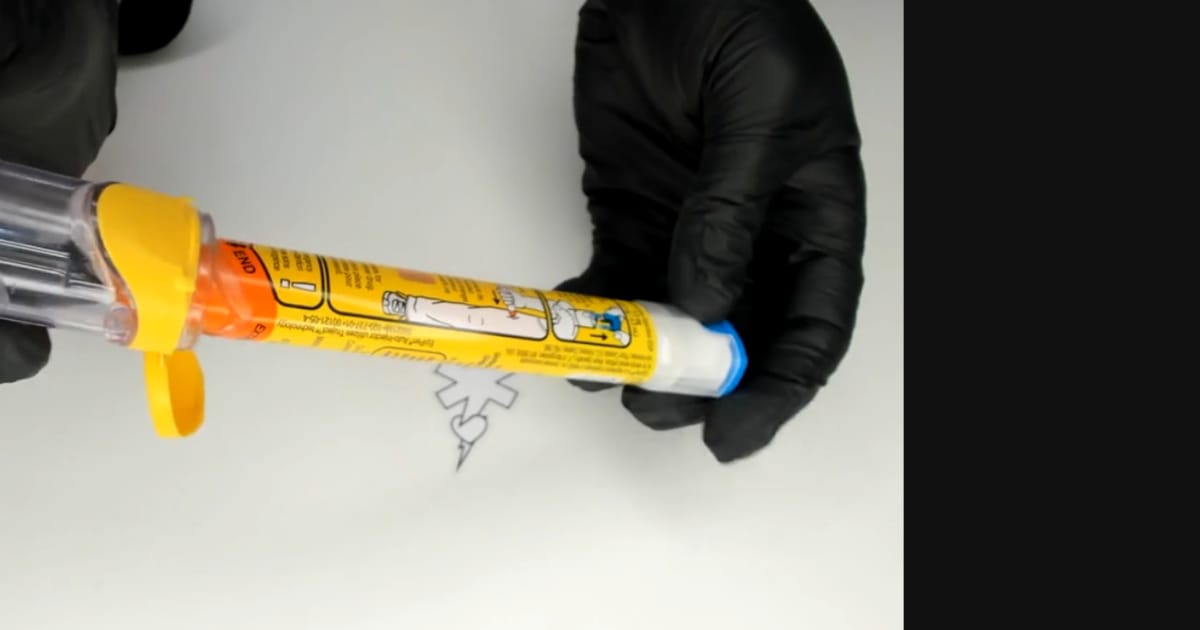
- Respond to a severe allergic reaction and follow your centre's own medication and emergency policy under pressure
- Manage bleeding, burns, falls and head injuries in a room where other children are still watching you
- Call 911 with the information a dispatcher actually needs, and keep the rest of the group supervised while you wait
- Write a clear incident record and give parents and arriving paramedics an ordered account of what happened
Ready to take this course?$180.00 + GST & applicable taxes
What Child Care First Aid actually is
It is a two-day, in-person course with CPR at Level B included, so you are not booking and paying for CPR separately. The Canadian Red Cross sets the hour requirement and it can change, so work from the exact hours and daily start times published with the run you are booking rather than from this page. There is no prerequisite and no prior first aid assumed. The Red Cross lists no pre-course requirements for this course at all, which means no minimum age, and we do not put an upper age limit on any course we run. There is one Delta rule that is not an age limit: anyone under 18 has to be registered by a parent or guardian, who accepts the registration policies on their behalf, and learners under 16 do not hold their own portal account.
What separates it from the general workplace first aid course is not difficulty, it is focus. This one is built around infants and children: smaller airways, smaller bodies, a patient who cannot tell you what is wrong, and a caregiver who is usually the only adult in the room. You may see it listed elsewhere as Standard Child Care First Aid; the certificate is issued as the Canadian Red Cross Child Care First Aid and CPR certificate. The Red Cross sets how long it stays valid, currently three years, and the exact expiry date is printed on the certificate you are issued.
The curriculum belongs to the Canadian Red Cross and we teach to it, so the lesson list is theirs to publish and not ours to paraphrase. If a licensing officer, an accreditation binder or a program supervisor needs the current official course description, ask us and we will send you to the Canadian Red Cross's own page for it. Broadly, this is a pediatric-focused first aid and CPR course, and you receive the Red Cross material as part of your registration.
What Delta adds is context. Our instructors have gone to these calls for real, at three in the afternoon, in a room with seven other children in it. So when someone asks how hard you actually push on an eleven-month-old, or what to do when a parent arrives before the ambulance does, the answer comes from someone who has stood in that room.
Alberta child care licensing: get the exact wording before you pay
Licensed child care in Alberta has its own first aid requirements. They come from provincial child care licensing and they are interpreted by your licensing officer, your agency or your employer. We will not tell you that this course satisfies them, and you should be wary of any training provider that does, because that is not a claim a training company is in a position to make about your specific position and your specific licence.
So ask, and ask precisely. Get six things from whoever set the requirement: the exact course name they will accept, the CPR level required, the number of hours or days, whether a particular certifying body is required, whether it has to be delivered in person, and whether the certificate has to still be valid on a particular date. Get it in writing if a job, a licence renewal or an inspection depends on it.
Then send that wording to us before you register, and we will tell you honestly whether this is the course that matches it. Sometimes the answer is yes. Sometimes the wording actually describes the general workplace certificate rather than the child care one. And sometimes the honest answer is that this is not the right course for you, in which case we would rather say so than take your money. That conversation costs you an email and saves you a weekend.
One trap worth naming on its own. This course carries CPR at Level B. If the wording you were handed names CPR-C, or names Basic Life Support, those are different levels with different names on the certificate, and a licensing officer or a hiring manager reading a card is reading the name on it. Check the level before you pay, not after.
Who this course suits, and who should book something else
The clearest fit is anyone whose working day is spent with small children. Licensed centre staff and program supervisors, early childhood educators, day home operators, out-of-school and preschool care staff, nannies and private caregivers, camp counsellors and recreation programmers. If your patient is going to be a two-year-old, train on a two-year-old rather than on an adult manikin and hope the skills transfer.
It also suits people with no requirement at all. Parents of infants, grandparents doing regular care, an aunt who has the baby two days a week. Nobody has asked you for a certificate and nobody is going to inspect it. You are welcome in the room anyway, and you would not be the only person there without a requirement to meet.
Some people should look elsewhere, and we would rather say so here than at the door. If what you have been asked for is a general workplace first aid certificate with CPR-C, that is our Intermediate First Aid course, which the Canadian Red Cross previously called Standard First Aid. The name on the card changed; if your requirement was written using the old name, send us the wording and we will confirm which certificate matches it. If your role is clinical or care-facing and the wording says Basic Life Support or healthcare provider CPR, this is not that course and the two are not interchangeable. And if the person who needs training is a young teen who babysits occasionally rather than a paid child care worker, ask us first, because a shorter youth-focused option may be the better purchase.
If you cannot tell which bucket you are in, that is normal. The naming across first aid courses in this country is genuinely confusing, and it has been changed more than once. Describe what you do all day and we will sort out which course that is.
What the two days actually look like
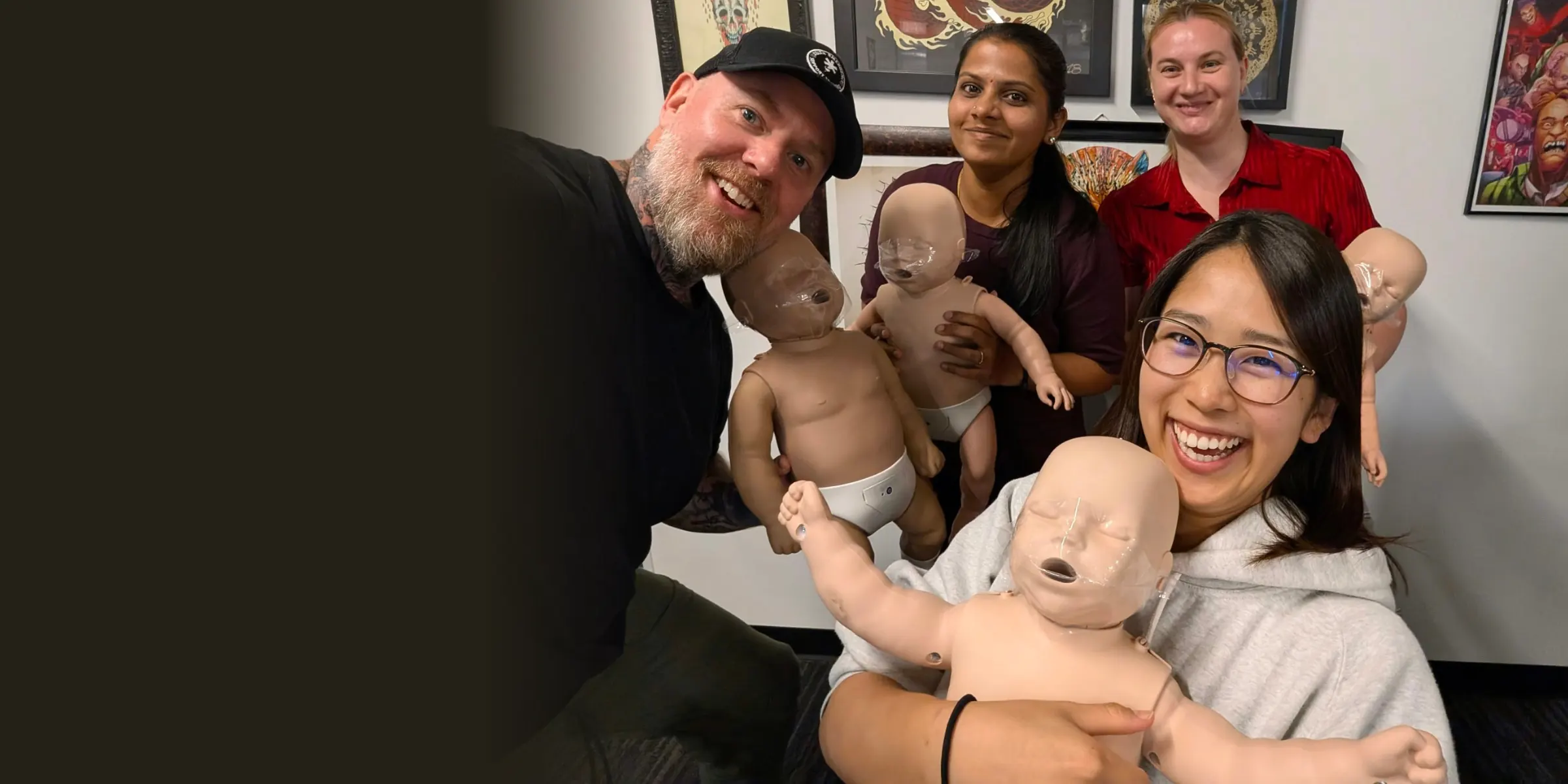
This is a hands-on course and you will spend most of it on the floor. Expect to be on your knees, working on infant and child manikins, doing the same skill again after your instructor corrects you, and then doing it again until your hands know it without your head being involved. The skills that matter in a real emergency are physical, and they do not survive being learned from a screen.
The scenarios are built the way these calls actually unfold in a child care setting, which is to say badly. One adult, several children, incomplete information, a child who was fine ten minutes ago, and a phone that you now have to use while your hands are busy. We spend deliberate time on the parts that never make it into a course description: who watches the other children while you work, what you tell the 911 dispatcher so they send the right thing, how to keep a panicking coworker useful, what to say to a parent on the phone, and what goes in the incident record afterwards.
There is no pretence that any of this is comfortable. Practising infant CPR is upsetting for most people the first time, particularly for anyone who has a small child of their own. Instructors know that and they teach around it rather than through it. Nobody is embarrassed for finding it hard, and it gets easier with repetition, which is precisely why the course is built on repetition.
You will also get the honest version of what to expect from the emergency response itself, from people who are the emergency response. Response times, what crews want handed to them at the door, and what actually happens after the ambulance leaves. That context is the part students say they remember years later.
How you are certified, and where we run it
Attending the course is not the same as being certified. Certification requires full attendance and a demonstrated, evaluated performance of the required skills, with both written and hands-on components. Your instructor watches you throughout rather than testing you once at the end, so weak spots surface early enough to fix. Nobody is passed on effort, and a card that does not reflect real ability is no use to you and less use to the child who needs you.
Tell us early if you already know you will miss a stretch of day one or day two. A day home operator juggling coverage is not an unusual problem and we have solved it before. What we can offer narrows as the two days go on, so a Tuesday email beats a Thursday one, and we would far rather rearrange something with you in advance than tell you at the end that we cannot certify you.
We are bringing this course onto the new schedule now. It runs in person in Calgary, and we are adding Leduc dates for the greater Edmonton region. Dates are not on the calendar yet, so tell us the window you need and we will let you know when one lands, or we will arrange a private run for your team. Ask us for the current per-seat fee, what is included, and the refund and transfer terms, and we will confirm them in writing before you register. Do not treat any number you find on a third-party page as our current price.
For a whole staff team, ask about onsite delivery. We can bring the course to your centre, your school, your agency or your day home network anywhere in Alberta for an additional fee that covers travel and instructor time, and we travel elsewhere in Canada and internationally on request. Onsite is the same course with the same evaluations. Tell us your group size, your location and the window you are trying to hit, and we will tell you what is workable rather than promising something that is not.
Renewal, paperwork, and what to bring
Deal with the expiry date on the day you get the certificate. The Canadian Red Cross sets the validity period, currently three years, and the exact date is printed on your certificate. Put it in your calendar with a reminder three months ahead. In licensed child care the expiry usually matters to somebody other than you, and discovering it lapsed during an inspection or a hiring check is a bad way to find out.
We do not currently list a separate short recertification course for Child Care First Aid, so do not assume a quick refresher will be waiting for you. Contact us before your certificate expires and we will tell you what the current renewal route actually is. Getting in touch early costs nothing and gives you options that a lapsed card does not.
Register with your legal name spelled exactly the way your employer, your agency or your licensing file expects to see it. This matters more here than on most courses, because the certificate is going into somebody else's paperwork and a mismatched name creates a problem months later. A certificate reprinted to fix a spelling takes weeks; typing it correctly at registration takes seconds.
Come dressed to work: clothes you can kneel, crouch and lie down in, closed shoes, hair tied back. Bring water, a lunch or a plan for one, and something to write with. If you are pregnant, have a back, knee or shoulder issue, have a hearing or mobility consideration, or English is not your first language, tell us before the course rather than on the morning. The required skills do have to be demonstrated, but how we get you there is flexible, and it is far easier to plan for in advance than to improvise at two in the afternoon.
A pocket mask that goes home with you
Your fee includes a hard-shell pocket mask: the real clamshell mouth-to-mask device, with the one-way filter valve, the elastic strap and the case. It comes out of its packaging in class, you train with it on the manikins, and then it goes home with you.
Nobody hands you a mask another class used and wiped down. Yours is new, and after the course it lives wherever you might one day need it: the kitchen drawer, the glovebox, the first aid kit at work.
Emergency or Standard: what the extra day buys
The Canadian Red Cross child care program has two tiers, and the names matter. Emergency Child Care First Aid is the one-day, eight-hour course built around the life-threatening core. This course, Standard Child Care First Aid, is the two-day, sixteen-hour tier: the same foundation, then the time to go wider and deeper across the injuries and sudden illnesses that come with caring for infants and children. Both carry CPR Level B.
Which one you need is usually not your choice to make: child care licensing wording, an agency, or an employer names a tier, and the word to look for in your paperwork is Emergency or Standard. If the wording names Standard, the one-day course will not satisfy the person who wrote it. Send us the exact sentence you were given and we will confirm the match before you pay for either.
Who this course is for
- Licensed child care centre staff and program supervisors across Calgary
- Early childhood educators, and students heading into an ECE role
- Day home operators and family day home agency staff
- Nannies, au pairs and private caregivers hired directly by a family
- Out-of-school care, preschool and playschool staff
- Day camp counsellors, recreation programmers and youth activity leaders
- Teachers, educational assistants and school volunteers working with young children
- Leduc and greater Edmonton child care staff who would rather not drive to Calgary for training
English isn’t your first language?
Our instructors teach in English, with live-translated classroom text available in supported languages. You can follow explanations on screen while participating in the same hands-on training as the rest of the class.
Because translated explanations require additional reading and processing time, your instructor may occasionally pause before moving to the next topic. This can make the instructional pace slightly slower.
Optional preparation materials may also be available before class to help you become familiar with common English first aid terminology.
Languages are confirmed course by course, so none is guaranteed until we confirm it with you.
Contact us before registering to confirm that your preferred language is available for your course.
Related reading
- Why Child and Infant CPR Is Not Adult CPR Made SmallerMost adult cardiac arrests start with the heart. Most in children start with breathing, and nearly every difference in pediatric CPR follows from that.
- Child Care First Aid Versus the Babysitter CourseTwo courses, two different students, and a job posting that names neither. How to tell which certificate your employer actually wants.
- September Is When Families Find Out They Need a CertificateSeptember brings a rush of childcare and babysitting certificate requests. Here is what this week covers, and the age rules that catch people out.
Where we teach this course
Public sessions run in Calgary, with dates in Leduc through the year.
We also deliver this course at your worksite for groups, useful for crews who can’t release staff to travel. Onsite delivery carries an additional fee on top of per-person pricing. Request an onsite quote.
We travel for private and group training across Canada, and internationally by arrangement. If you’re outside Alberta, tell us where you are and we’ll price it.
Your course materials
Digital access opens the moment you register. Physical manuals live in our classroom library for you to use during class. Want one of your own to keep? Buy it here at a discount.
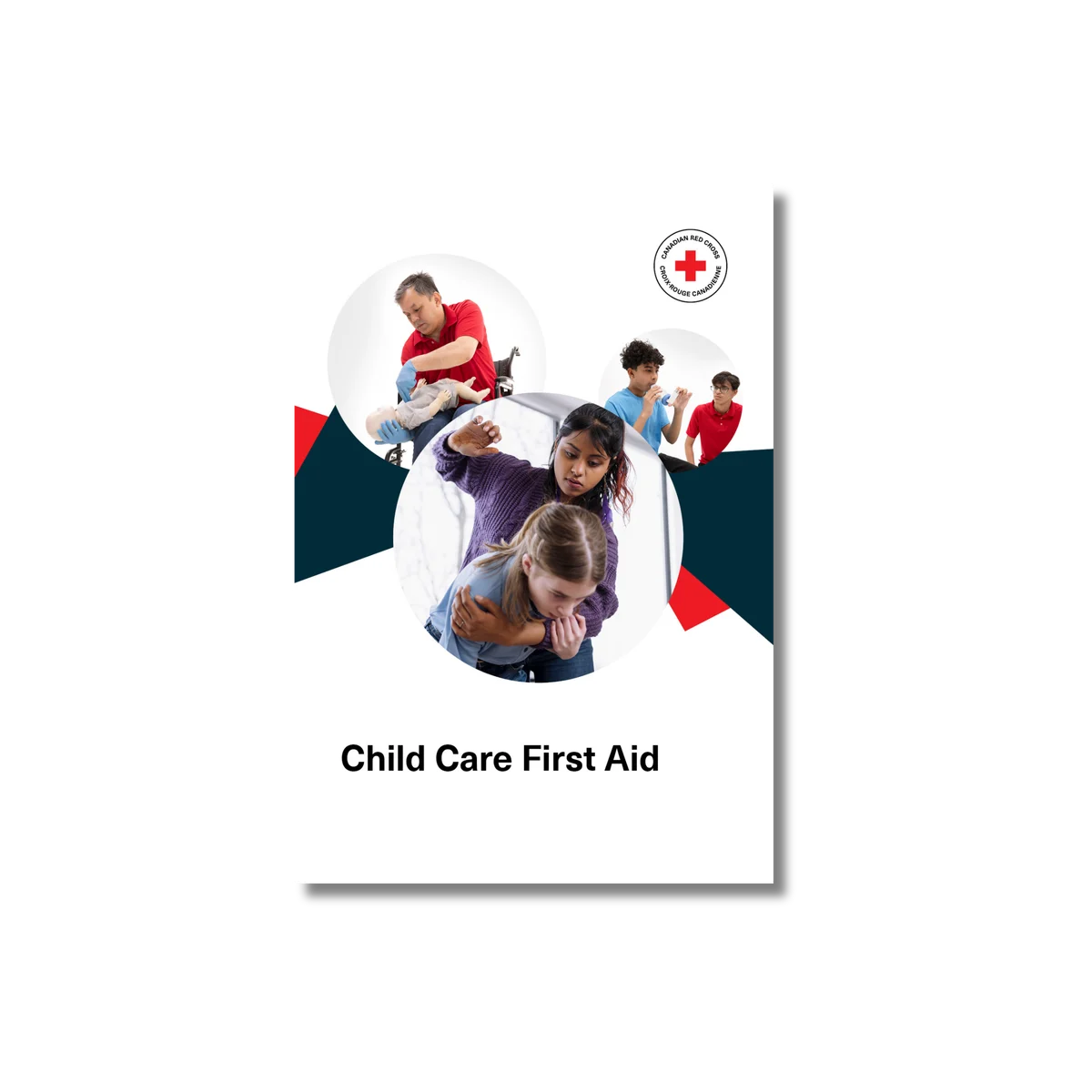
Canadian Red Cross Child Care First Aid Manual
$35.96 (10% off when you add it while registering)
$39.95Add it when you registerSee what this book covers
Bought on its own from the shop, it ships to you at full price. The discount exists only at registration.
Ready to take this course?$180.00 + GST & applicable taxes
Common questions
- Does this course meet Alberta child care licensing requirements?
- We will not tell you that it does, and no training provider honestly can. First aid requirements for licensed child care in Alberta are set through provincial child care licensing and interpreted by your licensing officer, agency or employer. Send us the exact wording you were given and we will tell you honestly whether this course matches it, including when the answer is that it does not.
- What CPR level is included, and is that the same as CPR-C?
- This course includes CPR at Level B. It is not the same as CPR-C, and it is not Basic Life Support. If the requirement you were handed names CPR-C or BLS specifically, check before you pay, because the level name is what a licensing officer or a hiring manager reads off the card.
- How long is the course, and how long does the certificate last?
- It runs about two days. The exact hours are set by the Canadian Red Cross and can change, so confirm the hours published with the run you are booking before you arrange time off work. The certificate is the Canadian Red Cross Child Care First Aid and CPR certificate, currently valid for three years, with the exact expiry date set by the Red Cross and printed on the certificate you receive.
- Is there a minimum age, or do I need first aid experience first?
- The Canadian Red Cross lists no pre-course requirements for this course, so there is no minimum age and no prerequisite, and we do not apply a maximum age on any course we run. People do start from zero. If the learner is a young teen who babysits occasionally rather than a paid child care worker, contact us first, because a shorter youth-focused option may suit them better. There is one Delta rule that is not an age limit: anyone under 18 has to be registered by a parent or guardian, who accepts the registration policies on their behalf, and learners under 16 do not hold their own portal account.
- How is this different from the general workplace first aid course?
- This one is built around infants and children and carries CPR at Level B. The general workplace course is our Intermediate First Aid, which the Canadian Red Cross previously called Standard First Aid, and it is the broader two-day certificate that carries CPR-C. The name printed on the card is what gets read later, so check which one your requirement actually names before you choose by title.
- Can you teach it at our centre or day home agency instead?
- Yes. We deliver onsite at your own centre, school or agency anywhere in Alberta for an additional fee covering travel and instructor time, and we travel elsewhere in Canada and internationally on request. It is the same course with the same attendance and evaluation requirements. Tell us your group size, location and the window you are aiming at and we will tell you what is workable.
- What does it cost?
- We do not publish a figure here that could go stale. Dates for this course are not on the calendar yet, so contact us for the current per-seat price, what is included, and the refund and transfer terms, and we will confirm them in writing before you register. Onsite group delivery is quoted separately because it depends on group size, location and dates.
- What happens when my certificate expires?
- The expiry date is set by the Canadian Red Cross and printed on your certificate. We do not currently list a separate short recertification for Child Care First Aid, so do not assume a quick refresher will be available. Contact us before your expiry date and we will tell you the current renewal route, which is a far better position than calling us after it has lapsed.
- What is the difference between CPR-A, CPR-B, CPR-C and BLS?
- The letter tells you which age groups you are trained on. CPR-A covers adults: the lowest level there is, which is why it pairs with the short entry-level workplace course. CPR-B covers children and infants: offered inside the child care first aid courses rather than on its own. CPR-C covers adults, children and infants: the level most people are asked for, and the next one up from A. BLS (Basic Life Support) covers adults, children, infants and neonates: Basic Life Support CPR, also known as Healthcare Provider CPR, a professional level CPR course used by firefighters, nurses, paramedics, doctors and other healthcare workers. Broader is not automatically better for you, though. If a form names a specific letter, the letter printed on your certificate is what the person checking it will be looking for, so match the wording you were handed rather than assuming a higher level will be accepted in its place. This course carries CPR-B, covering children and infants.
- What counts as a baby, a child or an adult, and which ages does this course cover?
- This course carries CPR-B, which covers children and infants. The Canadian Red Cross 2025 standards set the age groups this way. A baby is under 1 year old. A child is 1 year old up to the onset of puberty. An adult is anyone from the onset of puberty on. Puberty does not happen on a set birthday, so you judge it on the person in front of you. A 13 year old who has started puberty gets adult CPR, and one who has not is still a child. For an AED, use child pads on a child up to the onset of puberty or under 55 pounds (about 25 kg), and baby pads on a baby if the AED has them. If baby pads are not there, use child or adult pads. If child pads are not there, use adult pads. The Red Cross says adult pads are safe on a child or a baby, so do not wait for the right size. If you are training for a specific person, tell us their age and we will tell you which course fits.
- Can I take this course if English isn't my first language?
- Yes. Our instructors teach in English, and live-translated classroom text is available for this course in supported languages. Contact us before registering to confirm that your language is available for your course.
- Can I register on the same day as the course?
- Online registration closes at 11:59 PM the night before an in-person course. If you need training today, call or text 825-883-3582 before class starts. We may be able to fit you in, depending on space and the instructor's approval. It is not guaranteed.
- Online registration is closed. Does that mean the course is full?
- No. Closed online only means the online booking window has ended. A seat may still be open, or open up if someone cancels. Call or text 825-883-3582 to check.
- What if I arrive late?
- Certification needs full attendance and every required skill. Arriving late can mean we cannot certify you that day. If you are running late, call or text as early as you can so we can tell you what is possible.
Where to go next
Ready to register?
Pick your cohort above, or start here and choose your dates on the registration page.
Cancellation, transfer, and refund terms are shown before payment and confirmed at registration. Not sure which course fits? Email us and we’ll help.
Sources
- On successful completion you receive a Canadian Red Cross Child Care First Aid & CPR certificate. Canadian Red Cross (verified 2026-07-23).
- Alberta's Childcare Licensing Handbook (facility-based programs) states that a minimum of one in every two primary staff members must hold an up-to-date first aid certificate acceptable to the Statutory Director, and that Child Care First Aid should be taken if available. Government of Alberta, Education and Childcare (verified 2026-08-08).
- The Canadian Red Cross First Aid Program Standards 2025 define a baby as newborn to 1 year of age, a child as 1 year old to the onset of puberty, and an adult as the onset of puberty and older. Canadian Red Cross (verified 2026-09-26).
- The Canadian Red Cross Comprehensive Guide for First Aid & CPR (2025) says pediatric AED pads should be used on children up to the onset of puberty or weighing less than 55 pounds, and that if pediatric pads are not available it is safe to use adult pads on a child or baby. Canadian Red Cross (verified 2026-09-26).
← All courses · Last reviewed 2026-08-08