
Basic First Aid with CPR-A is the entry-level certificate: one day, roughly seven hours, in person, almost all of it on your feet or on the floor.
Read more about this courseShow less
Most people looking for it still type Emergency First Aid into a search bar, and they are not wrong to, the Canadian Red Cross renamed the course, and the certificate you leave with now reads Basic First Aid. We run it in Calgary, with Leduc and greater Edmonton dates added when demand supports them, so ask us what is scheduled. It is taught by instructors who work as paramedics, firefighters and emergency professionals, and we deliver it onsite at your own workplace for an additional fee, in Alberta and further afield on request. Read the third section before you book, because Alberta employers often ask for the longer two-day course instead, and the two are easy to mix up. One quick rule that settles most of it: this course carries CPR at level A, which is adult CPR. If you were asked for CPR-C, the two-day Intermediate First Aid course is the one that carries it.
Course details
- Certificate
- Canadian Red Cross Basic First Aid & CPR
- Certificate valid for
- 3 years
- Issued by
- Canadian Red Cross
- Duration
- Approx. 7 hours (1 day)
- Prerequisites
- None
- CPR / BLS
- What is CPR-A?CPR-A covers adults only.Using an AED on an adult is part of it.It is the lowest level there is, which is why it pairs with the short entry-level workplace course.More about CPR levels
- Locations
- Calgary, AB, 1550 5 St SW #300
- Price
- $120.00 + GST & applicable taxes (charged at checkout for your province)
Ways to take this course
Choose one
- In person: one or two days at our location. Nothing to do online beforehand.
- How it runs
- One day in class. Nothing online.
- Class times
- 9:00 a.m. to 5:30 p.m.
- Whole course
- 7 hours
or
Blended: online theory on your own first, then the class day in person. There is no live online session, and the online part must be finished before you arrive.- How it runs
- Online on your own first, then one day in class.
- Class times
- 9:00 a.m. to 2:45 p.m.
- Whole course
- About 4 hours online, then the class day
The same course, the same certificate and the same standards.
Upcoming dates, choose your cohort
Filter the dates: one day, all in class with nothing to do at home, or online first, then one day in class after your online part (approx. 4 h online first).
The online part of the blended course must be finished before you come in.
CalgaryOct 19, 2026 · Calgary, AB, 1550 5 St SW #300
- In class Mon, Oct 19, 9:00 a.m. to 5:30 p.m., 7 hours
- Mon, Oct 19 · 9:00 a.m. to 5:30 p.m.in class
Registration closes October 18, 2026.
October 2026
SMTWTFS12345678910111213141516171819202122232425262728293031In person: 1 class day, nothing online
In person(no online sessions)
- 1 full day in class
CalgaryIn person: one or two days at our location. Nothing to do online beforehand.CalgaryOct 31, 2026 · Calgary, AB, 1550 5 St SW #300
- About 4 hours online first, at your own pace
- In class Sat, Oct 31, 9:00 a.m. to 2:45 p.m.
- Sat, Oct 31 · 9:00 a.m. to 2:45 p.m.in class
Registration closes October 30, 2026.
October 2026
SMTWTFS12345678910111213141516171819202122232425262728293031Blended: online at home first, then 1 class day
Blended course(online theory at home first, then in person)
- Online theory first, about 4 hours at home, finished before your class day.
- 1 full day in class
CalgaryBlended: online theory on your own first, then the class day in person. There is no live online session, and the online part must be finished before you arrive.CalgaryNov 28, 2026 · Calgary, AB, 1550 5 St SW #300
- About 4 hours online first, at your own pace
- In class Sat, Nov 28, 9:00 a.m. to 2:45 p.m.
- Sat, Nov 28 · 9:00 a.m. to 2:45 p.m.in class
Registration closes November 27, 2026.
November 2026
SMTWTFS123456789101112131415161718192021222324252627282930Blended: online at home first, then 1 class day
Blended course(online theory at home first, then in person)
- Online theory first, about 4 hours at home, finished before your class day.
- 1 full day in class
CalgaryBlended: online theory on your own first, then the class day in person. There is no live online session, and the online part must be finished before you arrive.Unsure if Basic First Aid is what you need?
Figure out what you need in under 30 seconds, with these simple questions.
- Answer a few questions
- See the course that fits and why
- Pick a date and register
- Become certified
I’m taking the training myselfFor my job, a job I want, school, or my own life.I’m arranging training for my staff or workplaceSee what your workplace needs, and the course for it.Basic and Intermediate First Aid both include CPR. A CPR course on its own does not include first aid.
CalgaryDec 5, 2026 · Calgary, AB, 1550 5 St SW #300
- About 4 hours online first, at your own pace
- In class Sat, Dec 5, 9:00 a.m. to 2:45 p.m.
- Sat, Dec 5 · 9:00 a.m. to 2:45 p.m.in class
Registration closes December 4, 2026.
December 2026
SMTWTFS12345678910111213141516171819202122232425262728293031Blended: online at home first, then 1 class day
Blended course(online theory at home first, then in person)
- Online theory first, about 4 hours at home, finished before your class day.
- 1 full day in class
CalgaryBlended: online theory on your own first, then the class day in person. There is no live online session, and the online part must be finished before you arrive.
What you’ll be able to do
- Size up an emergency scene, make it safe to approach, and decide whether 911 is needed now
- Check an unresponsive person and open and protect their airway
- Perform CPR at level A on an adult
- Start CPR without freezing on the parts people freeze on, and keep going until help takes over
- Clear an airway obstruction in a choking adult, child or infant
- Control serious bleeding with the materials that are actually in the room
- Recognize shock early and keep a patient as stable as you can until help arrives
- Give arriving paramedics a short, ordered account of what happened and what you did
Ready to take this course?$120.00 + GST & applicable taxes
Emergency First Aid and Basic First Aid are the same course
The Canadian Red Cross renamed Emergency First Aid to Basic First Aid when it restructured the names of its first aid levels. Nothing about where the course sits changed. It is still the short, entry-level certificate with CPR included, one step below the general-purpose two-day course and several steps below the responder-level programs. We list both names on this page because both names are still in daily use and because people search for the old one far more often than the new one.
The rename causes more trouble than a rename should, and it is worth being blunt about why. Your employer's safety binder, a job posting, a volunteer coordinator's checklist or a school handout may still say Emergency First Aid, or EFA. The card you receive from us will say Basic First Aid. Those are the same thing, and if someone questions it, send them the certificate and tell them it is the current Canadian Red Cross name for that level. If it is a hard requirement with a deadline attached, get written confirmation from whoever set the requirement before you register rather than after you have spent the day.
There is a second confusion built into the new name, and it catches people every week. Basic First Aid is not Basic Life Support. They share a word and nothing else. Basic Life Support is provider-level CPR for clinical and professional responder roles, it carries a different certificate and a different renewal clock, and if your employer's wording says BLS then this page is not the course you are looking for. Book the wrong one and you lose the day and the fee.
The rest of the ladder moved too, which is why nothing you were told a few years ago quite matches what you see now. The course that used to be Standard First Aid is now called Intermediate First Aid. So if you are holding an instruction that names Emergency First Aid or Standard First Aid, you are reading old vocabulary against a new catalogue. Work out which level is actually being asked for before you pick a date.
What one day actually looks like
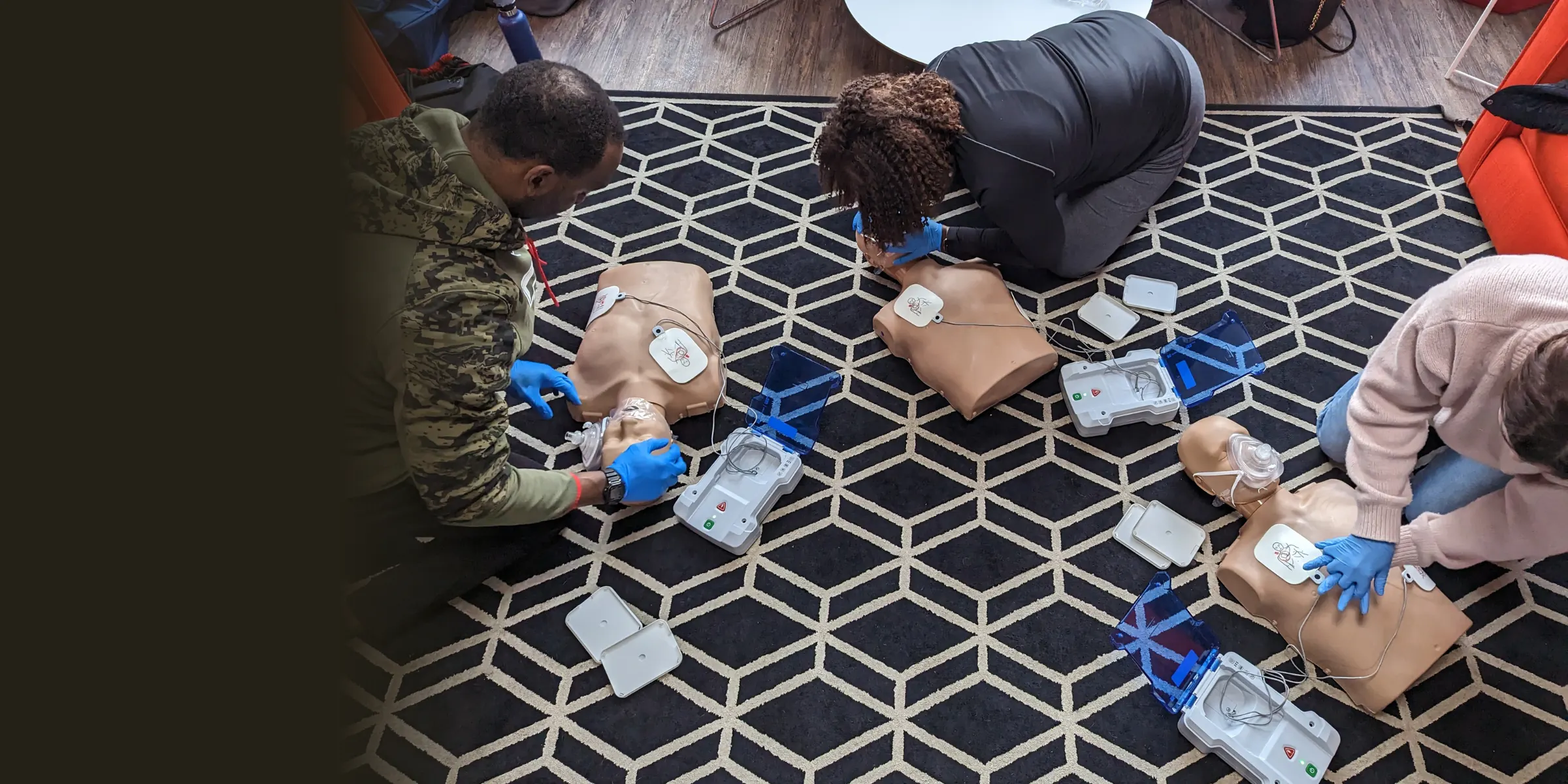
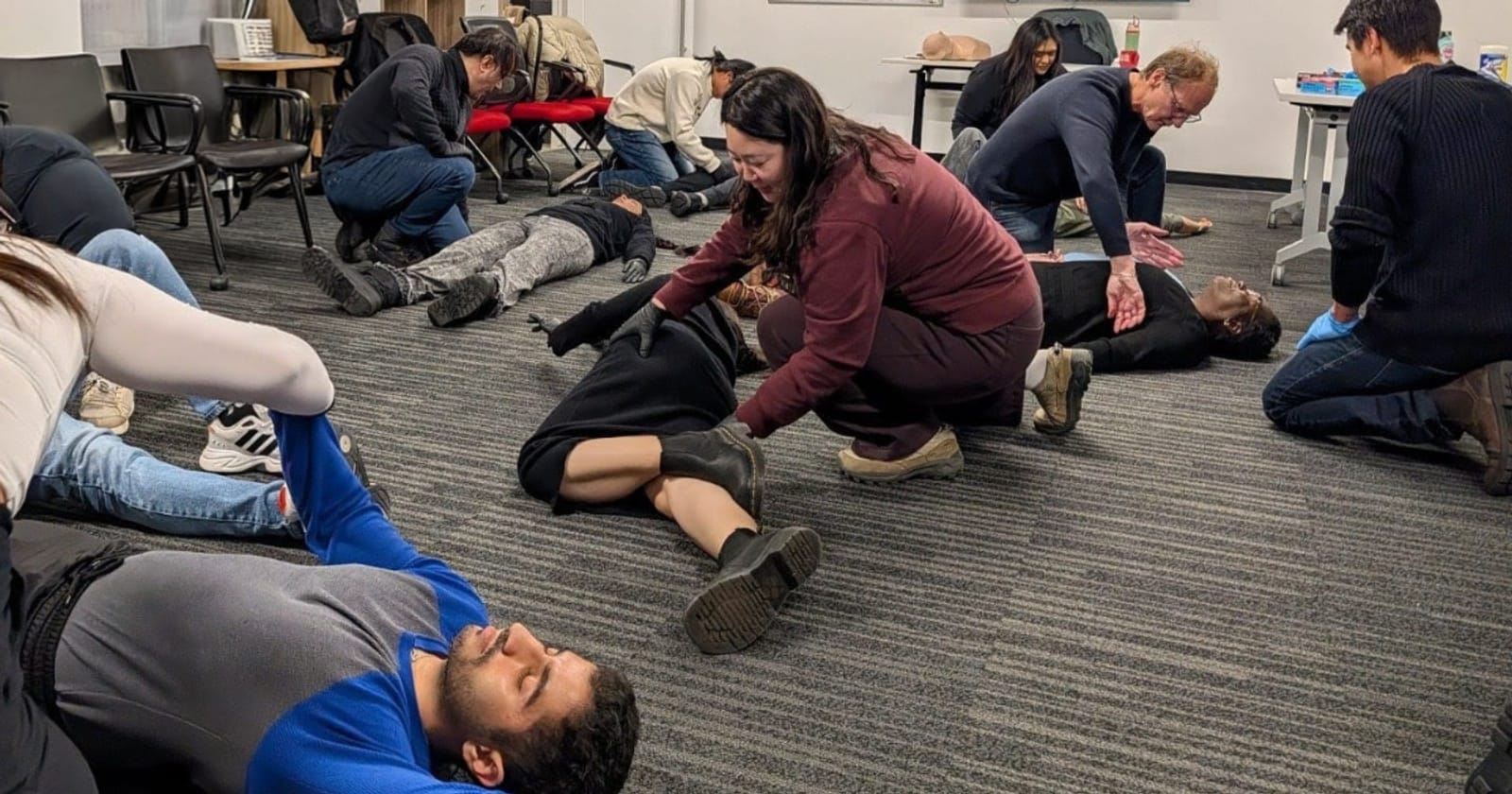
This is a single in-person day of roughly seven hours, and it is a working day rather than a lecture. Expect to be down on the floor with a manikin for a large part of it, expect your knees to know about it afterwards, and expect to do each skill more than once. Seven hours sounds like plenty until you are in it. It is enough time to make the core skills automatic and not much more, which is exactly the trade you are making when you choose the short course. Hours are set by the Canadian Red Cross and can change, so the exact hours and start time are published with each date under Upcoming dates, and the ones on the date you pick are the ones that hold.
The shape of the day is the first few minutes of an emergency, drilled until the sequence is automatic rather than something you have to think your way through. The Canadian Red Cross owns this curriculum and sets its content and order, so we are not going to publish our own version of their lesson list here. If a safety manager or a hiring file needs the current official outline, ask us and we will point you at the official Red Cross course description, which is the only version that stays current.
CPR at level A is part of the course, so you are not booking or paying for CPR separately. Level A is adult CPR, and it is the lowest of the CPR levels. That pairing is deliberate rather than a compromise: Basic First Aid is the shortest workplace first aid course we run, and it carries the lowest CPR level on purpose. If you were told to get a minimum, this is the minimum. Whether it is the minimum YOUR employer will accept is their call, not ours. If what you need is adult, child and infant CPR, that is level C, and the route to it is the two-day Intermediate First Aid course rather than this one. If your requirement names an AED specifically, send us the exact wording before you book: we will confirm what the current Red Cross version of this course includes, and if AED is the whole of what you were asked for, the CPR-A and AED session carries it on the certificate itself. And to say it once more, because it is the single most expensive mistake made on this page: no level of CPR is Basic Life Support.
What our instructors add is the part a manual cannot. They work as paramedics, firefighters and emergency professionals, and owner Jarrett Chisholm is an Advanced Care Paramedic. So when somebody asks what compressions really feel like on a real chest, or what an arriving crew wants to hear first, or whether it is worth starting CPR when you are not certain, the answer comes from someone who has been in the room. On a one-day course that context is most of the value.
The honest part: a lot of workplaces want the longer course
We would rather say this early than take your money for the wrong day. Basic First Aid is the shorter course, and the two-day level, Intermediate First Aid, which people still call Standard First Aid, is the one we are regularly asked about by people whose paperwork turned out to name it. If you are a designated first aid attendant, if your site has any real hazard to it, or if the instruction you were given did not specify a level, the two-day course may well be what is actually wanted. Booking this one and discovering that later costs you the fee, the day off, and the start date you were trying to hit.
So read the wording you were given, and read it literally. If it names Emergency First Aid or Basic First Aid, you are on the right page. If it names Standard First Aid, Intermediate First Aid, a number of hours in the teens, or two days, you are not. If it names BLS, healthcare provider CPR, or anything with the word provider in it, you want Basic Life Support. If it names Advanced First Aid or a responder-level certificate, this course is nowhere near it.
A few other mismatches come up often enough to list. Licensed child care often has its own wording and there is a child care specific version of the training, so check with your licensing body or employer before booking anything general. Clinical and care-facing roles often name provider-level CPR rather than a general first aid course. Industrial, remote and camp work often names something considerably longer, because the gap between your hands and a hospital is the thing that sets the requirement, but only the body that wrote your requirement can tell you.
Where Basic First Aid does fit cleanly: a lower-risk workplace that has specified the entry level, a volunteer or coaching role that asks for a current certificate without naming a level, a household that wants the core skills, or someone who needs to be certified quickly and has confirmed the short course is acceptable. If you are not certain which of those describes you, send us the exact wording you were given. We will read it and tell you honestly which course it points to, including when the answer is that this is not the right course, or that a cheaper one would have done.
Cost, certification, and what happens to the certificate
Tuition is $120 plus GST at the time of writing. Treat that as a reference figure rather than a final price: confirm the current amount, what is included with it, and the refund and transfer terms at registration or with us directly before you pay. The same goes for the schedule. Dates and daily start times are published with each scheduled run, and if nothing is listed yet for the window you need, or you are asking about Leduc and the greater Edmonton area, tell us what you need and we will say what is workable rather than leaving you guessing.
Attending is not the same as being certified, and on a one-day course that distinction bites harder than it does on a long one. Certification requires full attendance and an evaluated performance of the required skills in front of an instructor. There is no spare afternoon to make up a missed hour. If something comes up, tell us as early as you can and we will work out how you finish properly. We will not sign off on skills someone did not demonstrate, because a card that overstates what you can do is worse than no card at all.
The Canadian Red Cross sets the validity period and prints the expiry on the certificate itself, so the date on your card is the date that counts. It currently runs three years. Put that expiry in your calendar the week you finish, with a reminder a few months ahead, because first aid cards have a habit of being fine right up until the morning someone asks to see one. To renew, book Basic First Aid Recertification, a class of about four hours, on a date before your expiry. It is only for a certificate that has not expired yet. Once the date passes, the Red Cross does not allow a recertification and this full course is the way back.
Register with your legal name spelled the way an employer or a hiring file will expect to see it, and use an email address you actually read, since that is where your certificate details go. Correcting a misspelled name afterwards takes considerably longer than typing it carefully once.
Employers, schools and volunteer requirements: confirm before you pay
We will not tell you that this course satisfies your particular workplace, regulatory or school requirement, and you should be wary of any training provider that does. Requirements in Alberta come from a mix of occupational health and safety rules, industry practice, prime contractors and individual employers, and what counts as adequate coverage on a given site depends on the hazards, the crew size and how far that site is from medical care. The body that wrote your requirement is the only one that can tell you what meets it.
When you ask them, ask for four specific things: the exact course name they will accept, the CPR level required, whether a particular certifying body is required, and how many hours or days the course must be. Those four answers settle it every time. Get them in writing if a job offer, a contract or a start date depends on the outcome.
Schools, colleges and volunteer organisations work the same way. Some name a level, some name only a certificate, and some require the certificate to still be valid on a particular date rather than merely to exist. Check the page for your exact program and your exact intake year, and confirm with the admissions or volunteer office, because these details change quietly between cycles.
As a pathway, Basic First Aid is the first rung and it stacks sensibly. Plenty of people take it, use it, and later move up to the two-day Intermediate level when a new role asks for more, or add provider-level CPR alongside it. Nothing here is wasted if you go further later. It is only wasted if you buy it instead of the thing you were actually asked for, which is the entire reason this page keeps saying so.
Booking a seat, what to bring, and who can take it
There is no prerequisite. The Canadian Red Cross First Aid Program Standards list the pre-course requirements for this course as none, so you can arrive with no previous training at all, and no first aid certificate is expected of you. On age: no minimum age is published for this course, and none of our courses carries a maximum age. If you are booking for a young person and want to know whether the day will suit them, ask us and we will give you a straight answer rather than a policy.
Come dressed to work. Long trousers you do not mind getting dusty, closed shoes, hair tied back, and layers, because training rooms run hot or cold depending on the venue. Bring water, bring lunch or have a plan for it, and bring a pen. You will be kneeling, leaning over a manikin and getting up off the floor repeatedly, and doing that in office clothes is a long day.
Tell us in advance about anything that affects how you take part: a back, knee or shoulder injury, pregnancy, a mobility or hearing consideration, or if English is not your first language. CPR is genuinely physical and the required skills still have to be demonstrated, but the pace, the positioning and the way we demonstrate things are all adjustable. It is far easier to plan for that before the day than to improvise at two in the afternoon with a full room.
For groups, we bring the course to you. Onsite delivery runs at your own workplace in Calgary, in Leduc and the greater Edmonton region, elsewhere in Canada, and internationally on request, and it carries an additional fee that covers travel and instructor time. It is quoted per booking rather than per seat, since the cost depends on group size, location and dates. Send us your headcount and the window you are trying to hit and we will put a number to it.
A pocket mask that goes home with you
Your fee includes a hard-shell pocket mask: the real clamshell mouth-to-mask device, with the one-way filter valve, the elastic strap and the case. It comes out of its packaging in class, you train with it on the manikins, and then it goes home with you.
Nobody hands you a mask another class used and wiped down. Yours is new, and after the course it lives wherever you might one day need it: the kitchen drawer, the glovebox, the first aid kit at work.
Who this course is for
- Office, retail and other lower-risk Calgary workplaces filling their first aid coverage
- Parents, grandparents and caregivers who want the core skills without giving up two days
- Volunteers, coaches and community group leaders asked to hold a current certificate
- New hires with a start date approaching and a certificate to produce quickly
- Small-business owners certifying themselves or one or two staff
- People whose old entry-level first aid card has expired and who need it back
- Anyone who wants to be useful in the first five minutes rather than watch someone else act
- Leduc and greater Edmonton people asking us to bring a date or an onsite booking closer to home
English isn’t your first language?
Our instructors teach in English, with live-translated classroom text available in supported languages. You can follow explanations on screen while participating in the same hands-on training as the rest of the class.
Because translated explanations require additional reading and processing time, your instructor may occasionally pause before moving to the next topic. This can make the instructional pace slightly slower.
Optional preparation materials may also be available before class to help you become familiar with common English first aid terminology.
Languages are confirmed course by course, so none is guaranteed until we confirm it with you.
Contact us before registering to confirm that your preferred language is available for your course.
Related reading
- Check, Call, Care: What the Three Steps Actually MeanCheck, Call, Care is the emergency action framework taught in Canadian first aid. What each step really asks of you, in order, and why the order is the point.
- The First Minute of an Emergency Decides More Than You ThinkMost of what goes right or wrong at an emergency happens before anyone touches the patient. What the first minute asks of you, and what this week covers.
- What to Say When You Call 911 for Chest Pain or StrokeDispatchers work to a script. Give them the information in the order they need it and the ambulance moves sooner. Here is that order.
Where we teach this course
Public sessions run in Calgary.
We also deliver this course at your worksite for groups, useful for crews who can’t release staff to travel. Onsite delivery carries an additional fee on top of per-person pricing. Request an onsite quote.
We travel for private and group training across Canada, and internationally by arrangement. If you’re outside Alberta, tell us where you are and we’ll price it.
Ready to take this course?$120.00 + GST & applicable taxes
Common questions
- Is Basic First Aid the same as Emergency First Aid?
- Yes. The Canadian Red Cross renamed Emergency First Aid to Basic First Aid, and it is the same level of course: about one day, CPR-A included. Your certificate will carry the new name while much of the paperwork out there still uses the old one. If a formal requirement names Emergency First Aid specifically, that is this course, but confirm with whoever set the requirement if a deadline depends on it.
- Is Basic First Aid the same thing as Basic Life Support?
- No, and it is a mix-up we see regularly. Basic Life Support is provider-level CPR aimed at clinical and professional responder roles, with its own certificate and its own renewal cycle. Basic First Aid is a general first aid course that includes CPR-A, which is adult CPR. If your employer's wording says BLS or healthcare provider CPR, you need the Basic Life Support course, not this one.
- How long is the course, and what does it cost?
- It runs as a single in-person day of roughly seven hours. Tuition is $120 plus GST at the time of writing, which you should treat as a reference figure and confirm at registration along with what is included and the refund and transfer terms. Hours are set by the Canadian Red Cross and can change, so the exact hours and start time are published with each date under Upcoming dates, and the ones on the date you pick are the ones that hold.
- Is CPR included, or do I book that separately?
- CPR at level A is included, so no separate CPR booking is needed. Level A covers adults. It is the lowest CPR level there is, which is the point of this course: the shortest workplace first aid course, paired with the smallest CPR component that exists. If you need children and infants covered too, that is level C, and it comes with the two-day Intermediate First Aid course. If all you were actually asked for is CPR, or CPR with an AED named specifically, send us the wording: a shorter CPR and AED session may be the cheaper answer, and we will confirm what each one covers before you pay for either.
- Should I take this or the two-day course?
- If the requirement names Emergency First Aid or Basic First Aid, this is the level it is pointing at, confirm that in writing with whoever set the requirement if a job or a start date depends on it. If it names Standard First Aid, Intermediate First Aid, two days, or a number of hours in the teens, take the longer course instead. When the instruction does not specify a level at all, do not guess: send us the exact wording and we will tell you which course it points to.
- Will this certificate meet my employer's or my school's requirement?
- We cannot confirm that, and no training provider honestly can, because the body that set your requirement is the one that decides what meets it. Ask your employer, safety officer or school for four things: the exact course name accepted, the CPR level, whether a specific certifying body is required, and the required hours or days. Send us their answer and we will tell you honestly whether this course matches it, including when it does not.
- How long is the certificate valid, and how do I renew it?
- The Canadian Red Cross sets the validity period and prints the expiry date on the certificate itself, and it currently runs three years. While it is still current you can renew it with Basic First Aid Recertification, a class of about four hours. After the expiry date that is no longer allowed, and you take this full course again. Many people use the renewal point to move up to the two-day level instead.
- Is there a minimum age or any prerequisite?
- No prerequisite. The Canadian Red Cross First Aid Program Standards list the pre-course requirements for this course as none, so no previous training or certificate is expected. No minimum age is published for this course, and none of our courses has a maximum age. If you are booking for a younger student, contact us and we will tell you plainly whether the day is likely to suit them.
- What is the difference between CPR-A, CPR-B, CPR-C and BLS?
- The letter tells you which age groups you are trained on. CPR-A covers adults: the lowest level there is, which is why it pairs with the short entry-level workplace course. CPR-B covers children and infants: offered inside the child care first aid courses rather than on its own. CPR-C covers adults, children and infants: the level most people are asked for, and the next one up from A. BLS (Basic Life Support) covers adults, children, infants and neonates: Basic Life Support CPR, also known as Healthcare Provider CPR, a professional level CPR course used by firefighters, nurses, paramedics, doctors and other healthcare workers. Broader is not automatically better for you, though. If a form names a specific letter, the letter printed on your certificate is what the person checking it will be looking for, so match the wording you were handed rather than assuming a higher level will be accepted in its place. This course carries CPR-A, covering adults.
- What counts as a baby, a child or an adult, and which ages does this course cover?
- This course carries CPR-A, which covers adults. The Canadian Red Cross 2025 standards set the age groups this way. A baby is under 1 year old. A child is 1 year old up to the onset of puberty. An adult is anyone from the onset of puberty on. Puberty does not happen on a set birthday, so you judge it on the person in front of you. A 13 year old who has started puberty gets adult CPR, and one who has not is still a child. For an AED, use child pads on a child up to the onset of puberty or under 55 pounds (about 25 kg), and baby pads on a baby if the AED has them. If baby pads are not there, use child or adult pads. If child pads are not there, use adult pads. The Red Cross says adult pads are safe on a child or a baby, so do not wait for the right size. If you are training for a specific person, tell us their age and we will tell you which course fits.
- Can I take this course if English isn't my first language?
- Yes. Our instructors teach in English, and live-translated classroom text is available for this course in supported languages. Contact us before registering to confirm that your language is available for your course.
- Can I register on the same day as the course?
- Online registration closes at 11:59 PM the night before an in-person course. If you need training today, call or text 825-883-3582 before class starts. We may be able to fit you in, depending on space and the instructor's approval. It is not guaranteed.
- Online registration is closed. Does that mean the course is full?
- No. Closed online only means the online booking window has ended. A seat may still be open, or open up if someone cancels. Call or text 825-883-3582 to check.
- What if I arrive late?
- Certification needs full attendance and every required skill. Arriving late can mean we cannot certify you that day. If you are running late, call or text as early as you can so we can tell you what is possible.
Where to go next
Ready to register?
Pick your cohort above, or start here and choose your dates on the registration page.
Cancellation, transfer, and refund terms are shown before payment and confirmed at registration. Not sure which course fits? Email us and we’ll help.
Sources
- On successful completion you receive a Canadian Red Cross Basic First Aid & CPR certificate. Canadian Red Cross (verified 2026-07-23).
- The Canadian Red Cross First Aid Program Standards 2025 define a baby as newborn to 1 year of age, a child as 1 year old to the onset of puberty, and an adult as the onset of puberty and older. Canadian Red Cross (verified 2026-09-26).
- The Canadian Red Cross Comprehensive Guide for First Aid & CPR (2025) says pediatric AED pads should be used on children up to the onset of puberty or weighing less than 55 pounds, and that if pediatric pads are not available it is safe to use adult pads on a child or baby. Canadian Red Cross (verified 2026-09-26).
← All courses · Last reviewed 2026-07-23