
CPR-C is the broadest CPR certification we run: adult, child and infant CPR, plus using an automated external defibrillator.
Read more about this courseShow less
It is taught in person in Calgary, and in Leduc for the greater Edmonton region, by instructors who work as paramedics, firefighters and emergency professionals, and we deliver it onsite at your workplace for an additional fee. If somebody told you to get CPR certified and did not say which level, this is almost always the one they meant.
Course details
- Certificate
- Canadian Red Cross CPR Level C & AED
- Certificate valid for
- 3 years
- Issued by
- Canadian Red Cross
- Duration
- Approx. 5 hours
- Prerequisites
- None
- CPR / BLS
- CPR-C / AEDWhat is CPR-C?CPR-C covers adults, children and babies.Using an AED is part of it.It is the level most people are asked for, and the next one up from A.More about CPR levels
- Recertification
- You are welcome to renew earlier. The Red Cross encourages more frequent training for skill retention, and some employers, colleges and registration bodies require it.
- Locations
- Calgary, AB, 1550 5 St SW #300
- Price
- $100.00 + GST & applicable taxes (charged at checkout for your province)
Ways to take this course
Choose one
- In person: one or two days at our location. Nothing to do online beforehand.
- How it runs
- One day in class. Nothing online.
- Class times
- 9:00 a.m. to 3:00 p.m.
- Whole course
- 5 hours
or
Blended: online theory on your own first, then the class day in person. There is no live online session, and the online part must be finished before you arrive.- How it runs
- Online on your own first, then one day in class.
- Class times
- 9:00 a.m. to 12:30 p.m.
- Whole course
- About 3 hours online, then the class day
The same course, the same certificate and the same standards.
Upcoming dates, choose your cohort
Filter the dates: one day, all in class with nothing to do at home, or online first, then one day in class after your online part (approx. 3 h online first).
The online part of the blended course must be finished before you come in.
CalgaryOct 19, 2026 · Calgary, AB, 1550 5 St SW #300
- In class Mon, Oct 19, 9:00 a.m. to 3:00 p.m., 5 hours
- Mon, Oct 19 · 9:00 a.m. to 3:00 p.m.in class
Registration closes October 18, 2026.
October 2026
SMTWTFS12345678910111213141516171819202122232425262728293031In person: 1 class day, nothing online
In person(no online sessions)
- 1 full day in class
CalgaryIn person: one or two days at our location. Nothing to do online beforehand.CalgaryOct 31, 2026 · Calgary, AB, 1550 5 St SW #300
- About 3 hours online first, at your own pace
- In class Sat, Oct 31, 9:00 a.m. to 12:30 p.m.
- Sat, Oct 31 · 9:00 a.m. to 12:30 p.m.in class
Registration closes October 30, 2026.
October 2026
SMTWTFS12345678910111213141516171819202122232425262728293031Blended: online at home first, then 1 class day
Blended course(online theory at home first, then in person)
- Online theory first, about 3 hours at home, finished before your class day.
- 1 full day in class
CalgaryBlended: online theory on your own first, then the class day in person. There is no live online session, and the online part must be finished before you arrive.CalgaryNov 28, 2026 · Calgary, AB, 1550 5 St SW #300
- About 3 hours online first, at your own pace
- In class Sat, Nov 28, 9:00 a.m. to 12:30 p.m.
- Sat, Nov 28 · 9:00 a.m. to 12:30 p.m.in class
Registration closes November 27, 2026.
November 2026
SMTWTFS123456789101112131415161718192021222324252627282930Blended: online at home first, then 1 class day
Blended course(online theory at home first, then in person)
- Online theory first, about 3 hours at home, finished before your class day.
- 1 full day in class
CalgaryBlended: online theory on your own first, then the class day in person. There is no live online session, and the online part must be finished before you arrive.Unsure if CPR-C & AED is what you need?
Figure out what you need in under 30 seconds, with these simple questions.
- Answer a few questions
- See the course that fits and why
- Pick a date and register
- Become certified
I’m taking the training myselfFor my job, a job I want, school, or my own life.I’m arranging training for my staff or workplaceSee what your workplace needs, and the course for it.Basic and Intermediate First Aid both include CPR. A CPR course on its own does not include first aid.
CalgaryDec 5, 2026 · Calgary, AB, 1550 5 St SW #300
- About 3 hours online first, at your own pace
- In class Sat, Dec 5, 9:00 a.m. to 12:30 p.m.
- Sat, Dec 5 · 9:00 a.m. to 12:30 p.m.in class
Registration closes December 4, 2026.
December 2026
SMTWTFS12345678910111213141516171819202122232425262728293031Blended: online at home first, then 1 class day
Blended course(online theory at home first, then in person)
- Online theory first, about 3 hours at home, finished before your class day.
- 1 full day in class
CalgaryBlended: online theory on your own first, then the class day in person. There is no live online session, and the online part must be finished before you arrive.
What you’ll be able to do
- Recognize cardiac arrest in an adult, a child and an infant, and act
- Deliver compressions with the right depth, rate and technique for each age
- Adjust rescue breathing across adult, child and infant patients
- Use an AED, including where the pads go on a small patient
- Direct a bystander to call 911 and bring the AED while you keep working
- Keep good CPR going past the point where one person tires
- Use your own pocket mask instead of improvising barrier protection
- Hand over cleanly to paramedics and tell them what they need to know
Ready to take this course?$100.00 + GST & applicable taxes
Level C is the one most people actually need
CPR Level C covers adults, children and infants. Level A covers adults only. That single difference decides which course you should be sitting in, and the letter on your certificate is what an employer, a licensing body or a sports organization reads. The Canadian Red Cross defines the levels, not us.
If a child or a baby could ever be the person in front of you, Level C is your course. Parents and grandparents, teachers and education assistants, coaches, day home and child care staff, babysitters, camp and swim staff, and anybody working somewhere the public walks in with a stroller: compressions on a small child and on an infant are not the same technique as compressions on an adult, and rescue breathing is different again.
If your world is genuinely adults only, a machine shop, a warehouse crew, an adult-only worksite, Level A exists for exactly that, and we would rather you read its page than sit through infant skills you were never asked for. When the wording you were given says nothing more specific than CPR certified, ask the person who wrote it which level, or send it to us and we will read it with you.
What practising it is actually like
Because this is a Canadian Red Cross course, the Red Cross owns the curriculum and we teach to their standard, so we are not going to reprint their lesson list here. What is ours to describe is the room. You are on the floor, on your knees, over a manikin, for longer than most people expect, and you do it again after you have done it once. Nobody learns this from watching.
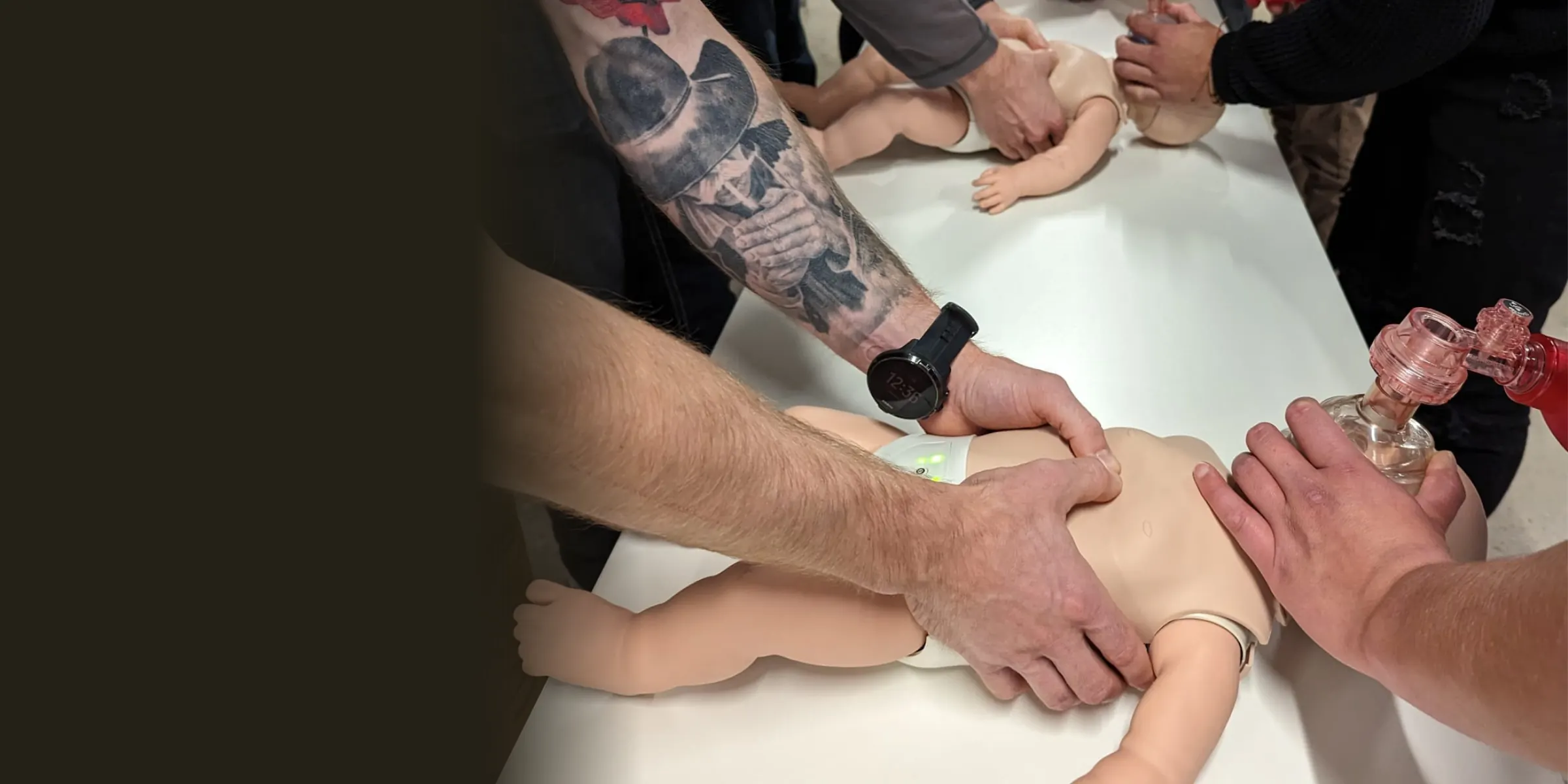
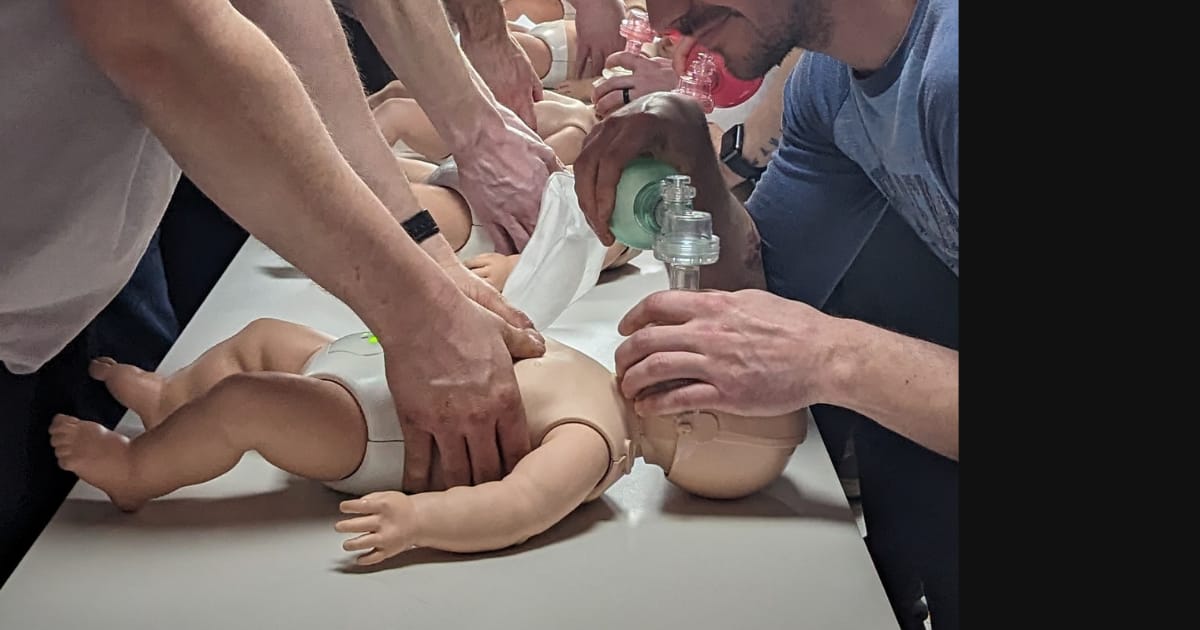
You work across the full range: adult manikins, child-sized technique, and infant manikins that fit along your forearm. The transitions between them are where most people discover what they did not know, and the transitions are exactly what gets practised until they stop feeling strange.
What Delta adds is context from people who have run real cardiac arrests. Our instructors work as paramedics, firefighters and emergency professionals, so the scenarios run the way calls actually go: an awkward spot on a hard floor, a bystander who wants to help but does not know how, a phone on speaker, and a patient who does not look like a clean classroom demonstration.
A pocket mask that goes home with you
Your fee includes a hard-shell pocket mask: the real clamshell mouth-to-mask device, with the one-way filter valve, the elastic strap and the case. It comes out of its packaging in class, you train with it on the manikins, and then it goes home with you.
Nobody hands you a mask another class used and wiped down. Yours is new, and after the course it lives wherever you might one day need it: the kitchen drawer, the glovebox, the first aid kit at work.
Who this suits, and who should book something else
Level C fits anyone whose life includes children, and anyone whose employer or organization asked for CPR without naming a level. It is the default answer for coaches, teachers, child care staff, new parents and grandparents, and the person at work who volunteered to be the one who knows what to do.
Book something else in two cases. If the wording you were given includes first aid, bleeding, burns, breaks, medical emergencies, then a CPR-only course will not cover it, and the Intermediate First Aid course has CPR-C built in already. If the wording says Basic Life Support or health care provider CPR, that is a different certificate aimed at people working in health care, and the BLS page is where to look.
We would rather have that conversation before you register than after. Send us the exact sentence you were given and we will tell you honestly which course it points at.
How the certificate works
Certification is not automatic. You attend the full course and demonstrate the skills to the instructor, on the floor, to the Red Cross standard. Nobody is passed on attendance alone, and that is deliberate: the certificate is meant to mean that somebody watched you do it properly.
What you receive is a Canadian Red Cross CPR Level C & AED certificate. The validity period is set by the Canadian Red Cross and printed on the certificate itself, so read the date the day you get it and put a reminder in your calendar a few months ahead. Renewing before the date passes is always simpler than letting it lapse.
Register with your legal name spelled exactly the way an employer will expect to see it. That spelling is what gets printed, and correcting it afterwards takes considerably longer than typing it carefully the first time.
Registering, and what to bring
Come dressed to work on the floor: clothing you can kneel and lean in, closed shoes, hair tied back. Compressions are physical, and you will be down over a manikin for a decent stretch of the session. Bring water and something to write with.
If you have an injury, a mobility limitation, a hearing consideration or anything else that changes how you take part, tell us when you register rather than on the day. We can plan around most things with notice and almost nothing on the spot.
If you are booking for a group, ask about onsite delivery. We bring the course to worksites and organizations in Calgary, in the Leduc and Edmonton region, elsewhere in Canada, and internationally on request, for an additional fee covering travel and setup.
Who this course is for
- Parents, grandparents and family caregivers with children in their lives
- Teachers, education assistants and school staff
- Coaches, referees and youth sports volunteers
- Day home, daycare and child care workers adding a current CPR certificate
- Camp counsellors, lifeguards and swim instructors
- Workplace first aid attendants whose role names CPR-C
- Anyone whose employer said get CPR certified without naming a level
- Leduc and greater Edmonton residents who would rather not drive to Calgary
English isn’t your first language?
Our instructors teach in English, with live-translated classroom text available in supported languages. You can follow explanations on screen while participating in the same hands-on training as the rest of the class.
Because translated explanations require additional reading and processing time, your instructor may occasionally pause before moving to the next topic. This can make the instructional pace slightly slower.
Optional preparation materials may also be available before class to help you become familiar with common English first aid terminology.
Languages are confirmed course by course, so none is guaranteed until we confirm it with you.
Contact us before registering to confirm that your preferred language is available for your course.
Related reading
- Find the Nearest AED Before You Need OneA defibrillator only helps if someone knows where it is. A ten-minute weekend job: find the AEDs closest to where you live, work and play, and check them.
- CPR Depth, Rate and Recoil: Why the Numbers MatterAt least 5 cm deep, 100 to 120 a minute, and a full release every time. What each number does inside the chest, and why tired rescuers drift off all three.
- Using an AED: What the Machine Does and What You DoAn AED talks you through every step and decides for itself whether a shock is needed. What happens when you open one, and the situations people worry about.
Where we teach this course
Public sessions run in Calgary, with dates in Leduc through the year.
We also deliver this course at your worksite for groups, useful for crews who can’t release staff to travel. Onsite delivery carries an additional fee on top of per-person pricing. Request an onsite quote.
We travel for private and group training across Canada, and internationally by arrangement. If you’re outside Alberta, tell us where you are and we’ll price it.
Ready to take this course?$100.00 + GST & applicable taxes
Common questions
- What is the difference between CPR-C and CPR-A?
- Level C covers adults, children and infants. Level A covers adults only. The Canadian Red Cross sets the levels, and the letter on your certificate tells an employer exactly which patients you were trained and evaluated on. If a child could ever be the person in front of you, take Level C.
- Is AED training included?
- Yes. Using an automated external defibrillator is part of the course, not an add-on, and the certificate you receive is a Canadian Red Cross CPR Level C & AED certificate.
- Do I need any experience or a previous certificate?
- No. There is no prerequisite, and no previous first aid or CPR certificate is required.
- My employer asked for first aid and CPR. Is this enough?
- Probably not on its own: this course is CPR and AED only. The Intermediate First Aid course includes CPR-C and covers the first aid side as well. Send us the exact wording you were given and we will tell you honestly which course it points at.
- How long is the certificate valid?
- The validity period is set by the Canadian Red Cross and printed on the certificate you receive, so read the expiry date the day it arrives and put a reminder in your calendar. When it gets close, get in touch and we will tell you the current renewal options.
- Is the course physically demanding?
- Honestly, yes. Compressions are hard physical work and you practise them across adult, child and infant manikins, on the floor. Tell us in advance about anything that affects how you take part and we will plan for it.
- Do we practise mouth-to-mouth on each other?
- No. There is no direct mouth-to-mouth contact between students. Ventilation skills are practised on manikins with barrier devices, and the pocket mask you train with is brand new and goes home with you.
- Can you run this at our workplace?
- Yes. We deliver onsite at client worksites for an additional fee covering travel and setup, across Alberta, elsewhere in Canada, and internationally on request. Send us your crew size, your location and the window you are aiming at.
- What is the difference between CPR-A, CPR-B, CPR-C and BLS?
- The letter tells you which age groups you are trained on. CPR-A covers adults: the lowest level there is, which is why it pairs with the short entry-level workplace course. CPR-B covers children and infants: offered inside the child care first aid courses rather than on its own. CPR-C covers adults, children and infants: the level most people are asked for, and the next one up from A. BLS (Basic Life Support) covers adults, children, infants and neonates: Basic Life Support CPR, also known as Healthcare Provider CPR, a professional level CPR course used by firefighters, nurses, paramedics, doctors and other healthcare workers. Broader is not automatically better for you, though. If a form names a specific letter, the letter printed on your certificate is what the person checking it will be looking for, so match the wording you were handed rather than assuming a higher level will be accepted in its place. This course carries CPR-C, covering adults, children and infants.
- What counts as a baby, a child or an adult, and which ages does this course cover?
- This course carries CPR-C, which covers adults, children and infants. The Canadian Red Cross 2025 standards set the age groups this way. A baby is under 1 year old. A child is 1 year old up to the onset of puberty. An adult is anyone from the onset of puberty on. Puberty does not happen on a set birthday, so you judge it on the person in front of you. A 13 year old who has started puberty gets adult CPR, and one who has not is still a child. For an AED, use child pads on a child up to the onset of puberty or under 55 pounds (about 25 kg), and baby pads on a baby if the AED has them. If baby pads are not there, use child or adult pads. If child pads are not there, use adult pads. The Red Cross says adult pads are safe on a child or a baby, so do not wait for the right size. If you are training for a specific person, tell us their age and we will tell you which course fits.
- Can I take this course if English isn't my first language?
- Yes. Our instructors teach in English, and live-translated classroom text is available for this course in supported languages. Contact us before registering to confirm that your language is available for your course.
- Can I register on the same day as the course?
- Online registration closes at 11:59 PM the night before an in-person course. If you need training today, call or text 825-883-3582 before class starts. We may be able to fit you in, depending on space and the instructor's approval. It is not guaranteed.
- Online registration is closed. Does that mean the course is full?
- No. Closed online only means the online booking window has ended. A seat may still be open, or open up if someone cancels. Call or text 825-883-3582 to check.
- What if I arrive late?
- Certification needs full attendance and every required skill. Arriving late can mean we cannot certify you that day. If you are running late, call or text as early as you can so we can tell you what is possible.
Where to go next
Ready to register?
Pick your cohort above, or start here and choose your dates on the registration page.
Cancellation, transfer, and refund terms are shown before payment and confirmed at registration. Not sure which course fits? Email us and we’ll help.
Sources
- The Canadian Red Cross First Aid Program Standards 2025 define a baby as newborn to 1 year of age, a child as 1 year old to the onset of puberty, and an adult as the onset of puberty and older. Canadian Red Cross (verified 2026-09-26).
- The Canadian Red Cross Comprehensive Guide for First Aid & CPR (2025) says pediatric AED pads should be used on children up to the onset of puberty or weighing less than 55 pounds, and that if pediatric pads are not available it is safe to use adult pads on a child or baby. Canadian Red Cross (verified 2026-09-26).
← All courses · Last reviewed 2026-07-23