
Standard First Aid with BLS is run for groups on request, such as fire departments, services and teams that need workplace first aid and provider-level CPR together. It is not on our public calendar.
Read more about this courseShow less
On your own, book Intermediate First Aid and a separate Basic Life Support session, which gives you both certificates. For a group, the combined course is the Intermediate First Aid course, currently 17 hours over two days, or 8.5 hours in the blended format, with the roughly four-hour Basic Life Support session attached, and there is no prerequisite. We confirm the exact combined schedule with you rather than quoting a single total here. We also run it in Leduc for the greater Edmonton region, deliver it onsite at your own worksite for an additional fee, and travel elsewhere in Canada and internationally on request. Instructors are working paramedics, firefighters and emergency professionals.
Course details
- Certificate
- Canadian Red Cross Standard First Aid with BLS
- Certificate valid for
- 3 years (BLS component 1 year)
- Issued by
- Canadian Red Cross
- Duration
- Approx. 2 days plus the BLS component
- Format
- In-person or blended (Calgary)
- Prerequisites
- None
- CPR / BLS
- What is BLS?BLS is Basic Life Support CPR, also known as Healthcare Provider CPR. It covers adults, children, babies and neonates.It is a professional level CPR course, used by firefighters, nurses, paramedics, doctors and other healthcare workers.More about the ages this covers
- Price
- $220.00 + GST & applicable taxes (charged at checkout for your province)
Unsure if Standard First Aid with BLS is what you need?
Figure out what you need in under 30 seconds, with these simple questions.
- Answer a few questions
- See the course that fits and why
- Pick a date and register
- Become certified
Basic and Intermediate First Aid both include CPR. A CPR course on its own does not include first aid.
When this runs
We teach this course and run it regularly. There is no public date open right now, and we won’t show one until it’s real.
What you’ll be able to do
- Take charge of a scene safely, decide within seconds whether someone needs 911 now, and put untrained bystanders to useful work
- Deliver provider-level CPR on adults, children and infants, alone and in a two-rescuer sequence
- Ventilate with a pocket mask and a bag-valve mask, and judge chest rise rather than guessing at it
- Apply and operate an AED without opening long pauses in chest compressions
- Control serious bleeding and recognize shock early enough to act on it
- Respond to chest pain, stroke, seizures, diabetic emergencies and severe allergic reactions including auto-injector use
- Manage burns, wounds, suspected head and spine injuries, and bone and joint injuries with what is on hand
- Hand a patient over to arriving paramedics in a short, ordered report they can use
What Standard First Aid with BLS actually is
It is two things bought together. The first is Intermediate First Aid, the general-purpose workplace first aid level that most people mean when they say "get your first aid", scene management, a patient who is in real trouble, bleeding, breathing, medical emergencies, injuries. The second is Basic Life Support, the Canadian Red Cross provider-level CPR course. Taken separately they are two registrations, two fees, and a separate trip in for the BLS session, a little over four hours on its own, on top of the two first aid days. Taken here they are one booking, one instructor, one continuous run of training.
It is scheduled as the first aid days with the BLS session on top. For scale: Intermediate First Aid on its own currently runs 17 hours over two days, or 8.5 hours in the blended format, and Basic Life Support on its own is a little over four hours. The Canadian Red Cross sets those hour requirements and can change them, and this combined version is not currently on our public booking calendar, so check the exact hours, dates and daily start times published with the run you are booking before you arrange time off. There is no prerequisite and no previous first aid or CPR training assumed. We run it in person in Calgary, and in a blended format where the theory portion is completed online before an in-person skills component.
The certificate issued is the Canadian Red Cross Standard First Aid with BLS. The two halves of it do not expire together. The Red Cross sets the validity periods, currently three years for the first aid certification and one year for the BLS component, and the exact dates are printed on the certificate you receive, not decided by us. The shorter clock is the one people lose track of, and there is a section further down on how to keep on top of it.
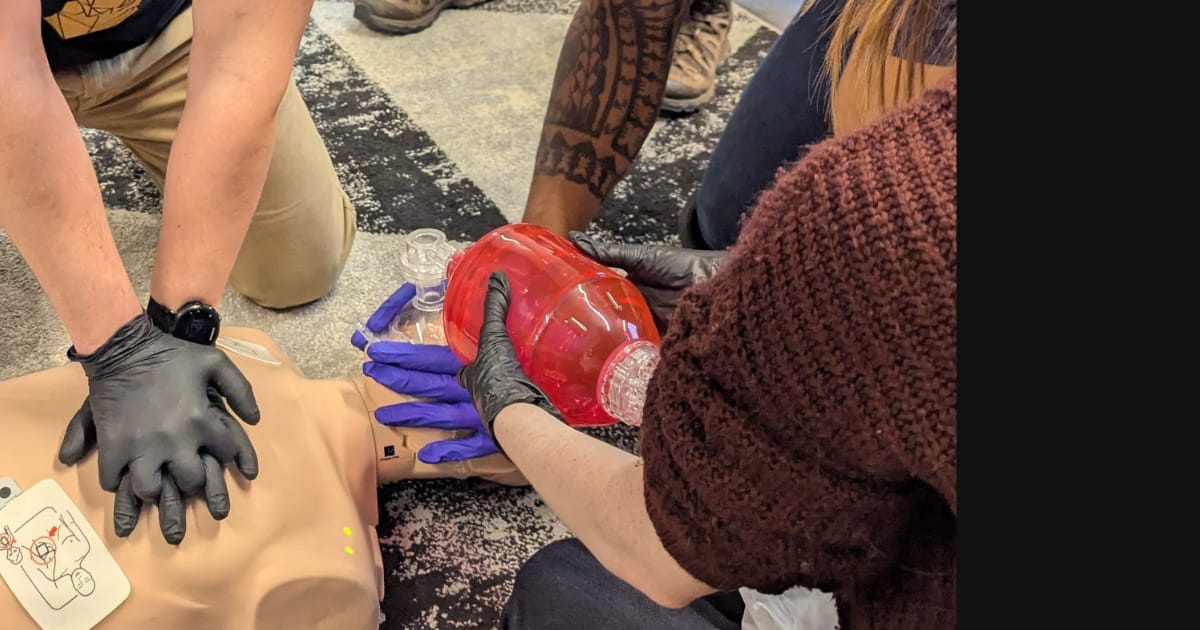
The Red Cross owns the curriculum and we teach to it. We are not going to reprint their lesson list on a marketing page. If you need the current official outline for a hiring file, a safety manager or a school admissions officer, ask us and we will point you at the official Red Cross course description rather than at our paraphrase of it. What we can describe is the shape of the room: hands on manikins, time on the floor, skills repeated until they hold up rather than demonstrated once.
CPR-C or BLS: the difference that decides which course you book
Almost every call we take about this course is the same question in different words. My employer wants CPR, is the CPR in a regular first aid course enough, or do I need BLS? It is worth answering properly, because the answer changes what you pay, how long you sit, and how often you come back.
CPR level C, usually written CPR-C, is the CPR taught inside the general first aid courses. It covers adults, children and infants, AED use and choking, and it is built for the situation where an emergency arrives without warning and you are the person who happens to be there. One rescuer, a pocket mask, a bystander you have to direct, and a five-to-ten-minute job before help arrives. If that is the level your paperwork names, Intermediate First Aid on its own includes it and is the shorter booking. Which level the wording actually points at is a question for whoever wrote the requirement, so send us their exact sentence and we will tell you.
Basic Life Support is the provider level. The underlying science is the same and the chest is the same chest, but the expectation is different: the arrest is yours to manage until EMS takes it off you, and you are expected to do it with equipment and with other trained people. That means two-rescuer sequences, a bag-valve mask as well as a pocket mask, pulse checks, planned compressor changes, and a hard discipline about keeping hands on the chest while everything else happens around it. It is a harder session, and it is written for clinical staff and professional responders rather than for bystanders.
So read the words you were given rather than guessing at them. Paperwork that says "CPR level C" or "CPR-C" usually points at the first aid level. Paperwork that says "BLS", "BLS provider", "CPR-HCP" or "CPR for health care providers" usually points at the provider level; those older labels are still in wide circulation and usually map to BLS today, but the only person who can confirm that is whoever set the requirement, so ask them in writing before you book. If the wording is ambiguous, names a level that no longer exists, or asks for both first aid and BLS in the same sentence, send us the exact sentence. We will tell you honestly which course fits, and we will tell you when the answer is a shorter one than this.
The old name, the new name, and finding this course at all
This course used to be called Standard First Aid with BLS. The Canadian Red Cross restructured how it names its first aid levels, and Standard First Aid became Intermediate First Aid, so the combined course became Standard First Aid with BLS. It is the same level and the same place in the catalogue. We list both names because both are still in wide use and because people search for both.
The old name has not gone anywhere in the real world. Your employer's safety binder, the job posting you are applying to, the union hall's checklist and your program's admission page may all still say Standard First Aid with BLS, or SFA with BLS. The certificate you receive at the end will carry the current Red Cross name. That mismatch is normal, and in ordinary conversation it is easily explained.
Where it stops being ordinary is a formal requirement with a deadline attached: a conditional job offer, a contract clause, a school intake with a firm date. In that case, get written confirmation from whoever set the requirement before you register, not after you have sat the course. Send them the current certificate name and ask plainly whether it is accepted. We would rather help you sort that out in an email than watch you spend two days, a BLS session and a fee on the wrong certificate.
There is a second name confusion worth heading off. Intermediate First Aid on its own includes CPR-C. Standard First Aid with BLS is the same first aid level with the provider-level CPR course attached instead. They look nearly identical on a booking page and they are not the same purchase, so book from the wording your employer gave you rather than from the course title you half remember.
Who this suits, and when a shorter booking is the right answer
The clearest fit is someone whose requirement genuinely names both halves, some health care support, care aide, clinic, treatment-room and therapy-assistant roles do, as do some health-adjacent program intakes, some industrial and site first aid postings, and some security and event medical roles. If both are named on your list, doing them in one booking saves you a separate registration and a separate half-day trip in for the BLS session, which is a little over four hours on its own. If you are not sure both are named, send us the wording first.
It also suits people who simply prefer to over-prepare. BLS is the harder CPR session and there is nothing stopping someone with no clinical role from taking it. If you would rather be the person in the building who has practised two-rescuer CPR with a bag-valve mask than the person who has watched it, this is a reasonable way to spend the extra half-day.
Now the honest part. If nobody has asked you for BLS, you probably should not buy it. Intermediate First Aid on its own is 17 hours over two days, or 8.5 hours in the blended format, and it renews on a single three-year clock instead of carrying an annual component. Conversely, if your employer wants provider-level CPR and nothing else, because you already hold a current first aid certificate or first aid is not part of your role, book Basic Life Support by itself and be finished in a little over four hours. And if you are heading toward industrial medic work or remote sites, look at Advanced First Aid instead, which is an 80-hour responder-level program and a different order of commitment entirely. If you are assembling a fire-service application, read the current recruitment posting for the service you are applying to and send us its exact wording, because those requirements change between cycles and we will not guess at them for you.
On requirements generally, we will not tell you that this course satisfies a specific regulation, standard, employer policy, fire service posting or school prerequisite. That claim belongs to whoever wrote the rule, not to a training provider, and any provider who promises it is guessing on your behalf. Ask for four specifics: the exact course name, the CPR level, the required hours, and whether a particular certifying body is named. Send us what they give you and you will get a straight answer, including "this is not the right course".
Two clocks on one certificate, and the one people miss
The single most common administrative problem with this course has nothing to do with the training. It is that people remember one expiry date when they are carrying two. The Canadian Red Cross sets both periods and prints them on your certificate: the first aid certification currently runs three years, and the BLS component currently runs one. Someone in year two is often perfectly current on first aid and quietly lapsed on the CPR that their employer actually checks.
So do the boring thing on the day you finish. Put both dates in your calendar, each with its own reminder six to eight weeks ahead, and store a copy of the certificate somewhere you can find it from your phone. Employers check currency at inconvenient moments, and a lapsed BLS component can keep you off a shift or hold up a start date over paperwork rather than ability.
For the annual half, BLS Recertification is a short refresher session, about two and a half hours, and it is only for people whose BLS is still valid on the day of the session. Once it has expired, the way back is the full BLS course, so book the refresher before your expiry date, and send us your certificate if you are not sure of it. When the three-year first aid certification comes due, ask us what the current renewal options are at that time, since the Red Cross adjusts its renewal rules periodically and we would rather quote you the live answer than a stale one.
One more thing to check if you are arriving with existing certificates rather than starting fresh: look at what you already hold before you pay for this. If your first aid certificate still has two years on it and only your CPR has expired, you may be buying the first aid half twice. Send us a photo of the card and the expiry dates and we will tell you which booking actually makes sense.
How the training runs, and what to bring
There are two delivery options. The full in-person format keeps you in the room with an instructor for the whole thing. The blended format moves the theory portion online, self-paced and completed on your own schedule, followed by in-person skills time. Shift workers, parents and anyone who cannot free consecutive weekdays tend to choose blended. People who have been away from first aid for years, or who learn better with someone watching their hands, usually do better in the full classroom version. If you choose blended, finish the online portion before you arrive and bring the completion record. Turning up with it half done means we cannot certify you that day.
Assessment is continuous, not a single pass/fail exam at the end. Your instructor watches you perform each required skill, corrects you while there is still time in the day to fix it, and there is a written component as well. Attending is not the same as being certified: certification requires full attendance and an evaluated demonstration of the required skills. We do not certify people who were not there for the BLS block, because the whole point of the provider level is the part that only happens with a partner and a bag-valve mask. If you know in advance you will miss part of a session, tell us early, the options on day one are far better than the options at the end.
Dress for floor work: clothes you can kneel and lie down in, closed shoes, hair tied back. Bring water, a lunch, a pen, and the legal name you want on the certificate spelled the way your employer's file will expect to see it, because a reprint takes days and typing it carefully takes a minute. There is more floor time here than in a straight first aid day, the two-rescuer BLS sequence puts you down on a manikin over and over rather than once, and the bag-valve mask work is done kneeling at the head. If a back or knee injury, recent surgery, pregnancy, or a mobility or hearing consideration affects that, tell us when you register and we will have the accommodation sorted before you walk in.
The fee is published with the run you are booking rather than quoted here, and prices change, so confirm the current amount, what it includes, and the refund and transfer terms before you register. For groups we bring the course to your own site, Calgary, Leduc and the greater Edmonton region, elsewhere in Canada, and internationally on request, for an additional fee covering travel and setup, quoted per booking rather than per seat. An onsite run needs clear floor space for manikin work and a room nobody walks through mid-scenario: a boardroom with the table pushed back works, a lunchroom at noon does not.
A pocket mask that goes home with you
Your fee includes a hard-shell pocket mask: the real clamshell mouth-to-mask device, with the one-way filter valve, the elastic strap and the case. It comes out of its packaging in class, you train with it on the manikins, and then it goes home with you.
Nobody hands you a mask another class used and wiped down. Yours is new, and after the course it lives wherever you might one day need it: the kitchen drawer, the glovebox, the first aid kit at work.
Who this course is for
- Health care support staff and care aides asked for workplace first aid and provider-level CPR together
- Clinic, treatment-room and therapy-assistant teams renewing both credentials in a single booking rather than two registrations
- Industrial and construction first aid attendants on Calgary sites that want provider-level CPR on shift
- Security supervisors and loss-prevention staff who reach a collapse before EMS arrives
- Event medical staff and volunteers working crowds, arenas and festivals
- Students entering health-adjacent programs whose intake letter names both first aid and BLS
- Leduc and greater Edmonton workers who would rather train close to home than commute to Calgary
- Anyone holding a conditional job offer that lists first aid and BLS as start-date paperwork
Related reading
- What a Workplace First Aider Is Actually Expected to DoThe duty is narrower and heavier than most people expect. What it involves in the first ten minutes, and why it decides which certificate you need.
- Using an AED: What the Machine Does and What You DoAn AED talks you through every step and decides for itself whether a shock is needed. What happens when you open one, and the situations people worry about.
- What Your Employer Means When They Say First AidEmployers ask for first aid in a dozen different phrasings. Here is how to turn a vague requirement into the right booking.
Where we teach this course
We teach this course in Calgary and Leduc. We run it for groups on request, at our centre or at your site, so it has no public dates.
We also deliver this course at your worksite for groups, useful for crews who can’t release staff to travel. Onsite delivery carries an additional fee on top of per-person pricing. Request an onsite quote.
We travel for private and group training across Canada, and internationally by arrangement. If you’re outside Alberta, tell us where you are and we’ll price it.
Common questions
- What is the difference between CPR-C and BLS?
- CPR-C is the CPR taught inside general first aid courses, built for a single rescuer with a pocket mask responding to something unexpected. BLS is the provider level, written for people expected to manage a resuscitation with equipment and a team: two-rescuer sequences, bag-valve mask, pulse checks and planned compressor changes. If the wording you were given says CPR-C or CPR level C, that generally points at the first aid level; wording like BLS, BLS provider, CPR-HCP or health care provider CPR generally points at the provider level, since the older labels are still in circulation. We will not tell you that either course satisfies your requirement, send us the exact sentence and we will tell you honestly which course it points at.
- Is this the same course as Standard First Aid with BLS?
- Yes. The Canadian Red Cross renamed Standard First Aid to Intermediate First Aid, so Standard First Aid with BLS is now Standard First Aid with BLS. Same level, same place in the catalogue. Your certificate will carry the current name while a lot of employer paperwork still uses the old one, which is normally easy to explain, but if a formal requirement with a deadline names the old title, get written confirmation before you register.
- Do I really get two certifications, and how long is each one valid?
- You leave with the Canadian Red Cross Standard First Aid with BLS certificate, which covers both halves. They run on different clocks: the Red Cross currently sets three years for the first aid certification and one year for the BLS component, and the exact dates are printed on the certificate you receive. Diarise both, because the annual one is the one people forget.
- I only need first aid. Should I book this one anyway?
- Probably not. If nobody has specifically asked you for BLS or provider-level CPR, Intermediate First Aid, which includes CPR-C, is 17 hours over two days (8.5 hours blended) and has no annual component to renew. Book this version when your requirement genuinely names both, or when you want the harder CPR session for your own reasons. Send us the wording you were given and we will tell you which one fits.
- Will this satisfy my employer's or my school's requirement?
- We will not promise that, and you should be wary of any provider who does. Requirements are set by employers, safety officers, schools and regulators, and they vary and change. Ask them for four specifics: the exact course name, the CPR level, the required hours, and whether a particular certifying body is named. Send us the answer and we will tell you honestly whether this course matches it, including when it does not.
- How long does it take, and can I do part of it online?
- The first aid half is Intermediate First Aid, currently 17 hours over two days, or 8.5 hours in the blended format, and the BLS half is a little over four hours on its own. The Canadian Red Cross sets those hours and can change them, and this combined version is not currently on our public booking calendar, so check the exact hours published with the run you are booking against your shift rotation before you pay. There is a blended option where the theory portion is completed online at your own pace before an in-person skills component, and that online work has to be finished before you arrive or we cannot certify you that day.
- Do I need previous first aid or CPR training to take it?
- No. There is no prerequisite and no previous first aid or CPR training is assumed, and people do start from zero. Expect it to be busier than a straight first aid course, because the provider-level CPR component moves at the pace of a real resuscitation. If it has been years since you did any CPR, the full in-person format will suit you better than blended.
- Can you run this at our worksite instead of in Calgary?
- Yes. We deliver onsite at client worksites in Calgary, in Leduc and the greater Edmonton region, elsewhere in Canada, and internationally on request, for an additional fee covering travel and setup. It is quoted per booking rather than per seat, since it depends on group size, location and dates. We need floor space for manikin work and a room that will not be interrupted.
- What counts as a baby, a child or an adult, and which ages does this course cover?
- This course carries BLS (Basic Life Support), which covers adults, children, infants and neonates. The Canadian Red Cross 2025 standards set the age groups this way. A baby is under 1 year old. A child is 1 year old up to the onset of puberty. An adult is anyone from the onset of puberty on. Puberty does not happen on a set birthday, so you judge it on the person in front of you. A 13 year old who has started puberty gets adult CPR, and one who has not is still a child. For an AED, use child pads on a child up to the onset of puberty or under 55 pounds (about 25 kg), and baby pads on a baby if the AED has them. If baby pads are not there, use child or adult pads. If child pads are not there, use adult pads. The Red Cross says adult pads are safe on a child or a baby, so do not wait for the right size. If you are training for a specific person, tell us their age and we will tell you which course fits.
Where to go next
Cancellation, transfer, and refund terms are shown before payment and confirmed at registration. Not sure which course fits? Email us and we’ll help.
Sources
- On successful completion you receive a Canadian Red Cross Standard First Aid with BLS certificate. Canadian Red Cross (verified 2026-07-23).
- The Canadian Red Cross First Aid Program Standards 2025 define a baby as newborn to 1 year of age, a child as 1 year old to the onset of puberty, and an adult as the onset of puberty and older. Canadian Red Cross (verified 2026-09-26).
- The Canadian Red Cross Comprehensive Guide for First Aid & CPR (2025) says pediatric AED pads should be used on children up to the onset of puberty or weighing less than 55 pounds, and that if pediatric pads are not available it is safe to use adult pads on a child or baby. Canadian Red Cross (verified 2026-09-26).
← All courses · Last reviewed 2026-07-23