What Your Employer Means When They Say First Aid
Employers ask for first aid in a dozen different phrasings. Here is how to turn a vague requirement into the right booking.
Jarrett Chisholm, ACP · September 7, 2026
In any given month we will see the same requirement written a dozen ways. Valid first aid. Standard first aid or equivalent. First aid ticket. Level 1. CPR certified. OFA 2. Some of those name a real certificate you can book today. Some name one that has not existed under that name since 2025. At least one is borrowed from another province's system and has no Alberta twin. All of them were written by someone who assumed you already knew what they meant.
Image needed · hero
job-noticeboard-first-aid-requirement.jpg
Photograph a real workplace noticeboard or staff room wall carrying several printed notices, rosters and one job posting pinned up. Shoot slightly off-square in available light so it reads as a working building rather than a stock office. The words first aid should be legible on the posting while the surrounding text stays soft. Landscape, 16:9, no company names or logos visible.
Alt text ready: “A workplace noticeboard with a printed job posting pinned among rosters and safety notices, the first aid line legible”
The cost of guessing is not small. Between the shortest workplace certificate and the highest level an employer is likely to ask for, there is a difference of several days of your life and a large gap in price. Cancellation and transfer windows close as the date approaches, so a seat booked on a guess is not always a seat you can undo. Reading a sentence with your credit card is the most expensive way to read it.
This week the Dispatch is about the distance between what an employer writes and what they need. Today is the vocabulary. Wednesday goes through a posting line by line, including who to ask when the words mean nothing and how to get the answer in writing. Thursday covers what a designated first aider is actually expected to do when someone gets hurt, because that duty is what sets the level. Saturday deals with the part almost nobody raises, which is getting the employer to pay for it.
Start with this. Nearly every workplace first aid requirement in Canada is one of four things wearing different clothes, and once you can tell them apart, the vague postings stop being frightening and become a single email you need to send.
The levels hiding behind one phrase
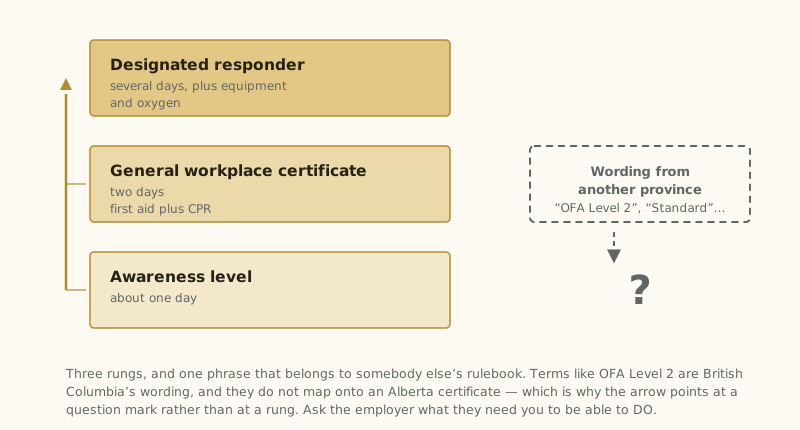
Level one is awareness. Roughly a day, sometimes less, built around the handful of emergencies that kill quickly and the first few minutes of each one. Employers ask for this when the risk is low, an ambulance is close, and they would rather everyone on the floor knew something than have one person know a lot. It is also the usual answer for volunteers, coaches, committee members and anyone whose duty is to help rather than to take charge.
Next comes the general workplace certificate: two days, first aid and CPR together, and this is what most Alberta employers mean when they write nothing more specific than the words first aid. If the posting is vague and the work is ordinary office, retail, trades, care or hospitality, this is the safe assumption. It was called Standard First Aid until 2025 and is now published as Intermediate First Aid, which is why so many job descriptions and so many course schedules currently disagree with each other. the two-day certificate most Alberta workplaces settle on.
Above that sits the designated responder level. Longer, more equipment, oxygen, and an expectation that when someone is badly hurt you are the person who takes over and stays with them until an ambulance arrives. Remote sites, industrial operations and anywhere the response time is measured in tens of minutes tend to ask for this. Employers rarely leave that one vague, because it costs them real money and they know it. the level sites choose when one person carries the kit.
The fourth one is not really a first aid certificate
The fourth thing an employer can mean is a certificate from another province's system. Level 1, Level 2 and Level 3 are British Columbia occupational first aid codes. Alberta does not number its first aid that way, so a posting written in those terms was either copied from a template or written by a manager who spent years working over the mountains. The same thing happens with Ontario wording. None of it is dishonest, and none of it tells you what to book.
What to do about it is simple and slightly awkward: write back and ask which Alberta certificate they will accept, by name. Nobody has ever thought less of a candidate for asking that question. The alternative is buying two days of your life on the strength of a number that does not exist in this province.
The one question that decodes almost everything
When the wording defeats you, stop reading it and ask a different question instead: what does this job expect me to do if a person is injured in front of me. Help until somebody else arrives points at the general workplace certificate. Be the person in charge of that patient, with a kit, a role and possibly oxygen, points at the designated responder level. Everything else is detail. That single question sorts more requirements correctly than any amount of staring at a job posting, and it is the question the rest of this week is built on. work through the same question with a few prompts.
Quick answers
- What does it mean when a job posting just says first aid?
- In Alberta it most often means the two-day workplace certificate that combines first aid with CPR, now published as Intermediate First Aid. Ask the employer to name the certificate before you book, because a vague posting is a summary of a rule rather than the rule itself.
- Is Level 1 or OFA 2 a first aid course I can take in Alberta?
- Those are British Columbia occupational first aid codes, not Alberta ones. If an Alberta employer uses that wording, ask them which Alberta certificate they will accept, by name, before you spend anything.
- How do I choose between the two-day course and advanced first aid?
- Ask what the job expects you to do when somebody is injured. Helping until an ambulance arrives points at the two-day workplace certificate. Being the designated person who takes charge, with a kit and equipment and a long wait, points at the advanced level.