What a Workplace First Aider Is Actually Expected to Do
The duty is narrower and heavier than most people expect. What it involves in the first ten minutes, and why it decides which certificate you need.
Jarrett Chisholm, ACP · September 10, 2026 · clinically reviewed by Jarrett Chisholm, ACP
Where this is taught: Standard First Aid with BLS, Advanced First Aid and Intermediate First Aid.
Most people picture the job as bandaging. A worker cuts a hand, the first aider produces a dressing, everyone goes back to work. That happens, and it is the least important part of the role. The part that should decide which certificate a workplace buys is what you are expected to do on the day somebody is seriously hurt, which is rarer, shorter and a great deal heavier.
Image needed · hero
first-aider-kneeling-beside-casualty-on-shop-floor.jpg
Photograph a staged scene in a working warehouse or workshop: one person in hi-vis kneeling beside a seated colleague and applying firm pressure to a plain dressing on the forearm, workplace first aid kit open on the floor beside them, a second worker in the background on a phone. Realistic PPE, no fake blood beyond a clean dressing, available light, slightly wide framing, landscape. No branded training materials in shot.
Alt text ready: “A workplace first aider kneeling beside a seated colleague on a warehouse floor, applying firm pressure to a dressing on the forearm”
This is an explanation of the shape of that duty, written so you can judge which level of training a job actually needs. It is not a substitute for hands-on training with an instructor, and reading it does not certify anyone to do any of it.
The honest description of the role is this. You are the person who keeps a situation from getting worse during the gap between the injury and the arrival of people with more equipment than you have. In a city that gap might be eight minutes. On a rural site, or a large industrial one where the crew still has to find you inside the building, it can be forty. The length of that gap, more than any wording in a job description, is what sets the level of training a workplace genuinely needs.
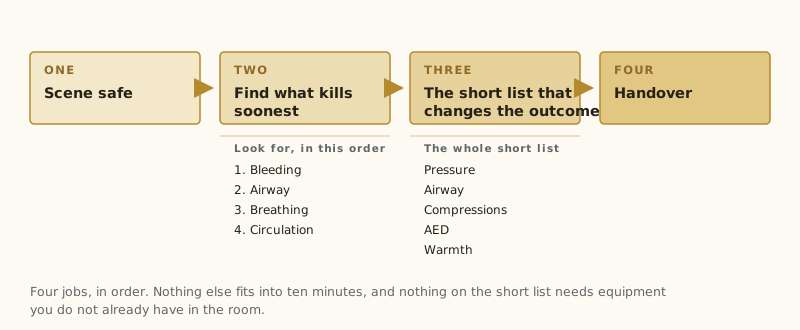
Inside that gap, the work sorts into four jobs, and they are not the four most people expect.
The first three jobs, in the order they matter
Making the scene safe enough to approach comes first. It sounds like a formality and it is the thing that turns one casualty into two. Machinery still turning, a live conductor, a vehicle on a slope, a chemical still leaking, a crowd closing in: the first aider who walks into any of that has just become the second patient, and now nobody is helping the first one. Stopping for three seconds to look before you kneel is the most valuable habit taught on any first aid course, and it is the first one people abandon under stress.
Finding what will kill soonest comes next, and the order is the whole point. Catastrophic bleeding, then an airway that is not open, then breathing that is not working, then a circulation that is failing. That sequence is not a ritual. It is roughly the order in which each problem ends a life, so it tells you what to do first when several things are wrong at once and you have one pair of hands and no help yet. Somebody with an obviously broken arm and a spurting thigh does not get the arm looked at.
Third is the short list of things that actually change the outcome: pressure on a bleed hard enough and long enough to stop it, opening an airway, chest compressions when there is no normal breathing, an AED on the chest as early as anyone can get one there, and keeping the person warm. That list is short deliberately. Under adrenaline nobody performs a long list, and almost everything else can wait for the ambulance without costing the patient anything. practise this handful of things until they are automatic.
The fourth job is the one nobody practises
Handover is the fourth, and it is the least glamorous of them. Getting help called early with a location precise enough to actually find, keeping track of what you found and roughly what time you found it, and then telling the arriving crew in about thirty seconds what happened, what you saw, and what you have already done.
It matters because the alternative wastes the opening minutes of professional care. A crew that has to rediscover the mechanism of injury, the time of collapse and whether the person was ever awake is spending its most useful minutes on archaeology. A first aider who can say a scaffold plank came down on him at ten past two, he was awake and talking to me, he stopped answering about four minutes ago has just changed what happens next. Nobody expects medical vocabulary from a workplace first aider. Times and changes are what matter, and they are free to write on the back of your hand.
Why the duty decides the certificate
Now the point of all of this. Read those four jobs again and ask how much of them your workplace expects one named person to carry alone, and for how long. That answer, rather than the wording on a job posting, is what should decide the level of certificate a site buys. It is also the question to ask before a one-off event, where the honest answer is sometimes that you do not want a staff member carrying any of it. talk to us about what that day actually needs.
A workplace where the gap is short, help is easy to reach and several people share the duty is asking for the general two-day workplace certificate. That training assumes an ambulance is coming reasonably soon and that your job is to hold the line until it does, which is a fair description of most offices, shops, schools and light trades.
Sites where the gap is long, where one named person carries the kit and is expected to manage a patient for half an hour, or where the injuries plausible on that site are the kind that kill quickly, are asking for something considerably more. More assessment, more equipment, oxygen, and enough repetition that a long incident does not fall apart around the twenty minute mark. Employers who need this usually know it. The ones who get it wrong are typically the ones who copied a first aid line from a smaller, tamer site and never looked at it again. training for the person expected to manage a patient alone.
Quick answers
- What is a workplace first aider actually responsible for?
- Keeping the situation from getting worse in the gap before better-equipped help arrives. In practice that is four jobs: making the scene safe to approach, finding what will kill soonest, doing the short list of things that change the outcome, and handing over accurately.
- What order should you deal with injuries in?
- Roughly the order in which each problem ends a life: catastrophic bleeding, then the airway, then breathing, then circulation. That ordering exists so you know what to do first when several things are wrong and you only have one pair of hands.
- Does reading about first aid count as training?
- No. An article can explain the reasoning so that real training makes more sense, but it is not a substitute for hands-on practice with an instructor, and it does not certify anyone to act.