Why Your CPR Expires Before Your Certificate Does
The CPR component often runs on a shorter clock than the certificate that contains it. Why the two differ, and how to tell which one governs you.
Jarrett Chisholm, ACP · August 6, 2026 · clinically reviewed by Jarrett Chisholm, ACP
Most people carry one date in their head: the day the first aid certificate runs out. On a good many cards there is a second date, earlier than the first, and it is the one that catches people out. The CPR or Basic Life Support component often runs on a shorter clock than the certificate that contains it.
Image needed · hero
learner-hands-compressing-training-manikin.jpg
Low angle, close crop of a learner's interlocked hands mid-compression on an adult CPR training manikin lying on a grey classroom floor. Shoulders and forearms in frame, face out of frame. Even indoor lighting, no flash, shallow depth of field so the manikin torso is sharp and the room falls away behind. No branding or course materials legible.
Alt text ready: “A learner's interlocked hands pressing down on the chest of an adult CPR training manikin on a classroom floor”
This is not a filing quirk, and it is not a training provider being awkward. The two clocks measure different things. They differ because the skills behind them decay at different rates, and one of those rates is a great deal faster than most people assume.
Knowledge lasts reasonably well. If you learned two years ago how to spot a stroke, or what to do about a bleed that will not stop, most of that is still retrievable. It is stored the way facts are stored. You can be prompted, you can reason your way back to it, and being a little slow rarely changes the outcome.
Compressions are not stored that way. They are a motor skill performed under pressure, at a depth and a rate your hands have to produce without being told, while someone in front of you is dying. Motor skills that are not rehearsed degrade measurably within months rather than years, and the person losing them almost never notices. Anyone who has sat a refresher knows the shape of it: the theory comes straight back, the depth does not.
Why the two clocks exist at all
Certification periods are a compromise between what is known about skill decay and what people will realistically do. If decay were the only input, everyone would rehearse compressions every few months, and almost nobody would turn up. So the certificate period is set long enough that people actually renew, and the components most likely to fail early are given a shorter clock of their own.
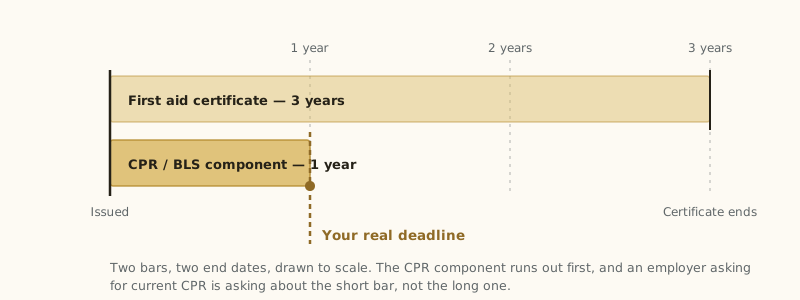
That is the reason CPR and Basic Life Support are usually tracked separately even when they arrive inside a larger course. The larger certificate, most often earned inside the longer classroom course most people take first, covers a broad body of material where slow recall is survivable. The component covers the one part where slow recall is not. the longer classroom course most people take first.
Employers have worked this out, which is why a workplace file often carries two rows for the same person with two different dates. Neither row is a mistake. If the shorter date is the one your employer tracks, the shorter date is the one that governs your working life, whatever the certificate says. Check the wording of your own requirement rather than assuming the longer date wins, and if the wording is ambiguous, ask the person who wrote it rather than the person who files it.
How to tell which clock governs you
Start with the card itself, and read every date printed on it rather than only the one in the largest type. If there are two end dates, the earlier one is your real deadline, because the moment it passes you are out of date for something, and that something is usually the part an employer is checking. Cards are not always laid out helpfully. The component date is often smaller, often abbreviated, and sometimes sits beside a code rather than a word.
Next, look at how the component was earned. A CPR component completed inside a longer course normally carries that course's date. A component completed on its own, for instance in a short session that covers the CPR and AED work by itself, carries its own date and its own cycle. If you have done both at different times you have two live dates, and the earlier one is the one to diarise. a short session that covers the CPR and AED work by itself.
Then read the requirement you are being held to, literally rather than generously. A job posting, a site safety policy and a school letter can all name different things using similar words. Some ask for a first aid certificate. Some ask specifically for a current Basic Life Support card. The same split runs the whole way up the scale, so renewal at the responder level follows the same two-clock pattern, and it is worth checking your own paperwork rather than repeating what a colleague told you. renewal at the responder level follows the same two-clock pattern.
What this is and is not
This is an explanation of how the dates behave, so you can plan around them instead of discovering them. It is not a substitute for hands-on training with an instructor and a manikin, and reading it does not certify anyone or extend any date on any card. If your component date has already gone, the fix is a class, not an argument with the calendar.
Quick answers
- Why does CPR expire before my first aid certificate?
- Because compressions are a motor skill and motor skills degrade within months when they are not rehearsed, while the knowledge parts of a first aid course stay retrievable for years. The shorter cycle is set against the faster decay.
- Which date should I use if my card shows two of them?
- Use the earlier of the two dates, because the moment it passes you are out of date for that component. The component is usually the item an employer is actually tracking in your file.
- Can I renew just the CPR part on its own?
- Often yes, if the component was earned separately or is tracked separately on your card. Check what is printed on the card and what your employer records before you book, because the two do not always agree.