How First Aid Recertification Actually Works
A recert is shorter and cheaper than the full course, but only while your card is current. How the window works, and how to read the dates on your card.
Jarrett Chisholm, ACP · August 5, 2026
Recertification is a real course, not paperwork. It is shorter than the full version and it costs less, because the material is easier to top up than to teach from scratch. You still attend, you still get assessed on the practical skills, and if the skills are not there on the day you can still be asked to book the full course instead.
Image needed · hero
first-aid-certification-card-expiry-date-close-up.jpg
Close-up with shallow depth of field of a wallet-sized first aid certification card held between thumb and forefinger above a plain wooden desk, tilted so the printed completion and expiry dates are legible and sharp. Natural window light from the left, neutral uncluttered background, no logos and no personal name legible (mask or blur the name field). Horizontal crop, card filling roughly two thirds of the frame.
Alt text ready: “A wallet-sized first aid certification card held between finger and thumb, angled so the printed completion and expiry dates are readable”
The difference between a recert and a full course is mostly assumption. A recert assumes you have done this before: that you have knelt over a manikin, that you know what an AED says when you open it, that the words are not new. It moves fast through the parts that are recall and spends the class time on the parts that decay.
Every recert carries the same entry condition. Your existing certificate has to be valid on the day you attend. Not the day you booked, not the day you paid. The day you are in the room. That single detail causes more rebookings than anything else we deal with.
That makes the dates on your card worth two minutes of attention. Most people have never read them properly, and the date they carry in their head is usually the year, not the day.
What a recertification actually covers
Take out the material you already have and what is left is the perishable part. Skills decay in a fairly predictable order. Compression depth goes first, because it is physically hard and nobody practises it between courses. Sequence goes next: what you check, in what order, and the point where you stop checking and start doing. Comfort with the AED goes surprisingly quickly for something so simple to operate.
A recert spends its time there. You will be on the floor, you will be assessed, and the standard the instructor is watching for is the same standard as in the full course. The bar does not drop because the course is shorter. What changes is how much of the day you spend being told things you were told last time.
This is also why the recert is not automatically the right choice. If it has been a long time since you used any of it, or your last course was a rushed arrangement you barely remember, the full course may serve you better even when the short one is open to you. Nobody will stop you booking the longer version. It is worth an honest look at how much you could do right now, cold, with nobody prompting you, and if that answer is uncomfortable then it is worth taking a minute to work out which version of the course you are actually due for. work out which version of the course you are actually due for.
Why the window closes on the expiry date
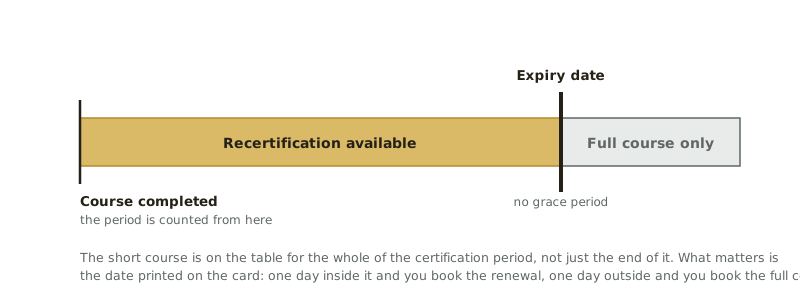
The cut-off is not administrative fussiness. A recertification is built on the assumption that the skills are still present in some form, and the certification period is the period in which that assumption is treated as reasonable. Past the end date the assumption no longer holds, so the short course is no longer offered against it. That rule sits above us, and we have no discretion over it.
Practically, the cheap option has a hard edge. One day inside the window and you are booking the shorter Advanced renewal for cards that have not yet lapsed. One day outside and you are booking the full course, at full price, for the full number of hours. There is no grace period, no partial credit, and no version of this conversation where the date is negotiable. the shorter Advanced renewal for cards that have not yet lapsed.
If your card has already gone past its date, that is not a catastrophe, it is a longer booking. Take the full course, get a fresh date on a fresh card, and set the reminder properly this time so that the next renewal is the short one.
How to read the dates on your own card
There are usually two dates on a card and people conflate them. One is when you completed the course. The other is when the certification runs to. The printed end date is the one that governs your booking, and it is counted from completion, not from the day you registered or the day you paid, which is why a course you booked in March and sat in June expires against June.
Where it gets confusing is that some certifications carry a shorter internal clock than the certificate they sit inside. Basic Life Support is the common example: renewing a Basic Life Support card while it is still in date is judged against that card's own end date, not against whatever longer date your employer wrote in your file. If your card shows more than one end date, the earlier one is the one to put in your calendar. renewing a Basic Life Support card while it is still in date.
If you cannot find the card at all, that is solvable and it is common. A completion can usually be looked up by name and approximate date. Do that while the window is open rather than after it shuts, because the lookup tells you what the date was, it does not change it.
Quick answers
- What is the difference between a first aid recertification and the full course?
- A recertification is shorter because it assumes you have done the course before, so it spends the class time on the practical skills that decay fastest rather than on material you already hold. The assessment standard is the same as the full course.
- Can I recertify after my first aid certificate has expired?
- No, the shorter recertification is only available while your existing certificate is still valid on the day you attend, so once that date has passed you book the full course instead. There is no grace period and no partial credit.
- Which date on my card decides when I have to renew?
- The printed end date governs your booking, and it is counted from the day you completed the course rather than the day you registered or paid. If the card shows more than one end date, the earlier one closes your window first.