Your First Aid Certificate Expired. Now What?
Recertification is shorter and cheaper than the full course, but only if you catch it in time. Here is how the timing works.
Jarrett Chisholm, ACP · August 3, 2026 · updated August 10, 2026
Recertification exists because someone who has held a certificate for three years does not need to be taught the whole thing from scratch. It is shorter, it costs less, and it renews the same credential, not a lesser version of it. The catch is timing, and the timing is stricter than most people expect.
Image needed · hero
expiry-date-on-a-certificate-card.jpg
Macro crop on the expiry date field of a certificate card, shallow depth of field so only the date is sharp. Blur or cover the holder name.
Alt text ready: “A close view of the expiry date printed on a first aid certificate card”
As a rule, recertification happens while your certificate is still current. Once it has expired, you are looking at the full course again, at full price and full length. The Canadian Red Cross only allows recertification for a certificate that is still valid on the day of the course, so there is no grace period after the date. The date on your card is not a suggestion.
So the practical advice is unglamorous: find your expiry date now, before you need it. Not when your employer asks, not when you are updating a résumé, and not the week a job posting closes. This whole week of posts is about certificate timing, because it is the cheapest problem in first aid to prevent and one of the most expensive to fix late.
The two clocks on one card
Here is the part that catches even people who are paying attention: many certificates carry two expiry clocks. The certificate as a whole usually runs three years, but the CPR or BLS component inside it can run out sooner, because provider-level CPR is renewed annually. Your card can be perfectly valid as a first aid certificate while the CPR level your employer actually cares about has been expired for a year.
The table below is the short version for the certificates we issue most. Your own card governs: validity is set by the Canadian Red Cross and printed on the certificate itself, so read yours rather than trusting a table on the internet, including this one.
| Certificate | Certificate valid | Faster clock inside it | Renew with |
|---|---|---|---|
| Intermediate (Standard) First Aid | 3 years | None: CPR-C renews with it | Recertification, or retake |
| Basic Life Support (BLS) | 1 year | The whole thing is the fast clock | BLS Recertification, about 2 hours |
| Intermediate First Aid with BLS | 3 years | BLS component: 1 year | BLS Recertification annually |
| Advanced First Aid | 3 years | BLS component: 1 year | AFA Recertification before expiry |
| Emergency Medical Responder | 3 years | CPR/BLS component: 1 year | EMR Recertification before expiry |
Thursday's post this week digs into exactly why the CPR clock runs faster than the first aid clock, because understanding the reason makes the renewal schedule much easier to remember.
What recertification actually is
A recertification course is a condensed pass through the full curriculum with the assessment standards intact. You demonstrate the skills, you sit the evaluations, and you leave with the same certificate you would get from the full course, valid for the same period. Nobody looking at the card can tell which route you took, because there is no difference to tell.
The saving is real. BLS recertification runs about two hours against roughly four for the full course. Advanced First Aid recertification runs about half the classroom hours of the full program, a five-day week instead of a multi-week cohort, which for most working people is the difference between booking it and postponing it. Postponing it is how people end up on the wrong side of the expiry date, which is the expensive side. the shorter renewal for Advanced First Aid holders.
What recertification is not: a shortcut for someone whose skills have genuinely gone. The course moves fast precisely because it assumes you held the material recently. If you scraped through the original course three years ago and have not touched a manikin since, the full course may honestly serve you better even when the recert is still open to you. That is a judgement call, and we will give you a straight answer if you ask.
Two states, and the date decides
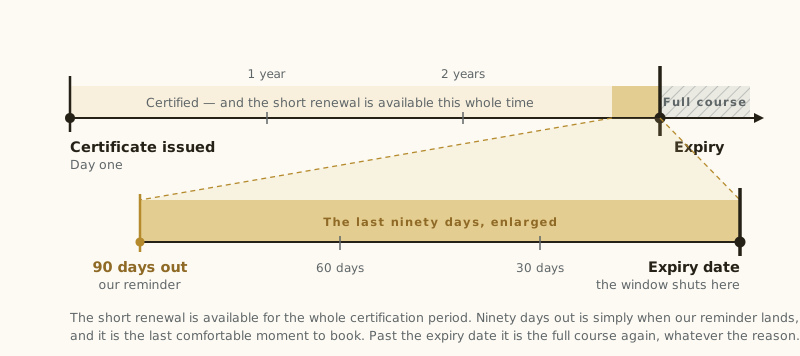
Every certificate you hold is in one of two states, and the state decides your options:
- Current: every option is open, including the short, cheaper recertification. Book before the date and you keep the fast lane.
- Expired, even by a day: the full course, full length, full price. The clock starts fresh and nothing from the old certificate carries forward.
One caution on the first state: your employer or regulator can be stricter than the certifying body. Plenty of workplaces require a certificate that is current on every day you work, and some professional roles renew on cycles shorter than the certificate itself. If a job depends on the card, the renewal date that matters is the earliest one anyone in the chain enforces, not the one printed at the bottom.
If you have already let it lapse
It is not a disaster; it is just more time and more money than it needed to be. You take the full course, you get a fresh certificate, and the clock starts again. There is even a quiet upside: the full course is a genuinely better refresher than the recert if your skills have been idle for years, and protocols do change between editions of the program.
What is worth doing differently this time is putting the new expiry date somewhere you will actually see it, the day you get the card, while the sting of paying full price is still fresh. A calendar reminder ninety days out is enough to make the cheap option available next time. Saturday's post walks through setting that reminder in about five minutes, including the second reminder for the faster CPR clock if your certificate carries one.
Higher-level certificates have their own rules
The professional-level certificates do not all behave the same way, and the stakes are higher because employment usually depends on them. Advanced First Aid and Emergency Medical Responder both carry the annual CPR/BLS component inside a three-year certificate, and industrial or oilfield employers often audit both dates. Some sites also impose their own renewal cycles that are shorter than the certificate, so a card the Red Cross would still happily renew can fail a site orientation. renewing at the Emergency Medical Responder level.
If you are not sure what you are holding, or what state it is in, do not guess. Send us a photo of the card and we will tell you exactly what it is, when each clock runs out, and which renewal course fits. It takes us two minutes and it has saved people from booking the wrong thing in both directions: paying for a full course they did not need, and booking a recert they were no longer eligible for. send us a photo of your card and we will read it for you.
Do this today
Before the week gets away from you: find the card, or the digital certificate email, and read both dates. If either clock runs out inside the next ninety days, book the renewal now while the short option is still on the table. If you cannot find the certificate at all, that is its own answer, and the search for it starts with whoever issued it. The rest of this week's posts cover how the recertification course itself works, why CPR expires before the rest of your certificate, and the ninety-day reminder that makes all of this someone else's problem.
And if reading two dates off a plastic card feels like a strange thing to put on a to-do list, consider what it buys: the difference between a two-hour evening renewal and a two-day course, between a quiet email to your employer and a scramble the week a contract starts. Small clock, big lever.
Quick answers
- Can I recertify my first aid after it expires?
- No. Recertification has to be completed while your certificate is still valid on the day of the course. Once it has expired, you take the full course again.
- How long is a first aid certificate valid?
- Most Canadian Red Cross first aid certificates run three years, though CPR and BLS components inside them can expire annually. Check the dates printed on your own card, because they vary by course.
- Is a recertification certificate worth less than the full course certificate?
- No. It renews the same credential for the same validity period, and the card does not distinguish which route you took. The assessment standards are the same.
- My card says three years, but my employer says my certificate has expired. Who is right?
- Possibly both. Many certificates carry a CPR or BLS component that expires annually inside a three-year certificate, and employers can also impose their own shorter renewal cycles. Check the component dates on the card and your workplace policy.