The Delta Dispatch

Advanced First Aid, IV, Fluid, Pre-hospital, ITLS, EMR, Firefighter Kumari Malhotra Advanced First Aid, IV, Fluid, Pre-hospital, ITLS, EMR, Firefighter Kumari Malhotra

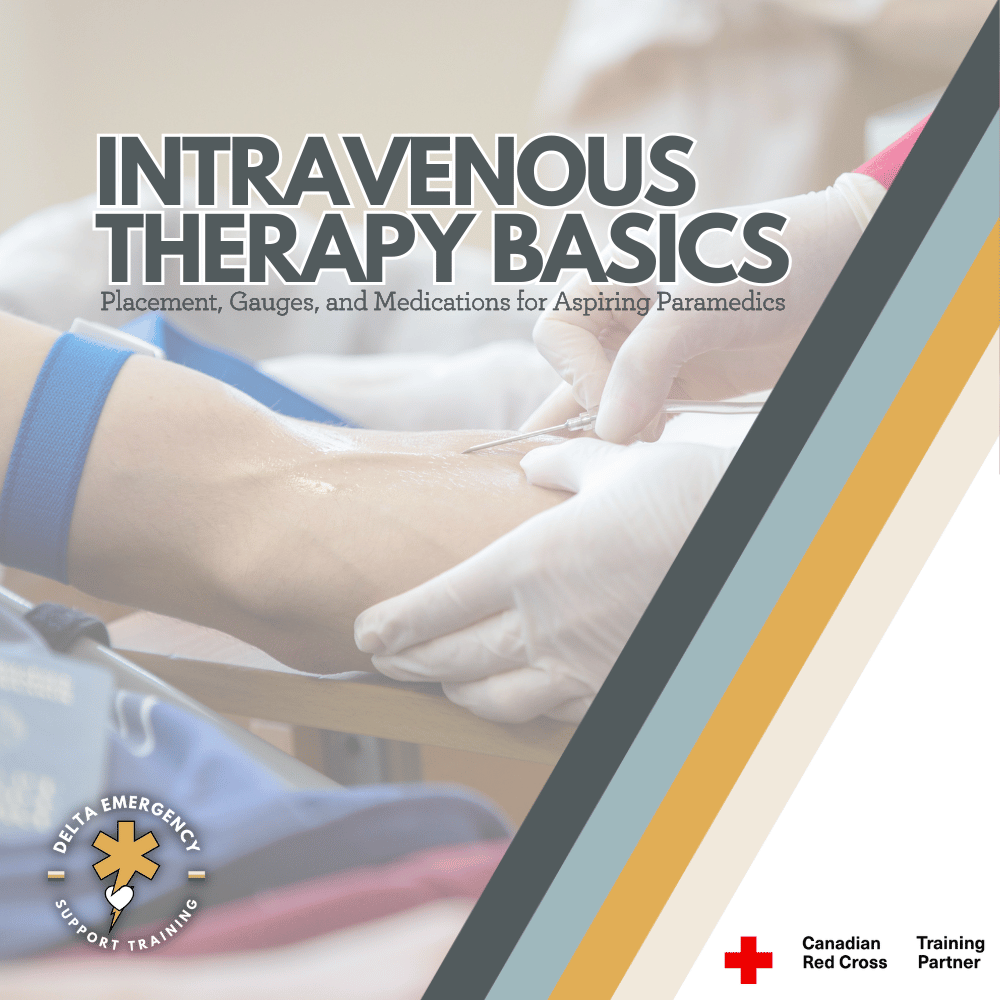
Intravenous Therapy for Beginners: Placement, Gauges & Medications

Intravenous (IV) therapy is a key skill for future paramedics and advanced responders. This beginner’s guide covers vein selection, catheter sizes, and common medications, helping you prepare for PCP training and real-world prehospital care.

For many first responders, advancing from Advanced First Aid or Emergency Medical Responder certification to Primary Care Paramedic training is an exciting milestone. It’s where your skills evolve from basic emergency management to a more advanced approach to prehospital medical care.

One of the essential new skills taught in PCP programs is intravenous (IV) therapy, a procedure that allows responders to deliver fluids and medications directly into the bloodstream for rapid, controlled treatment.

While IV initiation is not within the EMR or AFA scope of practice, understanding what it involves — and how it supports patient care — gives you a valuable head start.

What Is IV Therapy?

IV therapy involves inserting a sterile catheter into a patient’s vein to establish direct access to the circulatory system. This line can then be used to deliver fluids, medications, or draw blood samples. IV access is one of the fastest, most reliable ways to stabilize a patient in critical or emergent situations.

When Are IVs Needed?

Paramedics and advanced responders use IVs in a wide range of medical and trauma calls, such as:

  • Fluid resuscitation: Treating dehydration, burns, or blood loss

  • Medication delivery: For cardiac, allergic, or diabetic emergencies

  • Pain or nausea management: In controlled, monitored settings

  • Cardiac arrest care: To administer life-saving drugs quickly

  • Trauma management: When oral or intramuscular routes aren’t viable

Learning to Start an IV in PCP School

During PCP training, students learn the anatomy of veins, infection control, and catheterization techniques through classroom instruction, practice labs, and clinical placements. You’ll first work on training arms to master vein palpation, needle handling, and aseptic technique before performing supervised IV starts in clinical settings.

The process includes:

  1. Gathering and preparing sterile equipment

  2. Identifying a suitable vein

  3. Cleansing the site

  4. Inserting the catheter bevel-up

  5. Confirming flashback and advancing the catheter

  6. Securing the line and beginning the infusion

Common IV Insertion Sites (and Why They’re Chosen)

Vein selection is critical. Choosing the right site helps reduce complications, ensures proper flow, and keeps the patient comfortable.

Here are the most common IV entry sites used in prehospital and clinical settings:

1. Dorsal Hand Veins

These include the cephalic, basilic, and dorsal metacarpal veins on the back of the hand.

  • Pros: Easy to visualize and access; great for smaller catheters.

  • Cons: More sensitive; can be uncomfortable during movement or fluid administration.

  • Common Uses: General medication or fluid delivery when other veins are less accessible.

2. Forearm Veins

The cephalic and basilic veins along the forearm are often the first choice for IV starts.

  • Pros: Straight path, good flow rate, and easier stabilization with tape.

  • Cons: May roll or collapse if dehydrated; limited space for reattempts.

  • Common Uses: General medical and trauma patients, fluid resuscitation, medication administration.

3. Antecubital Fossa (Inner Elbow)

The median cubital, cephalic, and basilic veins in the crook of the arm are popular for rapid access.

  • Pros: Large veins, high flow rates — ideal for trauma or blood draws.

  • Cons: Restricts arm movement; prone to kinking if patient bends the elbow.

  • Common Uses: Emergency IV access, large-bore lines, or when rapid administration is needed.

4. External Jugular Vein (Neck)

Used in some prehospital or critical care settings when peripheral access isn’t possible.

  • Pros: Easy to locate in patients with difficult peripheral veins; high flow.

  • Cons: Requires skill and patient cooperation; greater risk if improperly managed.

  • Common Uses: Trauma, shock, cardiac arrest, or situations where arm veins are inaccessible.

5. Lower Extremity Veins (Dorsal Foot or Great Saphenous)

Used mainly when upper extremities are unavailable.

  • Pros: Alternative access in infants or patients with poor upper body veins.

  • Cons: Slower flow, higher infection risk, limited mobility.

  • Common Uses: Pediatrics, last-resort adult IV access.

Understanding IV Gauge Sizes

The gauge of an IV catheter refers to its diameter. Smaller numbers mean larger catheters.

  • 14–16G: For trauma or massive fluid resuscitation

  • 18G: For blood administration or major fluid replacement

  • 20G: General adult use; medications and moderate fluid therapy

  • 22–24G: Pediatrics, elderly, or fragile veins

Gauge choice depends on patient size, vein condition, and the urgency of the situation.

Common IV Medications in Paramedic Practice

While specific drug use depends on provincial protocols, IV therapy often supports:

  • Normal Saline (0.9% NaCl) – Fluid replacement or line maintenance

  • Dextrose (D10, D50) – Hypoglycemia management

  • Epinephrine – Cardiac arrest or anaphylaxis (specific concentrations)

  • Morphine / Fentanyl – Pain management (under standing orders)

  • Ondansetron – Nausea control

  • Nitroglycerin (IV form) – Chest pain management (advanced protocols)

Each medication requires strict dosage control, monitoring, and adherence to medical direction — something you’ll master in paramedic pharmacology.

Why IV Skills Matter

For professional responders, starting an IV isn’t just about inserting a catheter — it’s about stabilizing patients efficiently, safely, and confidently. In trauma, shock, or medical crises, IV access can mean the difference between life and death.

If you’re currently an EMR or AFA graduate considering the PCP path, familiarizing yourself with IV principles now will make your transition smoother and your training easier.

Final Thoughts

Learning to start an IV marks a major step forward in your responder journey. Though outside the AFA and EMR scope, it’s a skill that defines advanced prehospital care. As you move toward your Primary Care Paramedic program, understanding IV therapy — from vein anatomy to gauge selection — gives you a solid foundation for success.

Read More
Advanced First Aid, Awareness Kumari Malhotra Advanced First Aid, Awareness Kumari Malhotra

Distracting Injuries: Pulling Focus and Masking Pain

In trauma care, some injuries grab all the attention—but they aren’t always the deadliest. Distracting injuries can mislead responders and mask life-threatening conditions. Here’s what every first responder needs to know about spotting them, staying systematic, and keeping patient safety the top priority.

When trauma calls come in, it’s easy to fixate on the most obvious wound, the open fracture, the deep laceration, the heavy bleeding. But those are often distracting injuries: visible traumas that can obscure other, more dangerous threats. Recognizing them and continuing to assess systematically is what separates a good response from a lifesaving one.

What Is a Distracting Injury?

A distracting injury is one that draws your attention so strongly that both responders and patients may overlook other serious but less obvious issues. In paramedic protocols, these injuries can make a patient “unreliable” for clinical clearance of the cervical spine because they may mask neck pain or tenderness. As a result, spinal precautions should be maintained unless more definitive assessment rules them out.

Why They Matter

The danger of distracting injuries is twofold:

  1. They pull focus – A gruesome fracture or large bleed grabs everyone’s attention, often overshadowing a more subtle but life-threatening issue like a compromised airway or spinal injury.

  2. They mask pain – A patient in severe pain from a major injury may not report or even notice neck or back pain, leading responders to miss critical red flags for spinal trauma.

    Evidence-Based Insights

    Studies show distracting injuries are often upper-torso or limb injuries that change how a patient perceives or reports pain:

    • Heffernan et al. (2005) found that some patients with cervical spine fractures had no neck tenderness—but all had upper torso injuries like chest trauma, which likely distracted from the pain.

Common Examples

  • Long bone fractures (femur, humerus)

  • Major burns

  • Crushing or degloving wounds

  • Profuse bleeding or amputations

  • Severe chest or upper torso injuries

First Responder Priorities

  1. Stick to the primary survey (ABCs)
    No matter how distracting a wound looks, airway, breathing, and circulation must always come first.

  2. Protect the spine when in doubt
    If a distracting injury is present, assume the patient cannot reliably clear their spine. Apply spinal precautions unless imaging or protocols say otherwise.

  3. Reassess constantly
    A distracting injury may not only occupy the patient’s attention but yours as well. Don’t let tunnel vision take over.

  4. Think systematically, not emotionally
    The most dramatic injuries are not always the deadliest. Quiet but hidden injuries like internal bleeding or spinal cord compromise, may be far more dangerous.

The Bottom Line

Distracting injuries are more than just dramatic wounds—they can hide life-threatening problems and mislead both responders and patients. The best protection is discipline: follow a structured assessment, protect the spine when necessary, and never let your focus shift entirely to the injury that looks worst. A calm, systematic approach can make the difference between managing trauma and saving a life.

Read More

The Critical Role of BSI: Protecting Yourself First as a First Responder

Body Substance Isolation (BSI) is more than just wearing gloves—it's a life-saving habit for every first responder. From bloodborne pathogens to airborne illnesses, BSI protects you from invisible threats on every call. At Delta Emergency Support Training, we emphasize BSI in every scenario because your safety comes first. Learn what PPE to wear, how to use it, and why BSI is essential in every emergency situation.

When responding to emergencies, your focus is naturally on saving others. But as a first responder, your own safety must come first. That’s where Body Substance Isolation (BSI) comes in—a fundamental part of emergency medical care that often gets overlooked, especially by new responders.

BSI is more than just gloves—it's a mindset, a habit, and a crucial layer of protection against invisible but dangerous threats like bloodborne pathogens, bacteria, and bodily fluids.

At Delta Emergency Support Training, we emphasize BSI in every scenario because if you’re not safe, you can’t help anyone else.

🚨 What Is BSI?

Body Substance Isolation (BSI) is a set of precautions used to prevent contact with potentially infectious body fluids. This includes blood, vomit, saliva, urine, feces, and respiratory secretions.

BSI is part of Standard Precautions, a cornerstone of infection control recommended by health authorities and the Canadian Red Cross. BSI assumes that anyone could be carrying an infectious disease, whether or not symptoms are visible.

🦠 Diseases & Infections That Can Be Transmitted

Here are some of the infections you risk exposure to during first aid or emergency response:

Bloodborne Pathogens

  • Hepatitis B (HBV): Can survive in dried blood for up to a week

  • Hepatitis C (HCV): No vaccine, often leads to chronic liver issues

  • HIV/AIDS: Though lower risk, exposure via blood or sexual fluids can occur

Airborne & Droplet Diseases

  • COVID-19

  • Influenza

  • Tuberculosis

Contact-Transmissible Infections

  • MRSA (Methicillin-resistant Staphylococcus aureus)

  • Norovirus

  • C. difficile

These diseases can be transmitted through:

  • Cuts or broken skin

  • Mucous membranes (eyes, mouth)

  • Inhalation (coughs, sneezes)

  • Contaminated surfaces or medical equipment

🧰 What BSI Gear to Use—and When

🔹 Gloves (Always)

Used on every call. Always don gloves before patient contact, even when no fluids are visible. Use nitrile gloves for latex-sensitive patients and for better chemical resistance.

🔹 Eye Protection & Face Shield

For any situation involving splash risk (e.g., severe bleeding, childbirth, vomiting). Goggles or a full face shield help protect your mucous membranes from exposure.

🔹 Gowns/Aprons

For major trauma, childbirth, or mass-casualty events with heavy blood loss or body fluid exposure.

🔹 Masks (Surgical/N95)

  • Surgical Mask: For droplet protection during coughing, vomiting, or respiratory distress.

  • N95 Respirator: Use during airborne illness calls (e.g., suspected TB, COVID-19) and when performing aerosol-generating procedures like CPR or suctioning.

🧠 Scenario-Based BSI Examples

Scenario 1: Motor Vehicle Collision

  • Patient bleeding heavily from the scalp and face.

  • You wear: Gloves, goggles/face shield, gown if time permits.

  • Tip: Be cautious kneeling near broken glass or on spilled fuel.

Scenario 2: Unconscious Overdose

  • Risk of vomit, saliva, or needle sticks.

  • You wear: Gloves, mask, eye protection.

  • Tip: Never blindly reach into pockets or under the person—use tools and visual checks.

Scenario 3: Respiratory Distress in a Child

  • Coughing, drooling, rapid breathing.

  • You wear: Gloves, surgical or N95 mask, eye protection.

  • Tip: Keep your face out of the line of the patient’s airway.

Scenario 4: Diabetic Emergency with Vomiting

  • Patient is responsive but disoriented and vomiting.

  • You wear: Gloves, eye protection.

  • Tip: Position yourself behind or to the side—not in front—when managing vomiting to avoid splash.

⚠️ Hidden Dangers: BSI Tips from the Field

🔸 Where You Put Your Bag Matters

  • Keep gear off the ground and away from pools of fluid.

  • Use tarps, bags with plastic bottoms, or place equipment on elevated surfaces like a bench or chair.

🔸 Watch Where You Kneel

  • Glass, needles, body fluids, and animal waste can all be on the ground.

  • Wear durable, washable uniforms and clean gear after every shift.

🔸 Double Glove for Safety

  • In high-risk situations (e.g., trauma, unknown environment), wear two pairs of gloves and peel the outer layer off after initial contact.

🔸 Avoid Touching Your Face

  • It's a reflex, but it’s dangerous. You could unknowingly transfer pathogens to your eyes, nose, or mouth.

🔸 Proper Doffing Technique

  • Removing PPE incorrectly can contaminate you. Practice safe removal: gloves off first, then goggles, then gown, then mask.

🔸 Use a Buddy System

  • Have a partner check you for contamination before you remove gear or re-enter a clean zone.

🧽 After the Call: BSI Doesn’t End on Scene

  • Disinfect your equipment: Stethoscopes, trauma shears, radios, pens, and patient monitors all carry pathogens.

  • Change uniforms: Always bring an extra change of clothing. Launder contaminated items ASAP.

  • Hand hygiene: Wash thoroughly or use alcohol-based sanitizer (60–90%) after glove removal—even if your hands “feel clean.”

👩‍⚕️ Why BSI Isn’t Optional—It’s Life-Saving

BSI isn’t about paranoia—it’s about routine protection in an unpredictable world. Even minor exposures can result in career-altering infections, transmission to loved ones, or weeks of medical follow-up.

At Delta Emergency Support Training, we train first responders to treat every scene like it matters—because it does. From our Standard First Aid and Advanced First Aid/EMR courses to BLS and professional response training, we focus on real-world practices that protect you and your patients.

✅ Final Reminder

  • Always wear gloves.

  • Always assess the scene for fluid or sharp hazards.

  • Always treat every person as potentially infectious.

🩺 You’re no help to anyone if you’re not protected. BSI is not just protocol—it’s your first layer of survival on every call.

Read More