

The Babysitting course is the Canadian Red Cross course for anyone who is going to be responsible for somebody else's children with no other adult in the room.
Read more about this courseShow less
We run it in person in Calgary, and in Leduc for the greater Edmonton region, taught by instructors who work as paramedics, firefighters and emergency professionals, and who are parents themselves. We also run it live online, and that version is open to anyone in Canada: same instructor, same certificate, no travel. We bring it to schools, community halls and youth groups for an added travel and instructor fee, elsewhere in Canada and internationally on request. Two people usually read a page like this: the young person about to earn their first real money, and the parent or guardian paying for the course. Both of you are addressed below, and every date we currently have open is listed further down.
Course details
- Certificate
- Canadian Red Cross Babysitting certificate
- Certificate valid for
- Does not expire. Babysitting issues a completion certificate rather than a timed certification.
- Issued by
- Canadian Red Cross
- Duration
- 7 to 8 hours
- Prerequisites
- No previous training. Learners must be 11 years of age or older, or have completed Grade 5 (Canadian Red Cross Program Standards).
- Recertification
- No renewal needed. This certificate does not expire.
- Locations
- Live online
- Price
- $120.00 + GST & applicable taxes (charged at checkout for your province)
How this course runs
- Live online: attended from home in real time with your instructor. No in-person days.
- How it runs
- Attended from home in real time with your instructor. No in-person days.
- Class times
- 12:00 p.m. to 2:30 p.m. MDT
- Whole course
- 7 to 8 hours
Upcoming dates, choose your cohort
Anywhere in Canada — attended onlineDec 21 – Dec 23, 2026 · Live online, Canada-wide
Christmas break courseall 3 sessions required
- Session 1: Mon, Dec 21 · 12:00 p.m. to 2:30 p.m.online, from home
- Session 2: Tue, Dec 22 · 12:00 p.m. to 2:30 p.m.online, from home
- Session 3: Wed, Dec 23 · 12:00 p.m. to 2:30 p.m.online, from home
Registration closes December 20, 2026.
December 2026
SMTWTFS123456789101112131415161718192021222324252627282930313 afternoons from home (7.5 hours in total)Virtual course(live online, from home)
- 3 afternoons live online, from home, 12:00 p.m. to 2:30 p.m. MDT, 7.5 hours in total, with your instructor on a computer.
Anywhere in Canada — attended onlineLive online: attended from home in real time with your instructor. No in-person days.Anywhere in Canada — attended onlineDec 27 – Dec 29, 2026 · Live online, Canada-wide
Christmas break courseall 3 sessions required
- Session 1: Sun, Dec 27 · 12:00 p.m. to 2:30 p.m.online, from home
- Session 2: Mon, Dec 28 · 12:00 p.m. to 2:30 p.m.online, from home
- Session 3: Tue, Dec 29 · 12:00 p.m. to 2:30 p.m.online, from home
Registration closes December 26, 2026.
December 2026
SMTWTFS123456789101112131415161718192021222324252627282930313 afternoons from home (7.5 hours in total)Virtual course(live online, from home)
- 3 afternoons live online, from home, 12:00 p.m. to 2:30 p.m. MDT, 7.5 hours in total, with your instructor on a computer.
Anywhere in Canada — attended onlineLive online: attended from home in real time with your instructor. No in-person days.Anywhere in Canada — attended onlineFeb 13 – Feb 15, 2027 · Live online, Canada-wide
Family Day long weekend courseall 3 sessions required
- Session 1: Sat, Feb 13, 2027 · 12:00 p.m. to 2:30 p.m.online, from home
- Session 2: Sun, Feb 14, 2027 · 12:00 p.m. to 2:30 p.m.online, from home
- Session 3: Mon, Feb 15, 2027 · 12:00 p.m. to 2:30 p.m.online, from home
Registration closes February 12, 2027.
February 2027
SMTWTFS123456789101112131415161718192021222324252627283 afternoons from home (7.5 hours in total)Virtual course(live online, from home)
- 3 afternoons live online, from home, 12:00 p.m. to 2:30 p.m. MDT, 7.5 hours in total, with your instructor on a computer.
Anywhere in Canada — attended onlineLive online: attended from home in real time with your instructor. No in-person days.Anywhere in Canada — attended onlineMar 27 – Mar 29, 2027 · Live online, Canada-wide
Easter long weekend courseall 3 sessions required
- Session 1: Sat, Mar 27, 2027 · 12:00 p.m. to 2:30 p.m.online, from home
- Session 2: Sun, Mar 28, 2027 · 12:00 p.m. to 2:30 p.m.online, from home
- Session 3: Mon, Mar 29, 2027 · 12:00 p.m. to 2:30 p.m.online, from home
Registration closes March 26, 2027.
March 2027
SMTWTFS123456789101112131415161718192021222324252627282930313 afternoons from home (7.5 hours in total)Virtual course(live online, from home)
- 3 afternoons live online, from home, 12:00 p.m. to 2:30 p.m. MDT, 7.5 hours in total, with your instructor on a computer.
Anywhere in Canada — attended onlineLive online: attended from home in real time with your instructor. No in-person days.Anywhere in Canada — attended onlineMay 22 – May 24, 2027 · Live online, Canada-wide
Victoria Day long weekend courseall 3 sessions required
- Session 1: Sat, May 22, 2027 · 12:00 p.m. to 2:30 p.m.online, from home
- Session 2: Sun, May 23, 2027 · 12:00 p.m. to 2:30 p.m.online, from home
- Session 3: Mon, May 24, 2027 · 12:00 p.m. to 2:30 p.m.online, from home
Registration closes May 21, 2027.
May 2027
SMTWTFS123456789101112131415161718192021222324252627282930313 afternoons from home (7.5 hours in total)Virtual course(live online, from home)
- 3 afternoons live online, from home, 12:00 p.m. to 2:30 p.m. MDT, 7.5 hours in total, with your instructor on a computer.
Anywhere in Canada — attended onlineLive online: attended from home in real time with your instructor. No in-person days.Anywhere in Canada — attended onlineJul 31 – Aug 2, 2027 · Live online, Canada-wide
Heritage Day long weekend courseall 3 sessions required
- Session 1: Sat, Jul 31, 2027 · 12:00 p.m. to 2:30 p.m.online, from home
- Session 2: Sun, Aug 1, 2027 · 12:00 p.m. to 2:30 p.m.online, from home
- Session 3: Mon, Aug 2, 2027 · 12:00 p.m. to 2:30 p.m.online, from home
Registration closes July 30, 2027.
July 2027
SMTWTFS12345678910111213141516171819202122232425262728293031August 2027
SMTWTFS123456789101112131415161718192021222324252627282930313 afternoons from home (7.5 hours in total)Virtual course(live online, from home)
- 3 afternoons live online, from home, 12:00 p.m. to 2:30 p.m. MDT, 7.5 hours in total, with your instructor on a computer.
Anywhere in Canada — attended onlineLive online: attended from home in real time with your instructor. No in-person days.Anywhere in Canada — attended onlineSep 4 – Sep 6, 2027 · Live online, Canada-wide
Labour Day long weekend courseall 3 sessions required
- Session 1: Sat, Sep 4, 2027 · 12:00 p.m. to 2:30 p.m.online, from home
- Session 2: Sun, Sep 5, 2027 · 12:00 p.m. to 2:30 p.m.online, from home
- Session 3: Mon, Sep 6, 2027 · 12:00 p.m. to 2:30 p.m.online, from home
Registration closes September 3, 2027.
September 2027
SMTWTFS1234567891011121314151617181920212223242526272829303 afternoons from home (7.5 hours in total)Virtual course(live online, from home)
- 3 afternoons live online, from home, 12:00 p.m. to 2:30 p.m. MDT, 7.5 hours in total, with your instructor on a computer.
Anywhere in Canada — attended onlineLive online: attended from home in real time with your instructor. No in-person days.Anywhere in Canada — attended onlineOct 9 – Oct 11, 2027 · Live online, Canada-wide
Thanksgiving long weekend courseall 3 sessions required
- Session 1: Sat, Oct 9, 2027 · 12:00 p.m. to 2:30 p.m.online, from home
- Session 2: Sun, Oct 10, 2027 · 12:00 p.m. to 2:30 p.m.online, from home
- Session 3: Mon, Oct 11, 2027 · 12:00 p.m. to 2:30 p.m.online, from home
Registration closes October 8, 2027.
October 2027
SMTWTFS123456789101112131415161718192021222324252627282930313 afternoons from home (7.5 hours in total)Virtual course(live online, from home)
- 3 afternoons live online, from home, 12:00 p.m. to 2:30 p.m. MDT, 7.5 hours in total, with your instructor on a computer.
Anywhere in Canada — attended onlineLive online: attended from home in real time with your instructor. No in-person days.
What you’ll be able to do
- Decide what to do first when something goes wrong and there is no adult in the house
- Recognize when a situation needs 911 and give a dispatcher a clear address and a clear description
- Act on common childhood emergencies with practised hands instead of guesswork
- Ask a family the questions you need answered before they walk out the door
- Say clearly what you can and cannot take responsibility for when a family is deciding whether to hire you
- Know the edge of your own judgement and phone a parent, a neighbour or 911 rather than hoping
- Talk about your training with confidence when you are agreeing what you will be paid
Ready to take this course?$120.00 + GST & applicable taxes
What the Babysitting course actually is
It is the Canadian Red Cross Babysitting course, and a learner who completes it is issued a Canadian Red Cross Babysitting certificate. There is no prerequisite in the sense of previous training. You do not need any first aid background, and nobody is expected to arrive knowing anything. There is a minimum age, which the next section states exactly and quotes, because that is the one rule on this page that will actually stop a registration.
The curriculum belongs to the Canadian Red Cross and we teach to it, so we do not reproduce their lesson list here. If you want the current official description of what the course covers, ask us and we will point you at the Canadian Red Cross's own page rather than at our summary of it. What we can describe honestly is the shape of the thing: it is a practical course about being the person in charge when something happens, and it treats babysitting as a job with responsibilities rather than as easy pocket money.
What Delta adds is the people teaching it. Our instructors have gone to the real version of these calls, in real houses, with a frightened parent on the phone. So when a student asks what actually happens after you call 911, or how long a crew really takes to reach a house in the suburbs, or what a paramedic wants to hear at the door, the answer comes from someone who has stood there.
The fee and the exact hours are shown with each date on this page, and they are the figures that hold for the date you pick. Ask us before you register if anything is unclear: we would rather answer it now than have you find out on the day.
The age rule, stated exactly, with no upper limit
The Canadian Red Cross First Aid Program Standards 2025 set the pre-course requirement for Babysitting: learners must be 11 years of age or older, or must have completed Grade 5. That is the rule we enrol on, word for word. If your child is not yet 11 and has not finished Grade 5, we cannot register them, and that is a Red Cross rule rather than a Delta preference.
There is no maximum age, and we want to be precise about this because the internet is full of the opposite. You will see the course described as designed for young people aged about 11 to 15. That is a description of who it was built for, not a cut-off, and the Program Standards state a minimum only. A 16-year-old, a 17-year-old, or an adult who wants this particular certificate is welcome. We put no upper age limit on any course we run.
If the young person in question is younger than 11, say so when you contact us and we will point you at Stay Safe!, the Red Cross course about being safe at home alone, which has its own lower minimum. It is a different course for a different stage, and it is the better purchase for a child who is not yet looking after anyone but themselves. We would rather redirect you than sell you the wrong thing and have a nine-year-old sit through material aimed above them.
Two Delta rules apply on top of the age minimum, and neither is an age limit. Anyone under 18 is registered by a parent or guardian, who accepts the registration policies on the learner's behalf, and learners under 16 do not hold their own portal account. We also collect very little about a young participant on purpose. Separately, the Red Cross Program Standards require youth classes to be supervised throughout, with learners not left unattended. That is a staffing obligation on us, not something a family has to arrange.
Taking it online, from anywhere in Canada
The online version is a real class, not a video to click through. An instructor teaches it live, sees your learner, answers their questions and watches them practise, and the certificate at the end is the same Canadian Red Cross Babysitting certificate the in-person class issues. Nothing on it says the course was taken at a kitchen table.
Because it is live rather than local, anyone in Canada can take it. You do not have to be near Calgary or Leduc, and there is nowhere to drive to. That matters most for families in small towns and rural areas, where the nearest scheduled babysitting course is a two-hour round trip and most of somebody's weekend. It also matters for a young person who is ready for the course but not ready to spend a day in a room full of strangers.
What you need is ordinary: a device with a camera, a reliable connection, and somewhere the learner can move around and get down on the floor without being in the way. A phone works, but a laptop or tablet is easier, because they will be watching a demonstration and copying it at the same time. Headphones help in a busy house.
The manual is posted to you. It is part of the course under Red Cross rules, so it cannot be declined and the fee is the same either way, and the digital copy opens the moment you register so reading can start before the parcel arrives.
The day is taught in parts with a long break in the middle rather than as one unbroken stretch, because a young person cannot hold attention for a full course day and pretending otherwise produces a certificate without the learning. The Red Cross sets the teaching hours and they are the same online as they are in a classroom, so the day is split up rather than shortened. Exact times are listed with each date on this page, and every part is required.
An adult needs to be home. Not in the room, not watching over their shoulder, but in the house and reachable. A young person is not left in an instructor's care online the way they would be in a classroom, and we ask for a phone number we can call if a learner disappears from the screen and does not come back. Classes are not recorded.
What to gather at home before an online class
There is no prerequisite for this course and nothing to buy. What the online version does need is a few ordinary household things within arm's reach, because your learner practises on real objects rather than watching somebody else practise. Almost everything on this list is already in the house, and where it is not, the substitute is named.
For the baby care half: something roughly baby-sized to hold, which can be a stuffed toy or a doll rather than anything bought for the purpose. A receiving blanket, or a dish towel about the same size, which does the burping practice and the folding practice both. A real diaper if there is one in the house, but do not buy a pack for this, the towel covers it. A baby bottle if you have one, and if you do not, any water bottle works for practising the hold. Something to wipe with: baby wipes, tissues, toilet paper or a face cloth are all fine, because what is being learned is the direction you wipe and why, not the brand.
For the first aid half: a pair of disposable gloves if you have them, and dish gloves or the cheap latex kind from a restaurant supply work just as well. If there are none in the house, say so and we will still demonstrate it properly. Two markers in different colours, with caps, ideally ones that push into each other, which is how we mimic an auto-injector. And something for bleeding care: gauze, bandages or dressings if you keep them, otherwise a dish towel, hand towel or face cloth.
For the technology: a working camera, a stable internet connection, and a microphone that works. Your learner does not have to talk to us. Plenty of young people would rather not, and we never make anyone perform on camera. What they do need is the ability to answer if they are asked something, and to acknowledge the instructor so we know they are with us.
One thing said plainly, because it is kinder before you pay than after. This course exists to build confidence in a young person who will be responsible for someone else's children, and confidence is built by doing the skills where an instructor can see them. A learner who cannot keep their camera on, cannot speak when asked, or will not take part in the practical work cannot be assessed and cannot be certified. Cameras stay on for the whole class. If one goes off repeatedly we will ask that learner to leave and rejoin when they are ready to take part. If that sounds like more than your young person is up for today, wait until they are, or book the in-person class instead. We would rather tell you now than take your money and hand back nothing.
For the young person: somebody is about to hire you
This is probably the first time anyone will pay you properly for anything, and it is worth being clear about what is actually happening. A family is going to leave their children in a house with you and then drive away. They are hiring you. That is a real job, with a real employer, and the reason a course like this exists is that the job has consequences a paper route does not.
The certificate is the part you can point at. When a parent you have never met asks what you would do if their toddler started choking, or whether you know where to find their address to give to a dispatcher, or how you would handle a two-year-old who will not go to bed, you want an answer that comes from having practised it rather than from having thought about it in the car on the way over. Being able to say you hold a Canadian Red Cross Babysitting certificate is a fair thing to bring up when you talk about what you charge.
Here is the uncomfortable part, said plainly, because pretending otherwise would not help you. Something can go wrong on your watch. A child chokes, falls off something, has a reaction, spikes a fever, locks themselves in a bathroom, or somebody knocks at a door you were not expecting. The point of training is not that you will be calm because you are brave. It is that you will have already met the situation once, in a room where it was safe to get it wrong, so your hands know what to do while your head catches up.
Expect to be on the floor and hands-on rather than watching a screen. You will practise, be corrected, and practise again, which is uncomfortable at first and then quietly stops being uncomfortable. Nobody is embarrassed for finding it hard, and nobody in the room started out good at it.
For the parent or guardian who is paying for it
You are buying two things, and only one of them is a certificate. The other is the first structured conversation your kid has ever had about being responsible for someone smaller than they are. It covers the parts families tend to skip: what to ask a family before they leave, what information you need written down, what you are allowed to decide on your own, and when you stop and phone an adult. Those habits transfer to babysitting siblings, and they transfer to the years after that.
The part of this course that matters most is rarely the bandaging. It is judgement, and a young person being willing to say out loud that a situation is beyond them instead of hoping it resolves. That is what the course is built to do, and it is a good trade for the price of a course, whatever the price turns out to be once we confirm it.
There are three cases where we will tell you to buy something else. If your child is under 11, Stay Safe! is the right course, not this one. If you are the one who wants first aid training because you have young children at home, this is a youth course and there is an adult course that fits you far better. And if you are looking at this because a teenager wants paid work in a licensed daycare, a preschool or an out-of-school care programme, that requirement is set through provincial child care licensing and by the employer or licensing officer, not by a training provider, and this is not the course that answers it. We will not tell you which certificate does satisfy it. Send us the exact wording your teen was given and we will tell you honestly which of our courses it appears to point at, including when the answer is none of them.
On registration mechanics: you register your child rather than them registering themselves, you accept the registration policies on their behalf, and media consent is a separate box that you are free to leave unticked. Nobody is excluded from a course for declining to have their photograph used. Tell us in advance about anything that affects how your child will take part, from a hearing consideration to anxiety about being in a room of strangers, and we will plan around it rather than discovering it on the day.
What the certificate is, and what it is not
It is a Canadian Red Cross Babysitting certificate issued to the learner who completed the course. That is the entire scope of it, and it is a genuinely useful thing for a young person to hold when they are looking for sitting work in their own neighbourhood.
It is not a workplace first aid certificate, and it is not a credential for licensed child care roles in Alberta. Those requirements come from provincial child care licensing and from individual employers, not from a training provider, and this is not the course that answers them. It is also not a promise about maturity: a certificate does not by itself make a twelve-year-old ready to sit for a newborn, and no reputable trainer would tell you otherwise.
If somebody has handed your family specific wording, from a community league, a camp, an agency, a school programme or a family friend with a policy of their own, send us that exact wording before you register. We will read it and tell you honestly whether this is the course that matches it. Sometimes the answer is that it is not, and we would rather have that conversation over email than have you find out afterwards.
On expiry: the Canadian Red Cross sets the validity terms for this certificate. We confirm the current terms with you in writing at registration rather than publishing a period here that could be out of date by the time you read it. When the learner does move on to an adult first aid certificate later, that will be a fresh course with its own validity, not a renewal of this one.
How to get on the list while there are no dates posted
There is nothing to book on this page today, and we are not going to pretend otherwise with a fake calendar. What you can do is register your interest. Tell us the learner's city, whether you want in-person or virtual delivery, roughly how old they are, and the window that works around school, and we will contact you as soon as a date opens. Interest enquiries are how this course gets scheduled, so telling us is not a formality.
Before anyone pays anything, we will confirm in writing what the run involves, what it costs, what is included, and the refund and transfer terms. Nothing about this course is committed until you have that. If you get a number from anywhere else, treat it as unverified and check with us.
Groups are usually the fastest route to a date. A school class, a scout or guide group, a church youth programme, a community association, or simply a handful of friends who all want it at the same time. We can bring the course to your own hall, school or centre in Calgary, in Leduc and the greater Edmonton region, or anywhere else in Alberta, for an added fee covering travel and instructor time, and we travel elsewhere in Canada and internationally on request. Tell us the group size and the window you are aiming at and we will tell you what is workable rather than promising something that is not.
We also offer this course virtually as well as in person, and which format runs depends on the intake. If one matters to you more than the other, say so in your enquiry. A young person who learns better with an instructor physically correcting their hands should be in a room, and we will tell you when the next room is.
Who this course is for
- Young people aged 11 and up who want to start earning money sitting for neighbours
- Teens already babysitting informally who want training and a certificate behind them
- Older siblings who look after younger brothers and sisters after school
- Parents and guardians buying a first structured step toward independence
- Students building an early resume, a volunteer record or a junior leadership file
- Scout and guide groups, school classes, youth programmes and community associations booking a private run
- Leduc and greater Edmonton families who would rather not drive to Calgary for a youth course
- Families outside either city who want the course delivered virtually or at their own hall
English isn’t your first language?
Our instructors teach in English, with live-translated classroom text available in supported languages. You can follow explanations on screen while participating in the same hands-on training as the rest of the class.
Because translated explanations require additional reading and processing time, your instructor may occasionally pause before moving to the next topic. This can make the instructional pace slightly slower.
Optional preparation materials may also be available before class to help you become familiar with common English first aid terminology.
Languages are confirmed course by course, so none is guaranteed until we confirm it with you.
Contact us before registering to confirm that your preferred language is available for your course.
Related reading
- The Five Minute Talk to Have Before You Leave a SitterA new babysitter needs five minutes of specific information before you walk out. Here is the list, in the order that matters most.
- Why Child and Infant CPR Is Not Adult CPR Made SmallerMost adult cardiac arrests start with the heart. Most in children start with breathing, and nearly every difference in pediatric CPR follows from that.
- Child Care First Aid Versus the Babysitter CourseTwo courses, two different students, and a job posting that names neither. How to tell which certificate your employer actually wants.
Where we teach this course
Public sessions run in Calgary, with dates in Leduc through the year.
We also deliver this course at your worksite for groups, useful for crews who can’t release staff to travel. Onsite delivery carries an additional fee on top of per-person pricing. Request an onsite quote.
We travel for private and group training across Canada, and internationally by arrangement. If you’re outside Alberta, tell us where you are and we’ll price it.
Your course materials
Digital access opens the moment you register. Physical manuals live in our classroom library for you to use during class. Want one of your own to keep? Buy it here at a discount.
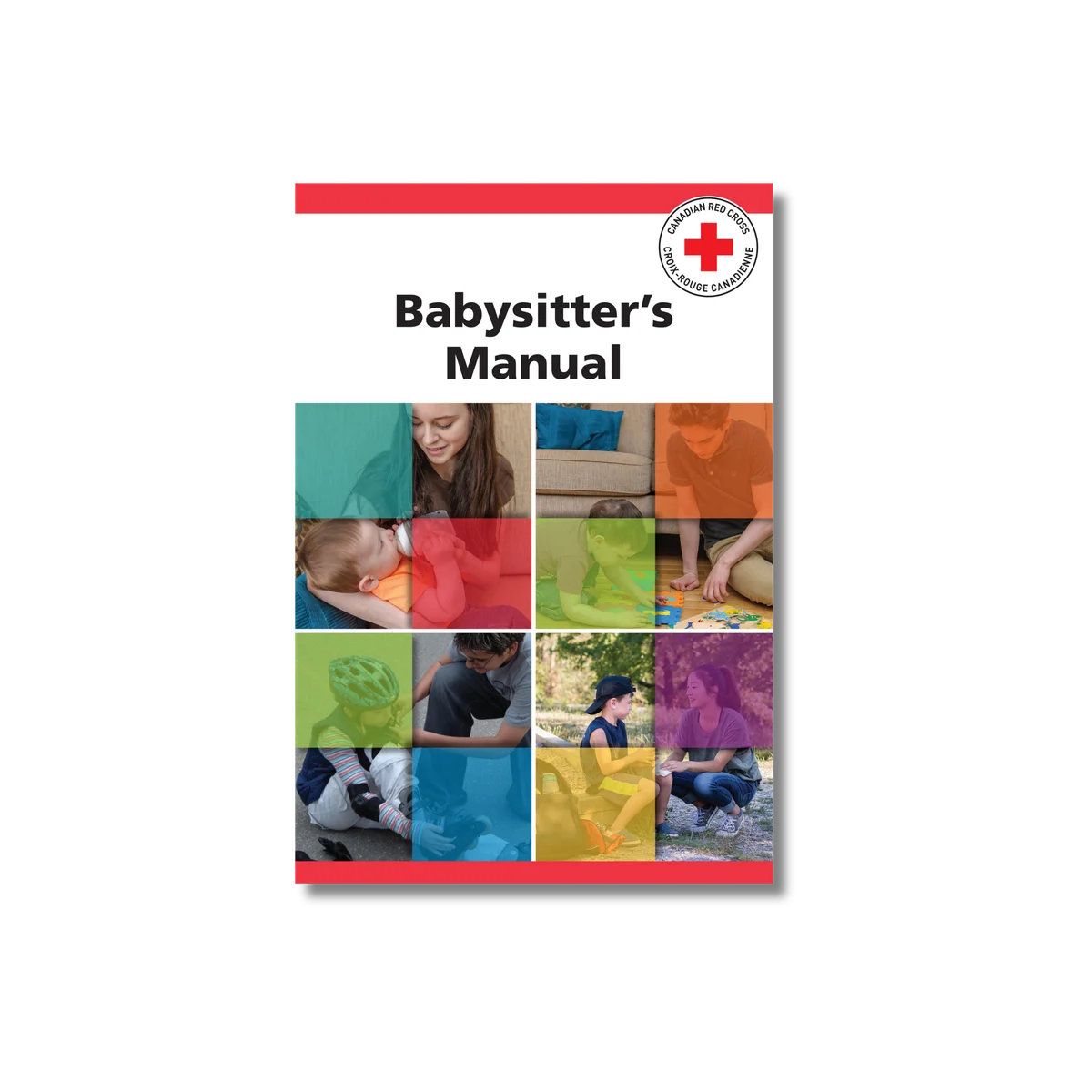
Canadian Red Cross Babysitter's Manual
$35.96 (10% off when you add it while registering)
$39.95Add it when you registerSee what this book covers
Bought on its own from the shop, it ships to you at full price. The discount exists only at registration.
Ready to take this course?$120.00 + GST & applicable taxes
Common questions
- How old does my child have to be to take the Babysitting course?
- The Canadian Red Cross First Aid Program Standards 2025 require that learners be 11 years of age or older, or have completed Grade 5. We enrol on that rule exactly. If your child is younger, contact us and we will point you at Stay Safe!, the Red Cross home-alone course, which has a lower minimum age.
- My child is 16. Are they too old for this course?
- No. The Canadian Red Cross publishes a minimum age only, and no maximum. Descriptions of the course as being for young people aged about 11 to 15 describe the intended audience rather than a cut-off, and we do not put an upper age limit on any course we run. If an older teen wants this specific certificate, they are welcome.
- How much is it, and how long does it take?
- The fee is on this page, and each scheduled date carries its own hours and start time. Everything is confirmed in writing before you pay, including what is included and the refund and transfer terms.
- Can I book a date right now?
- Yes, whenever a date is showing under Upcoming dates on this page. We run it in person in Calgary and Leduc, and live online for anyone in Canada. If nothing on the list suits you, tell us the city, the format and the window you want, and we will either tell you what is coming or arrange a private run for a group.
- Does a parent have to register, or can my teenager do it themselves?
- A parent or guardian registers anyone under 18 and accepts the registration policies on their behalf, and learners under 16 do not hold their own portal account with us. We also keep what we collect about a young participant deliberately minimal, and media consent is a separate, optional choice that never affects whether they can attend.
- Will this certificate let my teen work in a daycare or an out-of-school care programme?
- No, and you should be cautious of anyone who suggests it will. Requirements for licensed child care roles in Alberta are set through provincial child care licensing and by your employer or licensing officer, not by a training provider, and this youth course is not built for them. Send us the exact wording your teen was given and we will tell you honestly which of our courses matches it, or that none does.
- Is the course in person or online?
- We deliver it both ways, and which format is running depends on the intake. In-person is the better choice for a learner who benefits from an instructor physically correcting their technique, so mention your preference when you register your interest and we will tell you when a suitable session is scheduled.
- Does the Babysitting certificate expire?
- The Canadian Red Cross sets the validity terms for this certificate. We confirm the current terms with you in writing at registration rather than publishing a period here that could be out of date. Adult first aid training taken later is a separate course with its own validity, not a renewal of this one.
- Can I take this course if English isn't my first language?
- Yes. Our instructors teach in English, and live-translated classroom text is available for this course in supported languages. Contact us before registering to confirm that your language is available for your course.
Where to go next
Ready to register?
Pick your cohort above, or start here and choose your dates on the registration page.
Cancellation, transfer, and refund terms are shown before payment and confirmed at registration. Not sure which course fits? Email us and we’ll help.
Sources
- On successful completion you receive a Canadian Red Cross Babysitting certificate. Canadian Red Cross (verified 2026-07-23).
← All courses · Last reviewed 2026-07-25