
The one-day tier of the Canadian Red Cross child care program: emergency-level first aid and CPR for the people who look after infants and children, in eight hours. Taught by instructors who work as paramedics, firefighters and emergency professionals.
Read more about this courseShow less
Before you book, check one word in whatever paperwork sent you here: if it says Standard rather than Emergency, you need the two-day course instead, and we would rather tell you now.
Course details
- Certificate
- Canadian Red Cross Emergency Child Care First Aid & CPR B
- Certificate valid for
- 3 years
- Issued by
- Canadian Red Cross
- Duration
- Approx. 8 hours (1 day)
- Prerequisites
- None
- CPR / BLS
- What is CPR-B?CPR-B covers children and babies.It is offered inside the child care first aid courses rather than on its own.More about CPR levels
- Locations
- Calgary, AB, 1550 5 St SW #300, Leduc, AB, 4810 50th Ave
- Price
- $140.00 + GST & applicable taxes (charged at checkout for your province)
How this course runs
- In person: one or two days at our location. Nothing to do online beforehand.
- How it runs
- One day in class. Nothing online.
- Class times
- 9:00 a.m. to 5:30 p.m.
- Whole course
- 8 hours
Upcoming dates, choose your cohort
CalgaryOct 15, 2026 · Calgary, AB, 1550 5 St SW #300
Waitlist only- Thu, Oct 15 · 9:00 a.m. to 5:30 p.m.in class
Registration is closed for these dates.
October 2026
SMTWTFS12345678910111213141516171819202122232425262728293031In person: 1 class day, nothing online
In person(no online sessions)
- 1 full day in class
CalgaryIn person: one or two days at our location. Nothing to do online beforehand.Waitlist only. Join the waitlist and we’ll email you the moment a seat is available.
Edmonton regionDec 1, 2026 · Leduc, AB, 4810 50th Ave
- Tue, Dec 1 · 9:00 a.m. to 5:30 p.m.in class
Registration closes November 30, 2026.
December 2026
SMTWTFS12345678910111213141516171819202122232425262728293031In person: 1 class day, nothing online
In person(no online sessions)
- 1 full day in class
Edmonton regionIn person: one or two days at our location. Nothing to do online beforehand.CalgaryJan 26, 2027 · Calgary, AB, 1550 5 St SW #300
- Tue, Jan 26, 2027 · 9:00 a.m. to 5:30 p.m.in class
Registration closes January 25, 2027.
January 2027
SMTWTFS12345678910111213141516171819202122232425262728293031In person: 1 class day, nothing online
In person(no online sessions)
- 1 full day in class
CalgaryIn person: one or two days at our location. Nothing to do online beforehand.Unsure if Emergency Child Care First Aid is what you need?
Figure out what you need in under 30 seconds, with these simple questions.
- Answer a few questions
- See the course that fits and why
- Pick a date and register
- Become certified
I’m taking the training myselfFor my job, a job I want, school, or my own life.I’m arranging training for my staff or workplaceSee what your workplace needs, and the course for it.Basic and Intermediate First Aid both include CPR. A CPR course on its own does not include first aid.
Edmonton regionFeb 18, 2027 · Leduc, AB, 4810 50th Ave
- Thu, Feb 18, 2027 · 9:00 a.m. to 5:30 p.m.in class
Registration closes February 17, 2027.
February 2027
SMTWTFS12345678910111213141516171819202122232425262728In person: 1 class day, nothing online
In person(no online sessions)
- 1 full day in class
Edmonton regionIn person: one or two days at our location. Nothing to do online beforehand.CalgaryMar 18, 2027 · Calgary, AB, 1550 5 St SW #300
- Thu, Mar 18, 2027 · 9:00 a.m. to 5:30 p.m.in class
Registration closes March 17, 2027.
March 2027
SMTWTFS12345678910111213141516171819202122232425262728293031In person: 1 class day, nothing online
In person(no online sessions)
- 1 full day in class
CalgaryIn person: one or two days at our location. Nothing to do online beforehand.Edmonton regionApr 8, 2027 · Leduc, AB, 4810 50th Ave
- Thu, Apr 8, 2027 · 9:00 a.m. to 5:30 p.m.in class
Registration closes April 7, 2027.
April 2027
SMTWTFS123456789101112131415161718192021222324252627282930In person: 1 class day, nothing online
In person(no online sessions)
- 1 full day in class
Edmonton regionIn person: one or two days at our location. Nothing to do online beforehand.CalgaryMay 15, 2027 · Calgary, AB, 1550 5 St SW #300
- Sat, May 15, 2027 · 9:00 a.m. to 5:30 p.m.in class
Registration closes May 14, 2027.
May 2027
SMTWTFS12345678910111213141516171819202122232425262728293031In person: 1 class day, nothing online
In person(no online sessions)
- 1 full day in class
CalgaryIn person: one or two days at our location. Nothing to do online beforehand.Edmonton regionJun 17, 2027 · Leduc, AB, 4810 50th Ave
- Thu, Jun 17, 2027 · 9:00 a.m. to 5:30 p.m.in class
Registration closes June 16, 2027.
June 2027
SMTWTFS123456789101112131415161718192021222324252627282930In person: 1 class day, nothing online
In person(no online sessions)
- 1 full day in class
Edmonton regionIn person: one or two days at our location. Nothing to do online beforehand.CalgaryJul 15, 2027 · Calgary, AB, 1550 5 St SW #300
- Thu, Jul 15, 2027 · 9:00 a.m. to 5:30 p.m.in class
Registration closes July 14, 2027.
July 2027
SMTWTFS12345678910111213141516171819202122232425262728293031In person: 1 class day, nothing online
In person(no online sessions)
- 1 full day in class
CalgaryIn person: one or two days at our location. Nothing to do online beforehand.Edmonton regionAug 5, 2027 · Leduc, AB, 4810 50th Ave
- Thu, Aug 5, 2027 · 9:00 a.m. to 5:30 p.m.in class
Registration closes August 4, 2027.
August 2027
SMTWTFS12345678910111213141516171819202122232425262728293031In person: 1 class day, nothing online
In person(no online sessions)
- 1 full day in class
Edmonton regionIn person: one or two days at our location. Nothing to do online beforehand.CalgarySep 16, 2027 · Calgary, AB, 1550 5 St SW #300
- Thu, Sep 16, 2027 · 9:00 a.m. to 5:30 p.m.in class
Registration closes September 15, 2027.
September 2027
SMTWTFS123456789101112131415161718192021222324252627282930In person: 1 class day, nothing online
In person(no online sessions)
- 1 full day in class
CalgaryIn person: one or two days at our location. Nothing to do online beforehand.
What you’ll be able to do
- Recognize and respond to the life-threatening emergencies of infancy and childhood
- Perform CPR to the Level B standard on children, infants and adults
- Respond to choking in a child and an infant without freezing
- Use your own take-home pocket mask for ventilations
- Handle the first minutes that decide how the story goes, until help arrives
- Know exactly what the Standard tier adds, and when your paperwork demands it
- Keep your certification current with the shorter renewal path
- Walk back into the day home knowing the worst five minutes are rehearsed
Ready to take this course?$140.00 + GST & applicable taxes
Emergency or Standard: check the wording first
The Canadian Red Cross child care program has two tiers. This one, Emergency Child Care First Aid, is the one-day, eight-hour course built around the life-threatening core: the emergencies where what you do in the first minutes decides how the story goes. Standard Child Care First Aid is the two-day, sixteen-hour tier that starts from the same foundation and then goes wider and deeper across the injuries and sudden illnesses of infancy and childhood. Both carry CPR Level B.
Which tier you need is usually decided by whoever asked you to get certified: child care licensing wording, an agency, or an employer. The word to find in your paperwork is Emergency or Standard. If it names Standard, this course will not satisfy the person who wrote it, however well you do in it.
Send us the exact sentence you were given and we will confirm the match before you pay. Telling somebody they booked the wrong tier is a bad five minutes; telling them after their paperwork was rejected is much worse.
What practising it is actually like
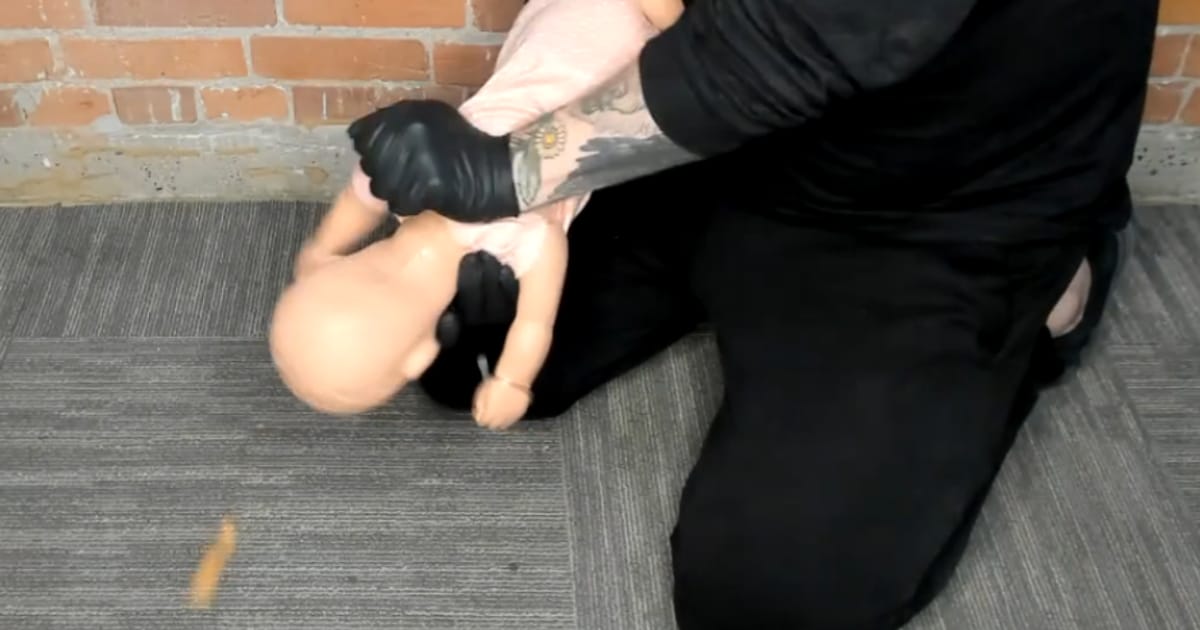
Because this is a Canadian Red Cross course, the Red Cross owns the curriculum and we teach to their standard, so we are not going to reprint their lesson list here. What is ours to describe is the room: you are on the floor with infant and child manikins, and the skills are practised until they stop feeling strange, because a choking infant is not the moment to be doing something for the second time in your life.
CPR Level B is the child care level: it covers the patients this course exists for, children and infants, along with adult CPR. The compressions, the breaths and the technique changes between a child and a baby are exactly the things that get repeated.
What Delta adds is instructors who work as paramedics, firefighters and emergency professionals, and who have run real pediatric calls. The scenarios are built the way those calls actually unfold: a day home, a playground, a parent on the phone, and a small patient who cannot tell you what happened.
A pocket mask that goes home with you
Your fee includes a hard-shell pocket mask: the real clamshell mouth-to-mask device, with the one-way filter valve, the elastic strap and the case. It comes out of its packaging in class, you train with it on the manikins, and then it goes home with you.
Nobody hands you a mask another class used and wiped down. Yours is new, and after the course it belongs wherever the children are: the diaper bag, the kitchen drawer, the day home first aid kit.
Who this suits, and who should take the two-day course
The one-day tier fits people whose paperwork names the emergency level, and people certifying by choice rather than requirement: parents and grandparents who want the life-threatening core handled in a single day, occasional caregivers, and relatives who mind the kids on weekends.
Take Standard Child Care First Aid instead when your licensing, agency or employer wording names it, which in licensed child care it very often does, or when you look after children as your work and want the depth that comes with the second day.
If you are certifying a whole day home, agency or centre staff, ask about onsite delivery and we will also help you confirm which tier your licensing officer expects before anybody pays.
How the certificate works
Certification is not automatic. You attend the full course and demonstrate the skills to the instructor, on the floor, to the Red Cross standard. Nobody is passed on attendance alone.
What you receive is a Canadian Red Cross Emergency Child Care First Aid & CPR B certificate, valid for three years. Read the date printed on it the day it arrives and put a reminder in your calendar; a shorter recertification path exists, and it is only open while your certificate is still valid, so renew before the expiry date rather than starting over.
Register with your legal name spelled exactly the way your licensing paperwork will expect to see it. That spelling is what gets printed.
Registering, and what to bring
Come dressed to work on the floor: clothing you can kneel and lean in, closed shoes, hair tied back. Bring water and something to write with; it is a full day.
If you have an injury, a mobility limitation, a hearing consideration or anything else that changes how you take part, tell us when you register rather than on the day. We can plan around most things with notice.
There is no prerequisite and no previous certificate required. If you are booking for a group, ask about onsite delivery: we bring the course to day homes, agencies and centres in Calgary, in the Leduc and Edmonton region, elsewhere in Canada, and internationally on request, for an additional fee covering travel and setup.
Who this course is for
- Parents and grandparents who want the life-threatening core in one day
- Occasional and weekend caregivers, aunts, uncles and family friends
- Day home providers whose licensing wording names the emergency level
- Nannies and babysitters stepping up from the youth courses
- Foster and kinship caregivers meeting an agency requirement
- Church, community and drop-in program volunteers who mind children
- New parents who want CPR for their own baby handled before it matters
- Anyone told to get child care first aid whose paperwork says Emergency
English isn’t your first language?
Our instructors teach in English, with live-translated classroom text available in supported languages. You can follow explanations on screen while participating in the same hands-on training as the rest of the class.
Because translated explanations require additional reading and processing time, your instructor may occasionally pause before moving to the next topic. This can make the instructional pace slightly slower.
Optional preparation materials may also be available before class to help you become familiar with common English first aid terminology.
Languages are confirmed course by course, so none is guaranteed until we confirm it with you.
Contact us before registering to confirm that your preferred language is available for your course.
Related reading
- Why Child and Infant CPR Is Not Adult CPR Made SmallerMost adult cardiac arrests start with the heart. Most in children start with breathing, and nearly every difference in pediatric CPR follows from that.
- Child Care First Aid Versus the Babysitter CourseTwo courses, two different students, and a job posting that names neither. How to tell which certificate your employer actually wants.
- Choking Infants: The One Thing You ChangeFor a choking infant you change one thing, and the reason is anatomical. What a chest thrust is, and why size changes the technique.
Where we teach this course
Public sessions run in Calgary, with dates in Leduc through the year.
We also deliver this course at your worksite for groups, useful for crews who can’t release staff to travel. Onsite delivery carries an additional fee on top of per-person pricing. Request an onsite quote.
We travel for private and group training across Canada, and internationally by arrangement. If you’re outside Alberta, tell us where you are and we’ll price it.
Ready to take this course?$140.00 + GST & applicable taxes
Common questions
- What is the difference between Emergency and Standard Child Care First Aid?
- Hours and depth. Emergency is the one-day, eight-hour tier built around the life-threatening core. Standard is the two-day, sixteen-hour tier that goes wider and deeper across childhood injuries and sudden illnesses. Both carry CPR Level B. If your licensing or employer wording names Standard, the one-day course will not satisfy it.
- Is this course enough for licensed child care in Alberta?
- That is decided by provincial child care licensing and interpreted by your licensing officer, agency or employer, not by a training provider, and licensed settings very often name the Standard tier. Send us the exact wording you were given and we will confirm which course matches before you pay.
- What is CPR Level B?
- The child care CPR level: it covers children and infants, the patients this course exists for, along with adult CPR. It is not Level C and not BLS, so if separate paperwork asks you for those, tell us and we will point you at the right course.
- How long is the certificate valid?
- Three years, printed on the certificate. A shorter recertification path exists, so put a reminder in your calendar and renew before the date passes rather than starting over.
- Do I need any experience or a previous certificate?
- No. There is no prerequisite and no previous first aid or CPR certificate is required.
- Do we practise mouth-to-mouth on each other?
- No. There is no direct mouth-to-mouth contact between students. Ventilation skills are practised on manikins with barrier devices, and the pocket mask you train with is brand new and goes home with you.
- Can you certify our whole day home, agency or centre?
- Yes. We deliver onsite for an additional fee covering travel and setup, across Alberta and beyond, and we will help you confirm which tier your licensing officer expects before anybody registers. Send us your staff count and location.
- I mostly babysit in the evenings. Is this the right course?
- Maybe more than you need: the Babysitter course exists for youth sitters, and this course suits adults who care for children regularly or whose paperwork asks for child care first aid. Tell us who you look after and how often, and we will answer honestly.
- What is the difference between CPR-A, CPR-B, CPR-C and BLS?
- The letter tells you which age groups you are trained on. CPR-A covers adults: the lowest level there is, which is why it pairs with the short entry-level workplace course. CPR-B covers children and infants: offered inside the child care first aid courses rather than on its own. CPR-C covers adults, children and infants: the level most people are asked for, and the next one up from A. BLS (Basic Life Support) covers adults, children, infants and neonates: Basic Life Support CPR, also known as Healthcare Provider CPR, a professional level CPR course used by firefighters, nurses, paramedics, doctors and other healthcare workers. Broader is not automatically better for you, though. If a form names a specific letter, the letter printed on your certificate is what the person checking it will be looking for, so match the wording you were handed rather than assuming a higher level will be accepted in its place. This course carries CPR-B, covering children and infants.
- What counts as a baby, a child or an adult, and which ages does this course cover?
- This course carries CPR-B, which covers children and infants. The Canadian Red Cross 2025 standards set the age groups this way. A baby is under 1 year old. A child is 1 year old up to the onset of puberty. An adult is anyone from the onset of puberty on. Puberty does not happen on a set birthday, so you judge it on the person in front of you. A 13 year old who has started puberty gets adult CPR, and one who has not is still a child. For an AED, use child pads on a child up to the onset of puberty or under 55 pounds (about 25 kg), and baby pads on a baby if the AED has them. If baby pads are not there, use child or adult pads. If child pads are not there, use adult pads. The Red Cross says adult pads are safe on a child or a baby, so do not wait for the right size. If you are training for a specific person, tell us their age and we will tell you which course fits.
- Can I take this course if English isn't my first language?
- Yes. Our instructors teach in English, and live-translated classroom text is available for this course in supported languages. Contact us before registering to confirm that your language is available for your course.
Where to go next
Ready to register?
Pick your cohort above, or start here and choose your dates on the registration page.
Cancellation, transfer, and refund terms are shown before payment and confirmed at registration. Not sure which course fits? Email us and we’ll help.
Sources
- On successful completion you receive a Canadian Red Cross Emergency Child Care First Aid & CPR B certificate. Canadian Red Cross (verified 2026-07-23).
- The Canadian Red Cross First Aid Program Standards 2025 define a baby as newborn to 1 year of age, a child as 1 year old to the onset of puberty, and an adult as the onset of puberty and older. Canadian Red Cross (verified 2026-09-26).
- The Canadian Red Cross Comprehensive Guide for First Aid & CPR (2025) says pediatric AED pads should be used on children up to the onset of puberty or weighing less than 55 pounds, and that if pediatric pads are not available it is safe to use adult pads on a child or baby. Canadian Red Cross (verified 2026-09-26).
← All courses · Last reviewed 2026-08-01