
Why Child and Infant CPR Is Not Adult CPR Made Smaller
Most adult cardiac arrests start with the heart. Most in children start with breathing, and nearly every difference in pediatric CPR follows from that.
Jarrett Chisholm, ACP · September 3, 2026 · clinically reviewed by Jarrett Chisholm, ACP
The differences between adult and child CPR are usually taught as a list. A different ratio when there are two rescuers, a different depth, a different hand position, breaths that matter more, an AED that matters less. Learned as a list they are hard to keep hold of and easy to swap around under stress.
Image needed · hero
infant-cpr-two-thumb-encircling-technique.jpg
Tight close up of an adult's hands using the two thumb encircling technique on an infant manikin lying on a firm surface. Both thumbs side by side on the lower half of the breastbone, fingers wrapped around the back of the chest. Shoot from the manikin's feet at a low angle so thumb placement and finger position are both visible. Plain neutral background, even soft light, no shadow across the hands.
Alt text ready: “Close view of two thumbs positioned on the centre of an infant manikin's chest with the fingers encircling the back”
None of it is arbitrary. Almost every difference comes from a single fact: adults and children usually arrive at cardiac arrest by different routes, and the treatment follows the route rather than the size of the patient. Once you know the route, you can rebuild most of the list from first principles instead of memorising it.
In an adult, the usual story is a heart that was already unwell and an electrical rhythm that fails suddenly. Breathing was normal a minute earlier, and the blood in the body is still carrying oxygen. What is missing is circulation, and often a shock to restore an organised rhythm. That is why compressions and a defibrillator sit at the top of the adult priority list.
A child's story usually runs the other way. Something interferes with breathing or with circulation first: a blocked airway, a severe asthma attack, drowning, a serious infection, blood loss. The heart itself is usually healthy and keeps working as long as it can, slowing as the oxygen runs down, stopping last rather than first. By the time a child is in cardiac arrest, the body has already been short of oxygen for some time.
Why the breaths come back to the centre
That timeline is why rescue breaths are not an optional extra in pediatric CPR. Compressions move blood, but if the blood reaching the brain and the heart muscle has already been stripped of oxygen, moving it faster does not deliver much. In a child that reserve is usually spent before the arrest happens, which is part of why the course where infant and child work gets the most floor time gives so much of its two days to airway and breathing. the course where infant and child work gets the most floor time.
The same logic explains an instruction that otherwise sounds backwards. A lone rescuer who finds an unresponsive adult calls for help and fetches a defibrillator first, because the treatment that adult most likely needs is a shock and it is not in the room. A lone rescuer who finds an unresponsive child gives about two minutes of CPR before leaving, because the treatment that child most likely needs is oxygen, and that is already in the room.
Ratios come from the same place. With two trained rescuers working on a child or an infant, the compression to breath ratio tightens so that more breaths are delivered for the same amount of compression time. A single rescuer stays on the wider ratio, not because the child needs less air, but because one person switching constantly between tasks loses more in interruptions than the extra breaths gain.
Why the mechanics change
Depth is a proportion rather than a fixed measurement: roughly one third of the front to back depth of that chest. A small chest is far more flexible than an adult one because much of it is still cartilage, so it gives easily. That produces a predictable error. People doing infant CPR push too gently, because the movement required looks alarming on something that small. The two finger and two thumb techniques exist to make the force controllable, not simply to make it smaller. Which one you learn depends on the course. The child care courses use two fingers. Basic and Intermediate First Aid teach two fingers first, then two thumbs with your hands around the chest, so you can feel how much better the thumbs work. BLS and the professional responder courses teach two thumbs only.
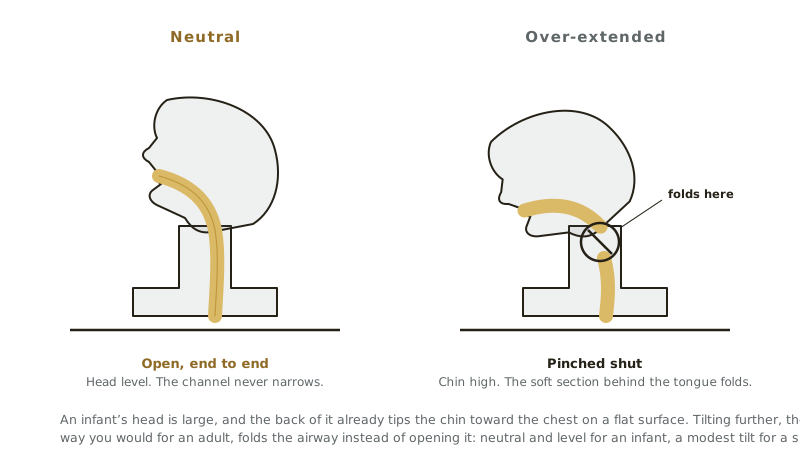
Airway geometry is the change people most often get backwards. An infant has a large head relative to the body and a short, soft windpipe. Lying on their back, the size of the back of the head already tips the chin toward the chest. Tilting the head back as you would for an adult does not open that airway, it folds it. An infant's head goes to neutral and level, and a small child gets only a modest tilt. If breaths are not going in, correct the position before you add effort.
Breath size is governed by the stomach. Give only enough air to make the chest begin to rise, then stop. Push harder and the pressure exceeds what the top of the oesophagus will hold, so air goes into the stomach instead of the lungs. A stomach full of air presses the diaphragm upward, reduces how much the lungs can take on the next breath, and makes vomiting more likely, which then threatens the airway you were working to protect.
Where the AED sits, and what this article is not
In adults a shockable rhythm is common in the first minutes, which is what makes a defibrillator the highest value action available to a bystander. In children it is less common, because the heart is failing from a lack of oxygen rather than an electrical fault. Attach the AED anyway and let the machine decide. It simply moves down the order, behind good ventilation and good compressions. If your adult skills are rusty, a short session on adult compressions and an AED fixes that separately. a short session on adult compressions and an AED.
Many machines carry pediatric pads or a key that lowers the energy delivered, and you should use them when they are there. If they are not, use the adult pads rather than none, because no defibrillation is worse than an imperfect dose. On a very small chest, where two pads would otherwise touch, put one on the front and one on the back.
One thing to be clear about. This is an explanation of why pediatric CPR is shaped the way it is, so that the technique is easier to hold and easier to perform when you are frightened. It is not a substitute for hands on training with an instructor and a manikin, and reading it does not certify anyone. If it is your teenager who is about to start looking after other people's children for money, what a young babysitter actually gets taught is worth reading before you decide. what a young babysitter actually gets taught.
Quick answers
- Why do children need rescue breaths during CPR?
- Because most cardiac arrests in children begin with a breathing problem, so the blood is already short of oxygen by the time the heart stops. Compressions then circulate blood that has little to deliver unless somebody puts air back in.
- How deep should chest compressions be on a child or an infant?
- About one third of the front to back depth of that chest, which is a proportion rather than a fixed measurement. That is also why the technique changes as the chest gets smaller: two hands for an adult, one or two hands for a child, and two fingers or two thumbs for a baby.
- Should you tilt an infant's head back to open the airway?
- No, an infant's head goes to neutral and level. The windpipe is short and soft, so tilting the head back the way you would for an adult folds the airway closed instead of opening it.