September Is When Families Find Out They Need a Certificate
September brings a rush of childcare and babysitting certificate requests. Here is what this week covers, and the age rules that catch people out.
Jarrett Chisholm, ACP · August 31, 2026
The last week of August is when the phone starts. A daycare centre asks a new hire for a certificate before their first shift. A school sends a form home about a field trip. A fourteen year old is offered work watching the neighbours' children on Friday nights, and their parents decide they want them trained before that happens. Every year it lands at once, and every year a good number of people pay for the wrong course.
Image needed · hero
september-first-aid-classroom-calgary-childcare-staff.jpg
Wide shot of a bright training room. Six to eight adults in casual clothes kneeling on foam mats, each with a child sized CPR manikin in front of them. An instructor in a Delta polo standing at the left, mid sentence, hands demonstrating a compression. Natural light from a window on the right. Shoot at eye height from the back of the room at f4 so the nearest two students are sharp and the rest fall off gently. No student faces need to be identifiable.
Alt text ready: “Adults kneeling on foam mats in a training room, each practising on a child sized CPR manikin while an instructor demonstrates”
This week the Dispatch is about the childcare end of first aid: which course belongs to which person, what actually separates a babysitting course from an adult child care certificate, why CPR on a small child is not adult CPR done gently, and what to say to a new sitter before you walk out the door.
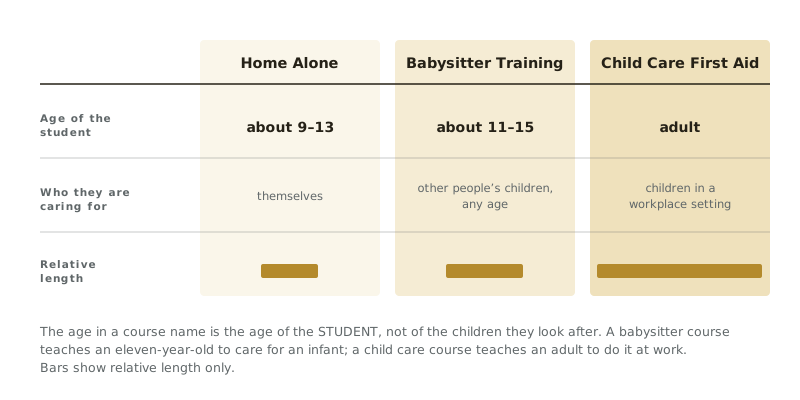
Before any of that, the mistake that costs the most money. The age attached to a course is almost never the age of the child being looked after. It is the age of the student sitting in the room, and once you know that, three quarters of the confusion goes away.
Written down it sounds obvious. On the phone in early September it is the most common mix up we hear, and it sends people to the wrong booking page steadily for a month. It runs in both directions too: adults ring asking for the babysitting course because the children they work with are babysitting age.
The age band belongs to the student, not the child
A babysitting course is written for a young teenager. The pace, the vocabulary, the scenarios and the assumptions all point at a student somewhere in the eleven to fifteen range who has never had a job and is about to be responsible for someone else's children for the first time. The children they end up minding could be any age at all, including babies. Nothing in the course name tells you about them.
Child care first aid is an adult course. The room holds early childhood educators, day home operators, out of school care staff, nannies, camp leaders, foster parents and people who simply want the longer certificate. They are assessed at adult standard and they are expected to be the responsible person on scene, because in their setting they will be. Again, the ages of the children they work with are not what the course title is describing.
There is a third course that gets caught up in this and it is not a babysitting course at all. It is for a child who will be at home on their own for a couple of hours after school, and the subject is that child's own safety rather than looking after anybody else. Parents book it every September thinking it is a junior version of babysitter training. It is a different thing entirely.
Three courses that sound similar and are not
Babysitter training is a single day, and it is half first aid and half job. A sitter learns to ask a family the right questions before accepting the work, to hold a bedtime that is being negotiated at them, and to act when a child chokes, falls badly, burns a hand, reacts to something they ate, or stops responding. Judgement runs through all of it, including the decision to phone a parent rather than sort something out alone. If your teenager is the one taking it, the course built for the eleven to fifteen age band is what you want, and the first aid inside it is real first aid rather than a softened version. the course built for the eleven to fifteen age band.
Home alone training is shorter again and pitched younger, roughly nine to thirteen. The subject is a child on their own for a short stretch after school: locking the door behind them, deciding who gets answered and who does not, staying out of trouble in the kitchen, and getting hold of an adult who is not in the building when something goes wrong. A child who finishes it has not been trained to mind a younger sibling, and it is worth saying that plainly at home before the first evening somebody tries it.
Child care first aid is the long one. Two days, adult level, with the infant and child material running through a full first aid and CPR certificate rather than sitting on the end as an extra. If you are being hired into a licensed childcare setting, the adult certificate childcare employers most often ask for is almost always what the posting is pointing at. Read the exact wording your employer gave you before you book, and if it is vague, ask them to be specific in writing. the adult certificate childcare employers most often ask for.
What is in the Dispatch this week
Wednesday goes deep on child care first aid against the babysitter course, including how to read a job posting that names neither of them properly and what to ask an employer who says only that first aid is required. Thursday is clinical: why child and infant CPR is not adult CPR scaled down, and what the physiology is doing that makes each of those changes necessary. Saturday is short and practical, a five minute conversation to have with a new sitter before you leave, written out so you can hand it over.
If you already know you need something and would rather be pointed at it than read about it, work through the questions and see what fits, then book from there. September sessions fill from the front. A course that is full on the fifteenth is no use to somebody starting work on the sixteenth, and moving a start date is usually harder than booking three weeks early. work through the questions and see what fits.
Quick answers
- What first aid course does a teenage babysitter need?
- A babysitting course, which is written for students around eleven to fifteen and combines first aid with the practical side of the job. Adult child care first aid is a longer certificate aimed at people working in childcare settings.
- Is a babysitting course the same as child care first aid?
- No, they are different courses for different students. Babysitter training is a one day course for young teenagers, while child care first aid is a two day adult certificate for people who work with children.
- When should I book a childcare first aid course for September?
- Book in August if you can, because September sessions fill from the front of the month. A certificate that arrives after your start date does not help you, and moving a start date is usually harder than booking early.