The Delta Dispatch
Alberta Fire Applicants & EMRs: Master the Medical Portion with Paramedics and Firefighters
Succeeding in the medical portion of a firefighter or EMR application in Alberta comes down to mastering the fundamentals under pressure. At Delta Emergency Support Training, active paramedics and firefighters teach you vital patient assessment skills, accurate vitals, effective communication, and safe medication administration.
Why Fire Applicants Fail the Medical Portion (And How to Prepare)
Firefighting is one of Alberta’s most demanding careers, and the medical portion of the application ensures candidates can handle life-or-death situations both trauma and medical, under pressure. Many applicants struggle, not because they lack dedication, but because they underestimate the scenario-based, high-pressure nature of this part of the evaluation. Here’s what to know and how to prepare.
1. Not Understanding the Scenario-Based Format
Applicants may know first aid procedures but are unprepared for realistic simulations. Evaluators look for:
Correct prioritization of patient care
Efficient use of available equipment
Accurate assessment of vitals (pulse, blood pressure, respiration, oxygen saturation)
Maintaining composure under pressure
Preparation Tip:
Practice scenarios under timed conditions. Include taking accurate vitals for each patient, documenting them, and adjusting care accordingly. Repetition builds both speed and confidence.
2. Poor Time Management During Simulations
Time pressure is a common challenge during firefighter medical evaluations. Some applicants try to rush through tasks, either spending too long on minor details or speeding through essential steps. This can result in incomplete assessments, inaccurate vitals, missed medication checks, or poor patient communication.
Key Tip:
Don’t rush—take your time to work methodically.
Focus on the fundamentals of your patient assessment: scene safety → primary survey → airway, breathing, circulation → vitals → medications → secondary survey → ongoing care.
If you get stuck or feel pressured, return to the basics and systematically work through each step. Accuracy and thoroughness are more important than speed.
Use practice scenarios to balance efficiency with careful, precise assessment.
Preparation Tip:
Use a mental checklist: Scene safety → Primary survey → Secondary survey → Ongoing care → Hand-off report.
Practice completing your assessment efficiently while still accurately measuring vitals and administering medications.
Practice whenever you can! Run calls in your head.
3. Lack of Critical Thinking
Memorized procedures aren’t enough—patients don’t always behave as expected. Evaluators want to see adaptability: can you adjust your care based on vital signs, patient feedback, or medication needs?
Preparation Tip:
Train with scenarios including complications like fluctuating vitals, patient distress, or adverse medication reactions.
Ask yourself after each practice: “How would I adjust their oxygen saturations fall, or a medication has unexpected effects?”
4. Inadequate Patient Communication
Medical competence isn’t just technical—communicating clearly with patients is critical. Poor communication can make patients anxious or uncooperative, affecting assessment accuracy.
Preparation Tip:
Practice explaining what you’re doing and why while performing assessments and administering medications.
Use calm, clear language: “I’m going to give you your medication now; it may make you feel drowsy. Let me know if you feel unwell.”
Listen and respond to patient concerns—they may give vital clues about their condition.
5. Not Knowing Medications, Indications, and Contraindications
Many applicants fail by being unsure about common medications, their proper use, or when not to administer them. Evaluators want to see that you can safely give medications if required, understand dosage, and recognize contraindications.
Preparation Tip:
Study common pre-hospital medications: aspirin, epinephrine auto-injectors, nitroglycerin, oxygen, and glucose.
Know the indications (when to use), contraindications (when not to use), dosage, and potential side effects.
Practice scenario-based administration with simulated patients.
6. Inadequate Knowledge of Fire-Specific Medical Risks
Alberta applicants face unique hazards: industrial chemicals, wildfires, smoke inhalation, cold-weather trauma. Failing to anticipate these can affect performance.
Preparation Tip:
Focus on airway management, burns, smoke inhalation, rapid trauma assessment, vitals monitoring, and safe medication use.
Understand environmental impacts: extreme temperatures, long ambulance response times, and remote locations.
7. Overlooking Soft Skills and Professionalism
Evaluators notice panic, poor teamwork, and rushed or inaccurate communication. Both soft skills and technical skills are tested simultaneously.
Preparation Tip:
Role-play with peers, focusing on calm, professional communication.
Practice reporting vitals and medications verbally and accurately to simulate handoff to paramedics.
Debrief after every scenario: identify strengths and areas for improvement.
8. Tips for Final Preparation
Simulate Realistic Conditions: Wear PPE, gloves, and work under distractions to mimic real assessments.
Practice Accurate Vitals and Medication Use: Include pulse, respiration, oxygen saturation, blood pressure, and scenario-based administration of medications.
Time Your Scenarios: Track your completion time without sacrificing accuracy.
Review Fundamentals: CPR, airway management, bleeding control, shock recognition, spinal immobilization, and medications.
Debrief Every Practice: Discuss patient communication, vital trends, medication decisions, and overall decision-making.
Conclusion
The medical portion of the firefighter application isn’t meant to trip you up—it ensures you’re ready to handle emergencies. By practicing realistic scenarios, taking accurate vitals, communicating effectively with patients, knowing your medications, managing your time, and thinking critically, Alberta applicants can approach the evaluation confidently and maximize their chances of success.
At Delta Emergency Support Training, you’ll be taught by active paramedics and firefighters, gaining real-world insights and practical skills that go beyond the textbook. This hands-on instruction ensures you’re fully prepared for both the medical portion of your firefighter application and real-life emergencies.
Check, Call, Care: The First Aid Formula That Saves Lives
Emergencies happen fast. Learn how to act quickly and safely using the Red Cross Check, Call, Care model. From assessing scene safety to checking ABCs and calling 911, this guide breaks it down step-by-step.
A Red Cross-aligned guide to recognizing and responding to medical emergencies with clarity and confidence
In a real emergency, adrenaline kicks in. You may feel frozen or overwhelmed—but a simple, proven three-step approach helps cut through the chaos:
🟥 Check
🟧 Call
🟩 Care
This method, taught by the Canadian Red Cross, provides a clear framework that anyone—whether trained in basic or advanced first aid—can follow. At Delta Emergency Support Training, we use this model to help our learners build real-world readiness in life’s most urgent moments.
Let’s break down each step, including when and how to act, what to say to 911, and how to begin providing lifesaving care.
🔴 STEP 1: CHECK
Scene Safety Comes First—Always
Before you rush in to help, pause and assess the scene. Why? Because your safety matters, too.
Ask yourself:
Is the scene safe for me?
What hazards might be present? (e.g., live wires, traffic, aggressive individuals, hazardous materials)
What happened here? Can I tell how the person got injured?
Are there other people hurt? Do I need more help?
You can't help anyone if you become the second victim. Scene safety isn't optional—it’s essential.
Example: If someone has collapsed on the sidewalk near a construction site, your first thought might be “Help them!” But first, ask: Could there be falling debris? Is it safe to approach?
Check the Person
Once the scene is safe, approach the person from the side and check for responsiveness.
Start by speaking to them:
“Hi, can you hear me?”
“My name is ____. I’m trained in first aid. I’m here to help.”
No response? Try physical stimulation:
Tap them firmly on the shoulder and ask, “Are you okay?”
If they do not respond to voice or touch, they are unconscious.
At this point, it's time to move to step two: CALL 911.
🟧 STEP 2: CALL
Calling for Help: Alone or With Others
Your next move depends on your situation.
If you’re alone:
For an unresponsive person, call 911 immediately before starting care.
If you don’t have a phone and you can safely move the person, take them with you. If not, leave briefly to call for help.
If someone is with you:
Assign them directly: “You, in the blue shirt—call 911 now and come back to tell me what they say.”
This direct command avoids the bystander effect and ensures help is on the way.
What to Tell the Dispatcher
Stay calm and provide the following:
Your exact location (address, landmarks, GPS if possible)
What happened (e.g., “A person collapsed and is unresponsive.”)
The condition of the person (conscious? breathing?)
Any care you are providing (e.g., “I’m starting CPR.”)
Your phone number in case the call drops
Follow their instructions and do not hang up until told to.
🟩 STEP 3: CARE
Now it’s time to help.
Check ABCs – Airway, Breathing, Circulation
Kneel beside the person. Begin your primary assessment:
🔹 Airway
If the person is unresponsive, assume their airway could be blocked.
Perform a head-tilt, chin-lift:
Place one hand on the forehead, two fingers under the chin, and gently tilt the head back.
This opens the airway unless a spinal injury is suspected.
🔹 Breathing
Place your ear close to their mouth and nose, facing their feet.
Look for chest movement, listen for breath sounds, and feel for breath on your cheek.
Check for 5 to 10 seconds.
If they are not breathing normally, prepare to begin CPR.
🔹 Circulation
As you check breathing, scan the body for major bleeding.
Look under the body if safe to do so.
Severe, visible bleeding must be addressed immediately—use direct pressure with gloved hands or a clean dressing.
Provide Appropriate Care Based on the Assessment
Depending on what you discover:
If unresponsive and not breathing:
Start CPR (30 compressions, 2 breaths) immediately.If unresponsive but breathing normally:
Place the person in the recovery position to keep their airway clear and continue to monitor them.If responsive and bleeding heavily:
Apply direct pressure, use a dressing if available, and keep them calm and still.If a spinal injury is suspected:
Do not move the person unless they are in immediate danger. Support their head and neck in the position foundand wait for EMS.
🔁 Continue to Monitor and Support
Stay with the person until EMS arrives. Provide emotional support if they’re conscious. If their condition changes, recheck ABCs and adjust your care.
🧠 Final Thoughts
"Check, Call, Care" isn’t just a slogan—it’s a lifesaving sequence that gives ordinary people the power to respond to emergencies with clarity and confidence.
At Delta Emergency Support Training, we teach this model as the foundation of all our Red Cross-aligned courses—from Standard First Aid and CPR/AED Level C to Advanced First Aid / EMR.
📣 Take Action
🩺 Ready to learn more than just theory?
🧰 Want real skills from experienced paramedics and certified Red Cross instructors?
Enroll in a Standard First Aid course with Delta Emergency Support Training and be prepared to step up—safely, smartly, and confidently.
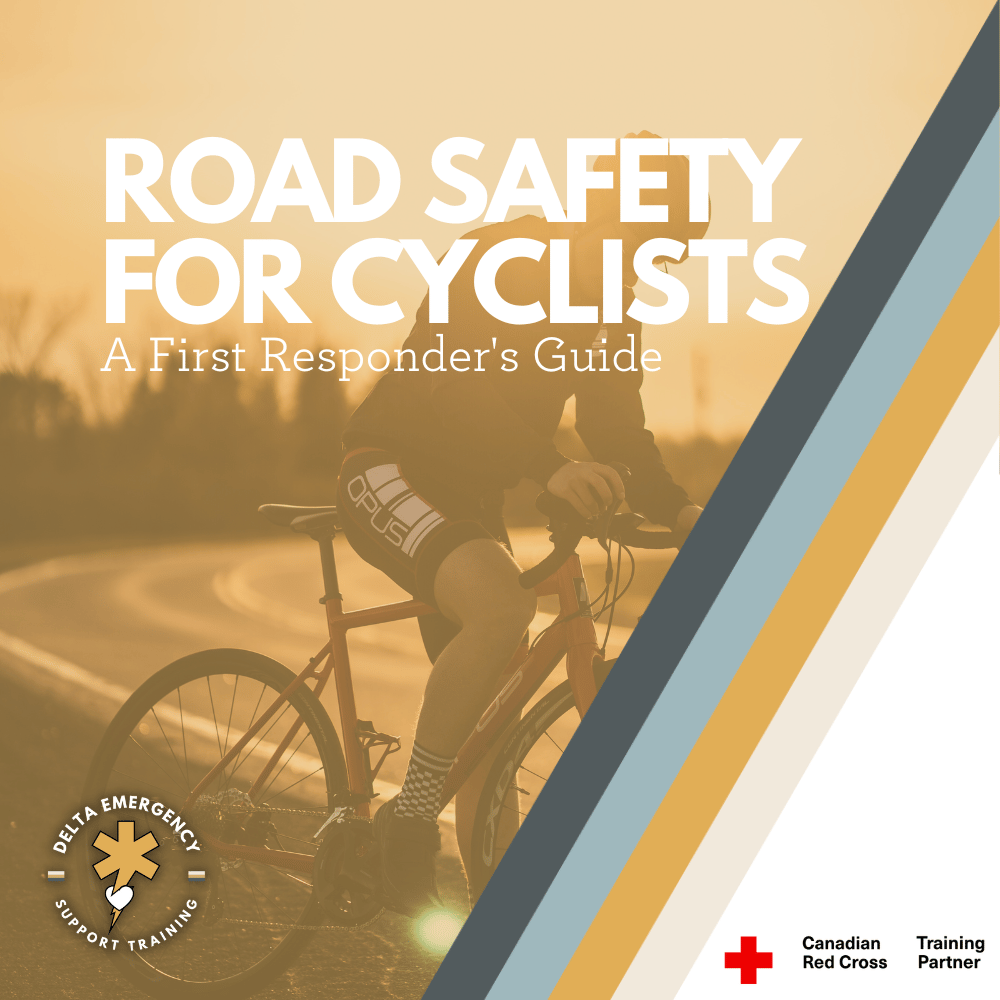
Road Safety Tips for Cyclists: A First Responder's Guide
In our guide for first responders and firefighters, we emphasize crucial road safety tips tailored for cyclists. From the paramount importance of wearing helmets to the necessity of being visible on the road, these insights are indispensable for fostering safer cycling environments. By obeying traffic laws, riding defensively, and utilizing bike lanes effectively, cyclists and motorists can work together to prevent accidents and promote road safety for all.
cyclist riding off to the side of the road
As a first responder, your role in ensuring road safety extends beyond responding to emergencies. It involves proactive measures to prevent accidents and mitigate their impact. When it comes to bicycle safety, understanding the rules of the road and adopting defensive strategies are crucial for both cyclists and motorists. In this guide, we'll explore essential road safety tips for cyclists, equipping first responders and firefighters with knowledge to promote safer roads for everyone.
Wear Your Helmet: The importance of wearing a helmet cannot be overstated. A properly fitted helmet significantly reduces the risk of head injuries in the event of a crash. First responders often witness the devastating consequences of head trauma, making it imperative to stress the importance of helmet use to cyclists. Ensure that your helmet fits snugly and sits level on your head, with the straps securely fastened.
Be Visible: Visibility is key to avoiding collisions, especially in low-light conditions or inclement weather. Cyclists should equip their bikes with front and rear lights, as well as reflectors, to increase visibility to motorists. Wearing brightly colored or reflective clothing further enhances visibility, making it easier for drivers to spot cyclists on the road.
Obey Traffic Laws: Cyclists are subject to the same traffic laws as motorists. This includes obeying traffic signals, yielding to pedestrians, and signaling intentions to turn or stop. By adhering to traffic laws, cyclists can predictably navigate the road, reducing the likelihood of accidents caused by confusion or misinterpretation of cyclist intentions.
Ride Defensively: Defensive cycling involves anticipating potential hazards and taking proactive measures to avoid them. Stay vigilant and alert while riding, scanning the road for obstacles, parked cars, and erratic drivers. Maintain a safe distance from vehicles, especially large trucks or buses, and avoid riding in their blind spots. Additionally, be prepared to react quickly to sudden changes in traffic or road conditions.
Use Bike Lanes and Paths: Whenever possible, utilize designated bike lanes and paths to separate cyclists from vehicular traffic. Bike lanes provide a dedicated space for cyclists, reducing the risk of collisions with motor vehicles. However, remain cautious and watch for obstacles or hazards within bike lanes, such as debris or parked cars.
Communicate Effectively: Communication is essential for safe cycling. Use hand signals to indicate turns, stops, and lane changes, allowing motorists and other cyclists to anticipate your actions. Make eye contact with drivers at intersections to ensure they see you before proceeding. Clear communication enhances mutual understanding on the road, promoting safer interactions between cyclists and motorists.
Conclusion:
As first responders and firefighters, your commitment to road safety extends beyond emergency response to proactive prevention measures. By promoting bicycle safety and educating cyclists and motorists alike, you can help reduce the incidence of accidents and injuries on our roads. Remember, a collective effort to follow the rules of the road and prioritize safety benefits everyone, creating a safer environment for cyclists and motorists alike. Together, we can make our roads safer for all road users.

