Stroke Is a Clock: Why Last Known Well Matters
Last known well is the first question the hospital asks. What happens to brain tissue during the delay, and why the answer decides the treatment.
Jarrett Chisholm, ACP · October 1, 2026 · clinically reviewed by Jarrett Chisholm, ACP
Where this is taught: Emergency Medical Responder, First Responder and Advanced First Aid.
Stroke is the emergency where the most valuable piece of information is not clinical at all. It is a time. Not the time you noticed, not the time you called, but the last moment anyone can vouch that the person was completely normal. Hospitals call it the last known well time, and it decides which treatments are still on the table.
Image needed · hero
stretcher-arriving-at-hospital-scanner-entrance.jpg
Hospital corridor or ambulance bay entrance, cool overhead lighting. Empty made-up stretcher being pushed through automatic doors, a wall sign reading CT visible above. One person in dark uniform trousers and a plain shirt walking alongside, glancing at a wrist watch. Motion blur on the wheels, crew face not identifiable, no patient in frame, no real institutional branding or logos visible.
Alt text ready: “A stretcher being wheeled through hospital doors under a sign reading CT, with a crew member walking alongside checking a watch.”
Behind that question sits a specific piece of biology, and it is worth understanding, because it explains why the answer is so unforgiving.
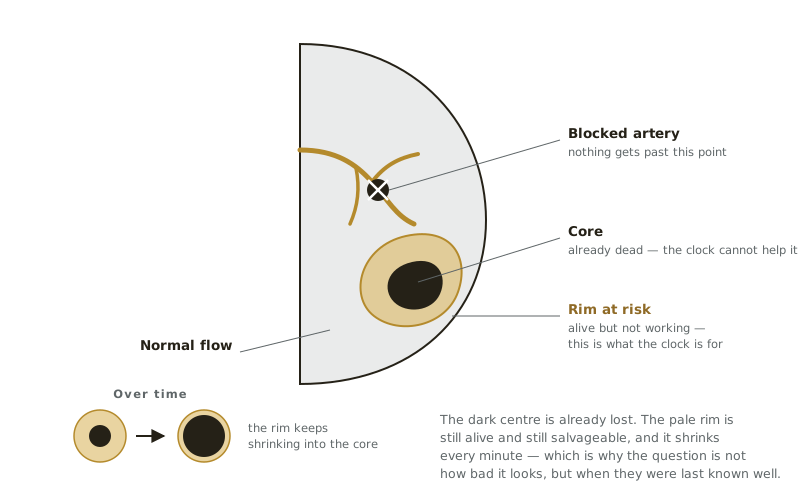
An ischaemic stroke is a blocked artery in the brain. Downstream of the blockage the tissue splits into two zones. At the centre, where flow has essentially stopped, cells die within minutes and nothing brings them back. Around that core sits a rim of tissue kept barely alive by blood arriving through small connecting vessels from neighbouring territory. That rim is not dead. It is not working either, and it is the reason the person's arm is weak and their speech has gone.
Treatment exists for the rim. Reopen the artery and tissue in the rim can go back to work. Leave it and the rim converts, steadily and permanently, into more core. Every minute of delay moves the boundary the wrong way. The figure usually quoted to convey the scale is on the order of two million neurons lost per minute. It is an estimate rather than a measurement, and the scale is the whole point of quoting it.
Why the question is a time and not a symptom
Two treatments hang on that clock. A clot-dissolving drug given into a vein is generally considered within roughly the first four and a half hours from last known well. Pulling the clot out mechanically with a catheter reaches further, out to twenty four hours in carefully selected patients with the right imaging, but it happens at a limited number of centres and the selection gets harder as the hours pass. Both decisions are made against the clock rather than against how bad the person looks in the room.
This is why the wake-up stroke is such a problem. Someone goes to bed well and wakes with a weak arm, and those symptoms might be twenty minutes old or eight hours old with no way to tell from the outside. Absent better information, the clock runs from bedtime. Anything you can add narrows it. A trip to the bathroom at two in the morning where they walked normally, a message they typed at four, a partner who spoke to them at five: those details change what can be offered, and only the people who were there have them.
The question to answer, then, is not when did you notice. It is when did you last see them completely themselves, and you should be ready to defend the answer. Guess early and you may cost the person a treatment option. Guess late and you may hand a treatment to someone it can harm. Getting comfortable with that kind of precise, unglamorous history taking is a large part of the responder level programme we teach in Calgary. the responder level programme we teach in Calgary.
Why nobody treats until the scan
About one stroke in seven is a bleed rather than a blockage, and from the outside the two can look identical. Weakness down one side, slurred speech, a drooping face: none of that tells you which you are looking at. The distinction is made by a CT scan and it is absolute, because a drug that rescues a person with a clot will kill a person with a bleed.
That is the reason you do not give aspirin for a suspected stroke, whatever you may have heard about chest pain. It also explains why an ambulance may pass a nearer hospital to reach one with a scanner and a stroke team, and why the crew will ask about blood thinners, recent surgery, and the time again, in the same words, after you have already answered. A meaningful share of these clots begin in a fibrillating upper chamber of the heart, so the irregular rhythm behind many of these strokes is not an idle question. the irregular rhythm behind many of these strokes.
Notice also what the crew does not do. Oxygen is not handed out routinely to a stroke patient whose oxygen levels are already normal, because pushing extra oxygen into an injured brain has not been shown to help and may not be harmless. That restraint surprises people who assume oxygen is always a kindness, and it is a fair illustration of a larger point: when supplemental oxygen actually helps and when it does not is a subject in its own right. when supplemental oxygen actually helps and when it does not.
The strokes that get missed
Face, arm, speech, time is the standard prompt and it catches most strokes in the front of the brain. What it misses are the ones at the back, and those are the strokes that get sent home. Sudden severe dizziness with an inability to stand or walk, sudden double vision or loss of vision to one side, sudden clumsiness in one hand, sudden difficulty swallowing, or the worst headache of a person's life arriving out of nowhere: all of those are stroke presentations, and not one of them fails a smile test.
Sudden is the operative word throughout. Neurological symptoms that arrive over seconds to a minute or two point at a blood vessel. The same symptoms building over days point somewhere else. If a deficit appears and then clears completely within the hour, that is not a false alarm to be filed away. It is a transient ischaemic attack, and the risk of a full stroke in the days that follow is high enough to be investigated urgently rather than at leisure.
This article explains the reasoning so that the urgency makes sense when you are standing in the middle of it. It is not a substitute for hands-on training with an instructor, and reading it does not certify anyone to assess or treat a stroke. Recognition is easy on a page and much harder in a hallway at six in the morning with a family talking over each other.
Quick answers
- What is the last known well time in a stroke?
- It is the last moment anyone can confirm the person was completely normal, not the moment symptoms were noticed. Treatment windows are counted from that point, which is why a hospital asks it first.
- Why is stroke treatment so time dependent?
- Around the dead core of a stroke sits a rim of brain tissue that is still alive but not working, and it converts to dead tissue as the minutes pass. Reopening the artery early is what rescues that rim.
- Should you give aspirin to someone having a stroke?
- Give nothing at all, because roughly one stroke in seven is a bleed and looks identical from the outside. Only a CT scan separates the two, and aspirin is dangerous in the bleeding kind.