Heart Attack and Stroke: The First Ten Minutes
Two emergencies where the first ten minutes belong to whoever is in the room. What actually helps, and the delays that cost the most.
Jarrett Chisholm, ACP · September 28, 2026
Where this is taught: Intermediate First Aid, CPR-C & AED and Basic First Aid.
Two emergencies account for most of the calls where a bystander genuinely changes the ending. One is a blocked artery in the heart. The other is a blocked or bleeding artery in the brain. Both are plumbing problems, both are treatable, and in the common form of each the treatment is to open the vessel back up. What decides whether that treatment works is almost entirely how much time has passed before it starts.
Image needed · hero
bystander-calling-911-beside-seated-man.jpg
Domestic kitchen, natural window light. Man in his sixties seated upright on a hard chair, one hand loosely on his sternum, looking unwell but conscious. Woman kneeling at his side, mobile phone to her ear, other hand steadying his shoulder, mouth open mid-sentence. Shoot at seated eye level, 35mm, shallow depth of field so the background clutter falls away. No blood, no drama, no uniforms.
Alt text ready: “A woman kneeling beside an older man seated on a kitchen chair, phone held to her ear, one hand on his shoulder.”
That clock does not start when the ambulance arrives. It starts at the moment the symptoms begin. Everything in between, the deciding, the waiting to see if it settles, the phone call to a family member first, comes out of the same budget as the treatment itself.
Most of the time lost in these two emergencies is not medical. It is human. People wait because the symptoms are milder than they expected, because it is the middle of the night, because they do not want to be the person who called an ambulance over indigestion. Those delays are the largest changeable factor in how heart attack and stroke end, and they happen in a living room, long before anyone in uniform is involved.
The useful skill here is not clinical. It is recognition, and the willingness to act on an incomplete picture. Most first aid training spends its hours on the doing. This one is about the deciding, because in these two emergencies the deciding is where the outcome is won or lost.
What the first ten minutes are actually for
Nothing you do at the kitchen table reopens a blocked artery. That happens in a hospital, with a drug or with a catheter, and it is out of your hands. What the first ten minutes buy is the earliest possible start on the process that gets the person there, plus a handful of small things that make the next stage faster.
The list is short and none of it is heroic. Call 911 rather than driving. Get the person sitting still rather than walking to the car. Write down the time the symptoms started, because you may be the only person who will ever know it. Unlock the door and turn the outside light on. Put the medications in the house into one bag. Send someone out to the street if the address is awkward to find. Every one of those is time that then does not have to be spent later, with the person in front of you.
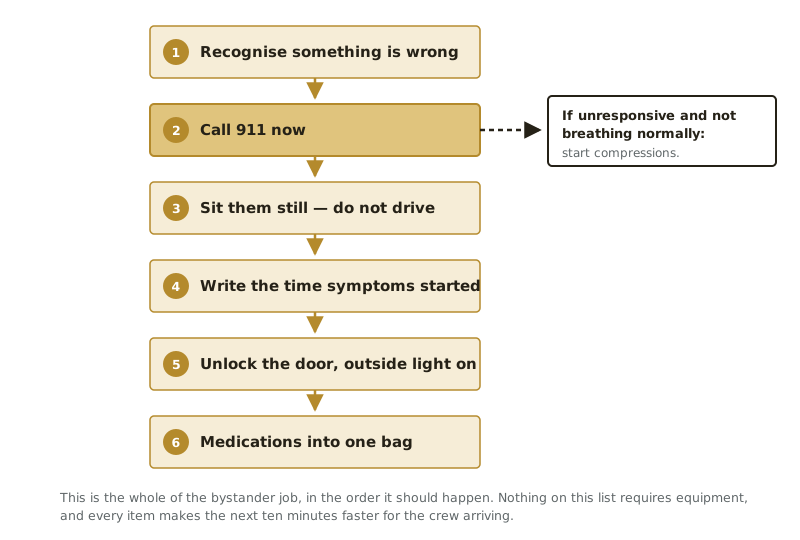
Driving to hospital yourself is the decision that costs the most, and it is the one people make most often. An ambulance is not a taxi with a siren. It carries a monitor, and what the crew is reading on that tracing decides which hospital you go to and what is standing by when you arrive. A person who turns up by private car starts at the back of that process, in a waiting room, describing symptoms to a clerk. what the crew is reading on that tracing.
The heart and the brain ask different things of you
For the heart, treat new discomfort above the waist as cardiac until someone with a monitor says otherwise. Sit the person down. If they carry their own nitroglycerin, they can take it the way they have been directed to. Aspirin is often suggested by the dispatcher, and that is where the instruction should come from, because there are people for whom it is the wrong call. If they stop responding and are not breathing normally, this has become a cardiac arrest and the answer changes to compressions, which is the argument for an evening practising compressions and the AED on a manikin before you ever need them. an evening practising compressions and the AED on a manikin.
Stroke asks a narrower question. Ask them to smile, ask them to hold both arms out with their eyes shut, ask them to repeat a short sentence. Any one of those failing is enough, and you are not collecting all three. Note the time they were last completely normal, because that is the question the hospital will ask first. Give nothing to eat or drink, since a stroke that affects swallowing turns a glass of water into a lung problem.
Both share an instruction people ignore. If the symptoms go away, still go. A deficit that clears in twenty minutes is a warning with a name and an urgent pathway, and a meaningful share of the people who have one go on to a full stroke within days. The relief is the trap.
Recognition is a rehearsed skill, not a read one
Reading this is not the same as doing it. In a room with a frightened person in it, the tidy list evaporates and what is left is whatever you have rehearsed. That is the entire argument for classroom time with somebody watching you, and it is worth a few minutes to work out which level of training fits what you actually do, because the answer is different for a parent, a site supervisor, and someone heading towards clinical work. work out which level of training fits what you actually do.
Quick answers
- What should you do in the first ten minutes of a suspected heart attack or stroke?
- Call 911 straight away, keep the person sitting still, and write down the exact time the symptoms started. Those three things do more for the outcome than anything else available to a bystander, because every treatment that follows is judged against that clock.
- Should you drive someone to hospital for chest pain?
- Call an ambulance rather than driving them yourself. The crew carries a cardiac monitor, and what it shows determines which hospital the person goes to and what is ready when they arrive.
- If stroke symptoms go away, do you still need to go to hospital?
- Go anyway, and go urgently rather than waiting for morning. Symptoms that clear within minutes often signal a transient ischaemic attack, and the risk of a full stroke in the days that follow is high.