A Heart Attack Rarely Looks Like It Does on TV
The clutch-the-chest picture misses a lot of real heart attacks. What the pattern actually looks like, and who tends to present quietly.
Jarrett Chisholm, ACP · October 7, 2026
Where this is taught: Advanced First Aid and Intermediate First Aid.
Television taught a generation what a heart attack looks like. A man clutches his chest, his face contorts, he goes down, and it is unmistakable. Real heart attacks are frequently none of those things, and the distance between the picture people carry and what actually arrives at an emergency department is measured in hours of delay.
Image needed · hero
instructor-explaining-cardiac-symptom-pattern.jpg
Training classroom, overhead fluorescent plus one window. Male instructor in a plain Delta polo, standing, demonstrating a closed fist held against the centre of his own chest. Four adult students seated at tables in the foreground, backs partly to camera, one taking notes. Shoot from the back of the room at standing height, 50mm, instructor sharp and students softly out of focus. No manikins in frame.
Alt text ready: “An instructor standing beside a whiteboard, one hand flat on his own sternum, demonstrating how people describe cardiac pressure to a small class.”
Start with the mechanism, because the presentation follows from it. A coronary artery narrows or blocks, usually because a fatty deposit in its wall tears and a clot forms over the tear. Downstream of that clot, heart muscle is working without enough oxygen, and it complains. What the person feels is that complaint, filtered through their own nervous system.
That filter is the part people underestimate. The size of the symptom does not track the size of the heart attack. Some of the largest events present as vague discomfort and profound tiredness, and some genuinely frightening chest pain turns out to be something else entirely. You cannot sort this by how dramatic it looks.
The practical response is to widen what counts as suspicious and to weigh the pattern rather than the intensity. That is a skill built deliberately, and it is most of what the longer course that goes deeper into medical emergencies spends its classroom hours on. the longer course that goes deeper into medical emergencies.
The pattern matters more than the pain
Pressure rather than sharpness is the usual description. People reach for heaviness, squeezing, tightness, a band, a weight, and they show you with a whole hand or a fist rather than a fingertip. Pain you can locate with one finger, pain that changes sharply as you breathe in, and pain that reproduces exactly when you press on the spot are all more typical of the chest wall and the lungs. None of that rules out a heart attack. It shifts the odds, which is all you are ever doing.
Spread is informative. Cardiac discomfort commonly travels to the jaw, the throat, one or both shoulders, the inner arm, or between the shoulder blades. This is a wiring artefact rather than anything mysterious: the heart shares spinal nerve segments with those regions, so the brain misfiles the signal and reports it somewhere with better representation. An aching jaw and a heavy left arm with very little in the chest is a presentation, not an oddity.
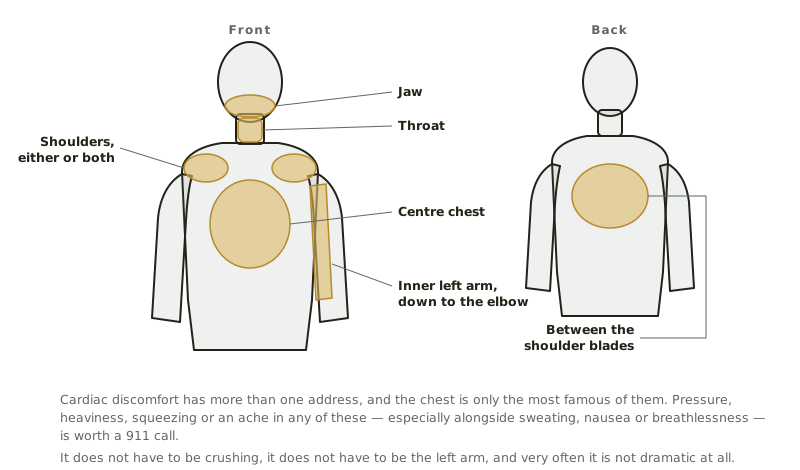
Company matters as much as location. Sweating out of proportion to the room, nausea, breathlessness, light-headedness, and a strong sense that something is badly wrong tend to travel with cardiac events. Sudden clammy sweat alongside any upper body discomfort is one of the more useful pairings in first aid, and it gets time in everything we run in Calgary and Leduc through the year for exactly that reason. everything we run in Calgary and Leduc through the year.
Who presents atypically, and why it matters
Women more often present without prominent chest pain and more often with breathlessness, fatigue, nausea, or discomfort in the back and jaw. The reasons are still argued over. The consequence is not: symptoms that do not match the television picture get taken less seriously, by the person having them as much as by anyone around them, and the delay to hospital runs longer.
People with long-standing diabetes are the other group worth knowing about. Diabetes damages small nerves over time, including the ones carrying pain signals from the heart, so the alarm is quieter or absent altogether. A heart attack may show up as sudden breathlessness, unexplained sweating, confusion, or simply feeling dreadful with no pain anywhere. Much the same holds for many people in their late seventies and beyond, where new confusion or a sudden inability to manage the stairs can be the whole presentation.
There is also the version that is not sudden at all. Discomfort that arrives with exertion, settles with rest, and has been doing that for a few weeks is angina. Angina that is becoming easier to provoke, lasting longer, or turning up at rest is the pattern that arrives in hospital as a heart attack a few days later. That change is a reason to be assessed now rather than at the next available appointment.
What to do with an uncertain picture
You are not being asked to diagnose. You are being asked to notice that several things have appeared together and to route the person to someone with a monitor and a blood test. A workable threshold: new discomfort above the waist in an adult, lasting more than a few minutes or coming and going, with any of sweating, nausea, or breathlessness, is a 911 call. Being wrong about that costs an ambulance ride. Being right and slow costs heart muscle that does not grow back, and that lopsided trade is why early recognition sits at the centre of the level healthcare providers are usually asked to hold rather than off to one side of it. the level healthcare providers are usually asked to hold.
Quick answers
- What does a heart attack actually feel like?
- Most people describe pressure, heaviness, squeezing or tightness rather than a sharp pain, often spreading to the jaw, throat, shoulder or inner arm. It commonly comes with sweating, nausea or breathlessness.
- Can you have a heart attack without chest pain?
- Yes, and it happens often enough to matter. People with long-standing diabetes, older adults and women more often present with breathlessness, fatigue, nausea or new confusion instead of pain.
- When should you call 911 for chest discomfort?
- Call when new discomfort above the waist lasts more than a few minutes or keeps coming back, especially alongside sweating, nausea or breathlessness. Waiting to see whether it settles is the most expensive choice on the table.