
When Oxygen Helps, and When It Does Not
Oxygen is not a general-purpose treatment. Here is the reasoning behind reaching for it, and the cases where it changes nothing.
Jarrett Chisholm, ACP · September 24, 2026 · clinically reviewed by Jarrett Chisholm, ACP
Where this is taught: Oxygen Therapy, Advanced First Aid and First Responder.
Oxygen has a reputation as the thing you give when a patient looks unwell and you are not sure what else to do. On a site with a cylinder sitting in the response kit, that instinct gets acted on often. It is worth understanding what oxygen can and cannot fix, because the answer is narrower than most people assume, and it explains a set of rules that otherwise look arbitrary.
Image needed · hero
oxygen-cylinder-and-regulator-in-response-bag.jpg
Plain overhead shot on a neutral grey surface. A small portable aluminium oxygen cylinder with a regulator fitted, gauge visible and reading full, lying beside an open black response bag. A sealed clear mask with tubing sits alongside, still bagged. Soft even light, no harsh reflection on the gauge glass, no branding on the cylinder or bag. Shot straight down, 50mm, everything in focus.
Alt text ready: “A small aluminium oxygen cylinder with a regulator attached, sitting in an open response bag next to a sealed mask and tubing.”
Start with what carries oxygen. Almost all of the oxygen in your blood is bound to haemoglobin. A very small amount is dissolved in the plasma, and at the pressures you can generate with a mask that dissolved fraction is close to irrelevant. Delivery to the tissues is roughly the amount of haemoglobin you have, multiplied by how full it is, multiplied by how fast the blood is moving.
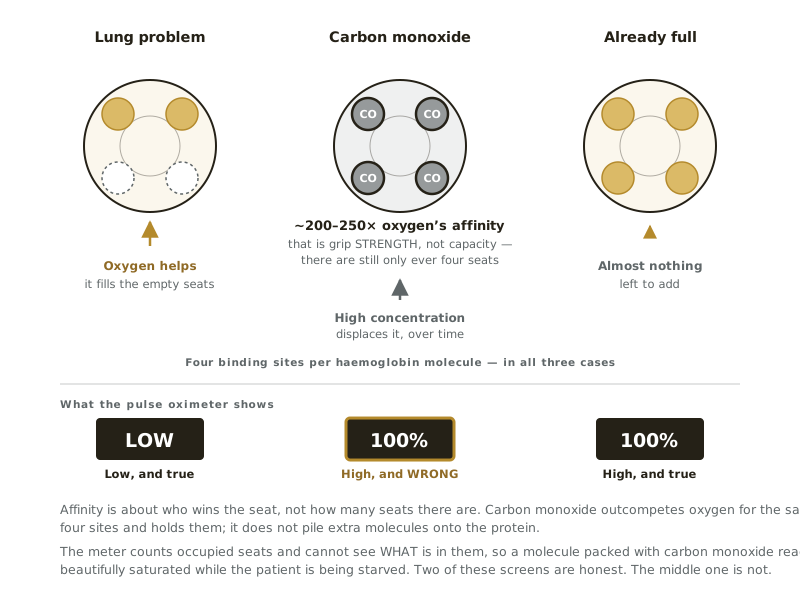
That one sentence tells you when supplemental oxygen works. It works when the haemoglobin is not full, because you are topping up the compartment that carries nearly everything. It does very little when the haemoglobin is already full, because the only thing left to add is the dissolved fraction, and there is almost no room in that compartment to add to.
So the useful question at a patient's side is not whether the person looks bad. It is whether there is reason to think their haemoglobin is arriving back from the lungs less than full, or that something has taken the carrying capacity away from them. where these decisions get practised under pressure.
Where oxygen genuinely changes the picture
The clearest case is a lung problem. Anything that stops oxygen crossing from the air into the blood, from a severe asthma attack to a chest injury to a near drowning to smoke in an enclosed space, leaves haemoglobin passing through the lung and coming out still partly empty. Raising the concentration of oxygen in the air going in pushes more across. That is oxygen doing precisely the job it is good at.
Carbon monoxide is the second case, and it is the one that catches people out on industrial sites. Carbon monoxide binds to haemoglobin in place of oxygen and holds on tightly, so the carrying capacity is occupied rather than empty. The pull is roughly 200 to 250 times stronger than oxygen's, and that figure describes grip rather than room: a haemoglobin molecule has four binding sites and never any more, so carbon monoxide wins those four seats instead of piling extra molecules onto the protein. That distinction matters, because a molecule with all four seats taken reads to a meter as a molecule that is beautifully full. A pulse oximeter cannot tell the two apart, which means the number on the screen can look reassuring while the patient is genuinely starved. High-concentration oxygen matters here because it shortens the time the carbon monoxide stays attached, and anyone pulled out of a space with a running engine, a generator, a propane heater or a fire gets it regardless of what the oximeter says.
Serious blood loss sits in a third category. Here the haemoglobin may be perfectly full, but there is either not enough of it left or it is not moving fast enough to matter. Oxygen is not the treatment in that situation, it is a small hedge while the real treatment, which is stopping the bleeding and getting the patient to definitive care, is arranged. Giving it is reasonable. Expecting it to solve the problem is not.
Where it does little, and where it does harm
A patient with a normal saturation and working lungs gains almost nothing from a mask. Chest pain is the classic example. For years oxygen went to everybody with a suspected heart attack, and the evidence that accumulated pointed the other way: routine oxygen in patients who were not short of it showed no clear benefit and raised reasonable concern about harm. Practice in most systems now is to give oxygen for a measured low reading, not for a diagnosis.
Harm arrives from two directions. Very high oxygen levels cause blood vessels to constrict and generate reactive molecules that injure tissue, which is why deliberately flooding a patient who does not need it is no longer treated as a neutral act. Separately, a small group of people with long-standing lung disease build up carbon dioxide when a high concentration is given and then left running unwatched. The mechanism is duller than the version most of us were taught: a high concentration undoes the lung's own habit of steering blood away from its worst areas, and blood that is fully loaded with oxygen carries less carbon dioxide than it did before, so more of it stays in the circulation. None of that is a reason to withhold oxygen from a hypoxic patient with lung disease. It is a reason to aim for a lower target and stay beside them while you do it.
Then there is the mistake that costs the most. Oxygen does not move air. If a patient is not breathing, or is barely breathing, or has an airway they cannot hold open, a mask on the face achieves nothing, because nothing is carrying the gas down to where the exchange happens. Airway control and ventilation come first every single time, and oxygen is what you enrich them with once they are working. A responder who reaches for the cylinder before opening the airway has the order backwards. the airway skills that have to come first.
How to think about it in the moment
Measure when you can, and know what the measurement is worth. A pulse oximeter is genuinely useful and it is genuinely wrong in cold fingers, in poor perfusion, in shivering and movement, under dark nail varnish, and in carbon monoxide exposure. Treat a low reading as real, and treat a normal reading as provisional when the story of the call says otherwise.
Set a target rather than a flow rate. Most protocols aim for a normal band of saturation in the general patient and a deliberately lower band in people with chronic carbon dioxide retention, then adjust the device to hold that band rather than picking a number of litres and walking away. Which figures apply to you depends on the protocol you work under, so read yours on a quiet day rather than during a call.
This article explains reasoning. It is not a substitute for hands-on training with cylinders, regulators and delivery devices, and reading it does not certify anyone to administer oxygen. Handling compressed gas safely, choosing between devices, and recognising a patient who is deteriorating despite the mask are practical skills, and they are learned with the equipment in your hands and someone watching. learn to run a cylinder and pick a delivery device.
Quick answers
- When does supplemental oxygen actually help a patient?
- It helps when haemoglobin is leaving the lungs less than full, which usually means a breathing or lung problem, and when carbon monoxide is occupying the carrying capacity. It does much less when the saturation is already normal.
- Why is oxygen no longer given routinely for a suspected heart attack?
- Because a patient who is not short of oxygen already has full haemoglobin, so a mask adds only the tiny dissolved fraction. The evidence built up over the last decade did not show benefit, so most systems now treat a measured low reading rather than a diagnosis.
- Does oxygen help someone who is not breathing?
- No, because oxygen only enriches air that something else is moving. A mask on a patient who is not breathing achieves nothing, so airway control and ventilation come first and oxygen is added once they are working.
Sources
- StatPearls, NCBI Bookshelf (US National Library of Medicine): Carbon monoxide binds haemoglobin with an affinity roughly 200 to 250 times that of oxygen, competing for the same four binding sites rather than increasing carrying capacity. (checked 2026-08-19)