
What a Usable Incident Record Contains
The report you write after an incident protects the patient and you. Here is what belongs in it, and what to leave out.
Jarrett Chisholm, ACP · September 23, 2026
Paperwork is the part of first aid that gets treated as an afterthought: filled in at the end of a shift, from memory, in the same twelve words every time. 'Worker reported sore back. Advised to see doctor. Returned to work.' A record like that is worse than nothing, because it looks like documentation while containing none.
Image needed · hero
responder-completing-incident-form-on-tailgate.jpg
Open tailgate of a white work truck, late afternoon light. A person in work gloves and a high-visibility sleeve is writing on a generic single-page incident form clipped to a clipboard, pen in hand, mid-word. A closed first aid bag and a pair of removed nitrile gloves sit beside it. Shoot from slightly above and behind the writer's shoulder, 50mm, so the form is legible as a form but the wording is not readable. No company names and no real patient details.
Alt text ready: “A gloved hand writing on a clipboarded incident form resting on the open tailgate of a work truck, with a first aid bag beside it.”
A record does three jobs. It carries information forward to whoever treats the patient next, which is the only one most people think about. It fixes the facts while they are still accurate, because memory reorganises an incident within hours and reorganises it again once the crew starts discussing it in the lunchroom. And it is the only evidence that what you did was reasonable, months or years later, when someone with no knowledge of the day asks what happened. the level where documentation stops being optional.
Those three jobs pull in the same direction, which is convenient. Writing for the next clinician produces a document that also holds up later. Writing to protect yourself first produces something defensive and vague that is useless to everybody, including you.
Below is what a usable record contains, and the small number of habits that separate a report you would be glad to have from one you would rather not read aloud.
Times, and why they carry so much weight
Write times down. Not 'this morning' and not 'around lunch'. Clock times, from a source that agrees with everyone else's clock, which in practice means your phone. The time the injury happened or was found, the time you reached the patient, the time you called, the time each significant thing changed, the time the ambulance arrived, the time it left.
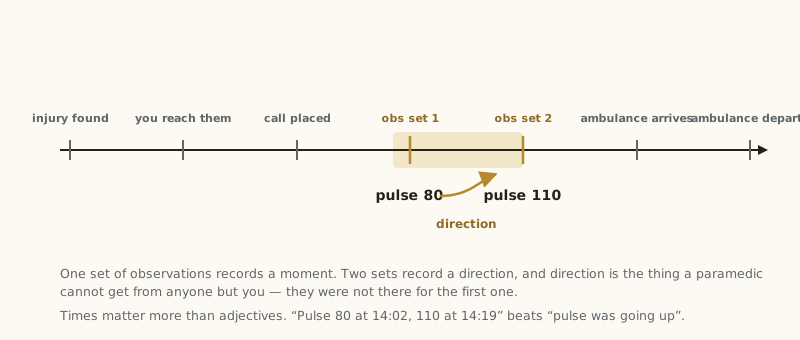
Times matter because nearly everything clinical is a rate of change. One set of observations tells the receiving clinician what the patient is like. Two sets, ten minutes apart, tell them which direction the patient is heading, and direction is what drives decisions. A patient whose pulse has climbed from 80 to 110 over fifteen minutes is a different problem from a patient who has been sitting at 110 since you arrived, and only the timestamps can separate them.
The same logic protects you. A gap in the record reads as a gap in the care, whether or not one existed, and nobody reading it later can tell the difference between nothing happening and nothing being written down. Times close those gaps for free.
Describe what you observed, not what you concluded
This is the habit that improves reports the most. 'Patient was in shock' is a conclusion. 'Skin pale and cool, sweating, pulse 124, anxious, asking the same question repeatedly' is an observation, and it is far more useful, because the next person can form their own view from it. Conclusions age badly and can be argued with. Observations do not and cannot.
Say what the patient said, in their own words, in quotation marks where you can manage it. 'It felt like something tore' carries more than 'complained of pain'. Record what you did and when you did it, including the things that did not work the first time: two attempts before the bleeding was controlled is useful clinical information, not a confession.
Record refusals in more detail than anything else on the page. If a worker declined care or declined transport, write down what you told them, the specific risk you explained, that they appeared to understand it, and that the decision was theirs. Refusals are the single most common place a record turns out to be too thin, and they are also the situation in which a thin record does the most damage. how we train workplace teams to document on their own site.
The parts people get wrong
Blanks come first. Do not fill in what you do not have, because 'unknown' is a legitimate and honest entry, while an invented detail, however harmless it seems at the time, quietly undermines every other line on the page.
Cause is the second trap. Whether somebody was following procedure, whether the guard was in place, whether the load was rated: those are investigation questions, and folding them into a care record contaminates both documents. Write what you saw and what you did. Let the investigation do its own work with its own methods.
Corrections and custody finish the list. If you need to change something, strike it through so the original stays readable, write the correction beside it, then initial and date the change, because a record that has visibly been amended honestly is stronger than a clean one somebody remembers differently. Treat the finished document as health information rather than site paperwork: it belongs somewhere restricted, not in a shared drive or a group chat. And finish it the same day, before the details soften, because a report written on Monday about a Friday incident is a memory of a memory. talk to us about your own incident form.
Quick answers
- What should a first aid incident record include?
- It should include clock times for every step, what you observed rather than what you concluded, the patient's own words where possible, exactly what you did and when, and a detailed note of any refusal of care or transport.
- Why do times matter so much in an incident report?
- Times turn a snapshot into a trend, and trends are what drive clinical decisions. Two sets of observations ten minutes apart show whether a patient is improving or deteriorating, which a single set can never show.
- Can you correct a mistake in a first aid record?
- Yes, by striking the error through so the original stays readable, writing the correction beside it, then initialling and dating the change. Do not rewrite the page or replace it with a clean copy.