Partial Versus Complete Choking: The First Three Seconds
A partly blocked airway and a completely blocked one need opposite responses. How to tell them apart in the first three seconds.
Jarrett Chisholm, ACP · August 12, 2026
The whole of choking management turns on a single question, and it is not the one people ask. It is not how hard to hit, or exactly where the hands go. It is whether any air is still moving. Everything you do next follows from that answer, and the two possible answers point in opposite directions.

A partial obstruction means the airway is narrowed but not sealed. Air is still going in and out, badly, past an object that is in the way. A complete obstruction means nothing is moving at all. Same object, same tube, entirely different problem, and the correct response to one is close to the worst thing you could do for the other.
Here is the part that people find counterintuitive. If the casualty is still moving air, the best thing you can do is very nearly nothing. Stand close, keep them calm, and let them cough. A cough is not a weak version of an abdominal thrust. It is a considerably more powerful one, generated from inside the chest with the airway briefly closed and then released, coordinated by a reflex that has been refined for exactly this job. No technique you apply from outside comes close to matching it.
Interfering with an effective cough is therefore a downgrade, and it carries a real risk on top of that. An object that is loosely held can be moved by a badly timed strike, and it does not always move in the direction you want. Converting a casualty who was coughing into a casualty who is silent is a genuine way to make a survivable situation worse, and it happens because helping feels better than watching.
The three-second test
Ask whether they are choking, in those words, and watch what happens rather than waiting for the reply. The question is useful because answering it takes air, so the manner of the answer tells you what you need before the content of the answer does. Someone who turns and says yes has an airway that is passing air. Someone who looks straight at you, opens their mouth and produces nothing has one that is not.
Sound means air. If they can speak, even one strangled word, air is moving past the obstruction. If they can cough forcefully, air is moving. If they are wheezing, gasping, or making a high-pitched noise on the way in, air is being dragged through a narrowed space, which is horrible to listen to and is not the emergency you are most afraid of. It is the other one, and it is the one where your job is to stay out of the way.
Silence is the sign that matters, and it is the sign bystanders miss, because people expect an emergency to announce itself. What a complete obstruction actually looks like is somebody standing up from the table, unable to make any noise at all, often putting a hand to the throat without ever having been taught to, and looking at whoever is nearest with an expression that is unmistakable once you have seen it. No sound and obvious distress means no air. Act.
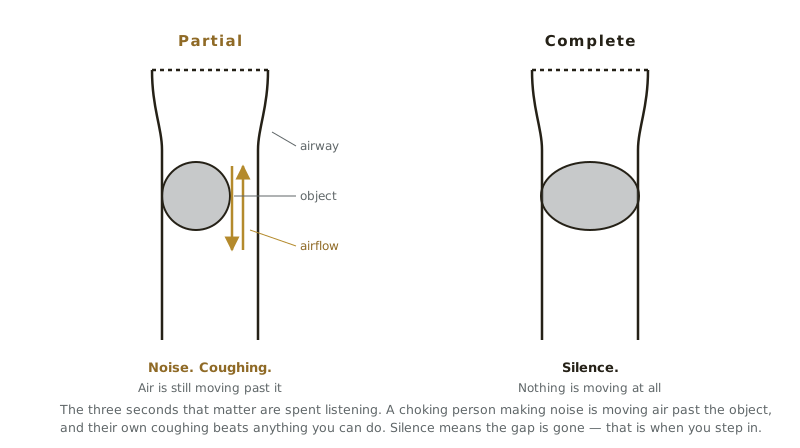
Anatomical figure: Anatomy & Physiology, Fig. 2411 Pharynx by OpenStax College, licensed CC BY 3.0. Cropped, recoloured, and combined with our own magnified airway panels and labels.
Why the responses are opposite
For a partial obstruction, your job is to protect the cough. Encourage it, do not slap the back, do not tell them to put their arms in the air, and do not offer water. Water is the standard restaurant response and it is a poor one: you are adding liquid to an airway that is already struggling to move air, and if the object shifts while they swallow you have made the problem harder rather than easier. Stand where they can see you, tell them to keep coughing, and do not crowd them.
When the airway is completely blocked, your job is to generate the pressure they can no longer generate for themselves. That is what back blows and abdominal thrusts exist to do, and Thursday's article takes the mechanism apart properly. The point worth carrying today is that those techniques are a substitute for a cough that has stopped working, which is precisely why you save them for the moment the cough actually stops working. how an airway is managed once equipment is in the room.
Between those two states there is a transition, and it is the reason you never walk away from a partial obstruction. Coughing is hard work. A casualty who has been coughing at full effort for a minute will tire, and a weakening cough is the leading edge of a complete obstruction rather than a sign of improvement. Stay within arm's reach, keep watching, and be ready to change what you are doing the second the noise stops. practise the airway sequence with an instructor watching.
Signs that arrive too late to be useful
Colour is a late sign. By the time the lips and face are visibly changing, the casualty has been without air long enough that you should have started a good while earlier. The same goes for a casualty who is going limp, or whose eyes are rolling. None of these are cues to wait for. They are evidence that a large part of your window has already been spent, and a rescuer who was taught to look for them will always start late.
Trust the sound instead, and trust it early. Noise means keep watching and keep them calm. Silence with obvious distress means act now. That one discrimination, made properly in the first three seconds, does more for the outcome than any refinement of technique that comes after it. our Calgary classrooms and how to find them.
Quick answers
- What is the difference between a partial and a complete airway obstruction?
- A partial obstruction still lets air move past the object, so the casualty can cough, wheeze or force out a word. A complete obstruction moves no air at all, which is why it is silent and why it is the one people fail to recognise.
- Should you hit someone on the back if they are coughing?
- Leave an effective cough alone, because it is already doing more than you can. A cough generates far more pressure than any technique applied from outside, and a badly timed strike can shift a loosely held object into a worse position.
- Should you give water to someone who is choking?
- Water is a poor idea and one of the more common restaurant mistakes. You are adding liquid to an airway that is already struggling to move air, and if the object shifts while they swallow the problem becomes harder to fix.