
How Back Blows and Abdominal Thrusts Actually Work
The pressure mechanism behind back blows and abdominal thrusts, why you alternate them, and why you keep going after the casualty collapses.
Jarrett Chisholm, ACP · August 13, 2026 · clinically reviewed by Jarrett Chisholm, ACP
Back blows and abdominal thrusts are usually taught as choreography. Stand here, lean them forward, strike there, so many of these and then so many of those. That is enough to pass an assessment. It is not enough to improvise when the casualty is a head taller than you, or pregnant, or seated in a wheelchair that will not let you get behind them, and improvising is exactly what real choking tends to ask for.
Image needed · hero
instructor-demonstrating-abdominal-thrust-hand-position.jpg
Close three-quarter side shot of an instructor standing behind an adult torso training manikin, both arms wrapped around it, one fist held by the other hand just above the navel. Sharp focus on the hands, manikin torso filling most of the frame. Neutral classroom background, even soft lighting, no branding.
Alt text ready: “An instructor standing behind an adult torso manikin with one fist held by the other hand just above the navel, demonstrating the position for an abdominal thrust.”
Underneath the choreography there is one idea, and it is worth more than the sequence. Even with the airway completely blocked, the lungs are not empty. A volume of air always remains behind after a normal breath out, and it is still sitting there when the obstruction lands. That trapped air is your ammunition. Every technique in the sequence is a different way of squeezing it so that it travels up through the blockage and takes the blockage with it.
That is also why a cough is the better treatment whenever it is available. A cough is the body doing this same job with far better coordination than you can manage from outside: close the airway, squeeze hard, release suddenly. When the cough stops working, back blows and abdominal thrusts are your attempt to reproduce it by force from the outside of the body.
One caution before the mechanism. Anybody who has received abdominal thrusts should be seen by a doctor afterwards, even if they feel fine and the object came out cleanly. The forces involved are not trivial and they are applied to a region of the body that has soft organs behind the muscle. That is not a reason to hesitate when somebody cannot breathe. It is a reason to finish the job properly by getting them checked.
Why back blows come first, and why the casualty leans forward
A back blow is percussive. The aim is a sharp, sudden strike between the shoulder blades with the heel of the hand, and its usefulness comes from the abruptness rather than the total force. A sudden strike sends a pressure wave through the chest and jolts the object, and objects that are held in place by friction rather than jammed by shape will often move with a jolt when they would not move at all under a steady push.
Leaning the casualty well forward is not politeness, it is direction. Upright, anything you shake loose has gravity working against it and can drop straight back into the airway. Head down and chest tipped forward, the same loosened object has somewhere to go, and that somewhere is out. Instructors are tedious about this position for a good reason: it decides what happens to the object in the second after you free it, and freeing something into a worse position is a real outcome.
What an abdominal thrust actually squeezes
An abdominal thrust does not push on the object. It pushes on the diaphragm. Your hands sit in the soft area between the navel and the bottom of the breastbone, and the movement is inward and then sharply upward, which drives the dome of the diaphragm up into the chest cavity. The lungs sit directly above it, the volume available to them shrinks suddenly, and the pressure of the air already inside them rises with it. That pressure has exactly one route out, and the obstruction is sitting in it.
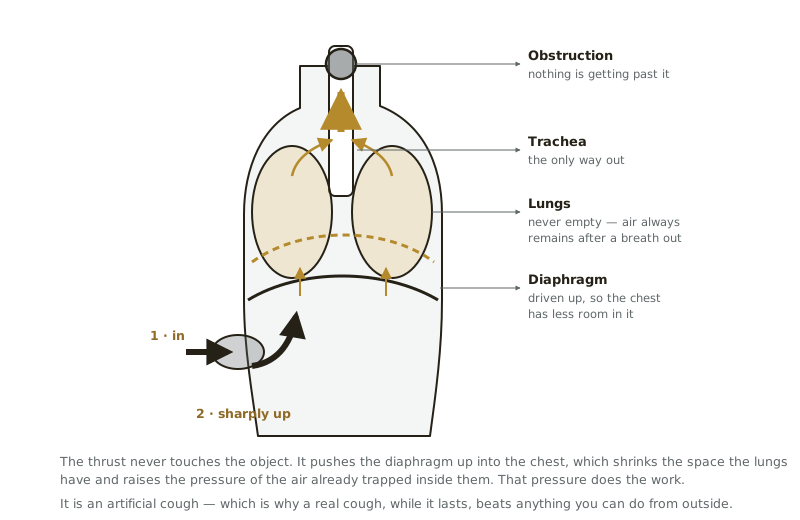
The two techniques differ in kind, and that is the real reason you alternate instead of repeating one until your arms give out. A back blow is a shock. A thrust is a squeeze. An object held in place by suction against wet tissue may release under a squeeze and completely ignore a shock, while an object wedged against the wall of the airway may shift with a shock and ignore a squeeze entirely. You cannot see which kind of problem you have, so alternating means trying both rather than betting on one.
There is also a resource being spent while you work. Each thrust uses some of that trapped air, and because the casualty is not moving air, nothing is replacing it. That is a second reason speed matters, and a reason not to deliberate over which technique to try next. Deliver each one properly, alternate them, and keep going.
Why you carry on after they lose consciousness
When a choking casualty goes unconscious, the instinct is that the situation has ended badly and passed out of your hands. The opposite is nearer the truth. Muscle tone disappears when consciousness does, including the tone in the muscles of the throat, and an object gripped by tense tissue can become an object sitting loose in a relaxed tube. Some obstructions that would not move for a conscious casualty will move once that tension has gone, which makes the moments after a collapse a genuine opportunity rather than the end of one. the course where the unconscious choking sequence is drilled.
Lower them to the floor, make sure an ambulance is coming, and start chest compressions. Compressions are usually described in terms of circulation, which is correct, but they also raise the pressure inside the chest much as an abdominal thrust does, and they do it over and over. You are continuing the same mechanical attempt by another route while supporting a casualty who now needs that support anyway. Each time you open the airway to give breaths, look inside the mouth first and remove anything you can both see and reach. Do not sweep a finger around blindly, because that is an efficient way to push a visible problem out of reach. what changes once oxygen and suction are available.
This article explains why the technique is shaped the way it is, so that it is easier to adapt when the situation refuses to match the classroom. It is not a substitute for hands-on practice on a manikin with an instructor correcting your hands, and reading it does not certify anyone to do anything. If the casualty is heavily pregnant, very large around the middle, or an infant, the abdominal thrust is replaced rather than adjusted, and those variations are worth learning from somebody who can watch you do them. two full days with a manikin and someone correcting your hands.
Quick answers
- How do abdominal thrusts clear a blocked airway?
- An abdominal thrust drives the diaphragm upward, which shrinks the space available to the lungs and raises the pressure of the air already trapped inside them. That pressure pushes outward against the obstruction, which is an artificial version of a cough.
- Why do you alternate back blows and abdominal thrusts?
- The two work by different physical means, so an object that resists one can still move with the other. A back blow is a sudden shock and a thrust is a squeeze, and you cannot see which of the two the obstruction will respond to.
- What do you do if a choking casualty becomes unconscious?
- Lower them to the floor, make sure an ambulance is coming, and begin chest compressions. Muscle tone drops when consciousness does, so an object that would not budge before may move now, and compressions raise pressure inside the chest as well as supporting circulation.