The EMR Entry Requirement Nobody Plans For
EMR asks for Intermediate First Aid with CPR-C, current on day one. Here is how to sequence the two courses without losing a month.
Jarrett Chisholm, ACP · August 26, 2026
Where this is taught: Emergency Medical Responder, Intermediate First Aid and Advanced First Aid to EMR Bridge.
Every EMR cohort we run has at least one person who registered, budgeted, booked the time off work, and then discovered there is a two-day course they have to complete first. It is a fixable problem. It is much easier to fix in June than in the week before the cohort starts, which is usually when it surfaces, and by then the two-day course they need may already be full.
Image needed · hero
first-aid-card-and-cohort-calendar.jpg
Overhead shot on a plain wooden desk: a certification wallet card with the name and certificate number blurred or covered, lying on a month-view paper calendar. One date circled in pen near the end of the month, and a two-day block marked several weeks earlier with a pen line joining the two. Warm daylight from the side, shallow depth of field, no faces.
Alt text ready: “A first aid certification wallet card lying on a paper month calendar with a cohort start date circled in pen”
The entry requirement is Intermediate First Aid with CPR-C, current on the day the EMR course begins. Intermediate First Aid is the two-day workplace course that was called Standard First Aid until the Canadian Red Cross renamed it in 2025, which is where the first bit of confusion comes from: people search for the old name, find nothing on any schedule, and assume the requirement means something unusual and hard to get. the two-day course that has to happen first.
Current on the day it begins is the phrase worth reading twice. A certificate that expires halfway through a multi-week cohort was not current at the start in any useful sense, and a card that lapsed three months ago does not become current because you have enrolled in something harder. Find your own card and read the date on it before you assume you are covered.
None of this is arbitrary. Knowing why the requirement exists changes how you spend those two days, and it is the difference between treating the first course as a toll booth and treating it as the floor the second course stands on.
Why the requirement exists
An EMR cohort has roughly eighty hours to turn someone into a person who can hold a scene together. That is not very long. It works only if the room already shares a floor: everyone can do compressions on a manikin, everyone has handled an AED, everyone has already been told off once for walking into a scene without looking at it first. Those hours have to come from somewhere, and the two-day course is where they come from.
Without that floor, the opening days of a cohort turn into remedial first aid for the people who need it and dead time for the people who do not, and both groups pay the same fee for the same hours. The entry requirement is what keeps the cohort spending its time on assessment, on airway management, and on making decisions with incomplete information, rather than on skills you can learn properly in a weekend for a fraction of the price.
Sequencing it without losing a month
Work backwards from the cohort start date rather than forwards from today. You want the two-day course finished with enough room that the certificate has been issued and is actually in your hand. Booking it for the weekend immediately before the cohort starts is possible and it is a bad plan: one cancelled class, one sick child, one storm on Highway 2, and you are standing at the door of a course you have already paid for without the thing that lets you through it.
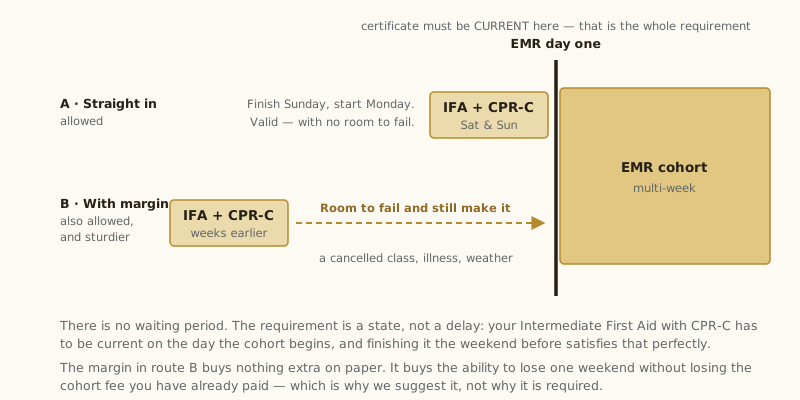
Give yourself a few weeks of margin if the calendar allows it. The two-day course runs often and costs a small fraction of the cohort fee, so flexibility is cheap to buy at this end and expensive to buy later. If the timing is genuinely tight, ask rather than guess, because we know which dates are already full and you do not. tell us the cohort you are aiming at and we will sequence it with you.
Budget for both courses from the beginning. The two-day fee is a small number next to a cohort fee, but the people who have budgeted to the last dollar are exactly the ones who go looking for a way around it, and there is no way around it. Two lines in the plan instead of one, and the surprise never happens.
If you already hold something higher
Holding a current Advanced First Aid certificate changes the arithmetic. There is a shorter route built for exactly that situation, and it is faster and cheaper than sitting the full cohort from the beginning. If that is you, look at the crossing before you look at the full course, and check the expiry date on the certificate you are bringing to it. a shorter crossing for people who already hold Advanced First Aid.
If you hold something from another provider, or something issued a while ago, send us a photograph of the card before you book anything at all. What is printed on it decides what you still need, and reading it takes us two minutes. Guessing wrong costs you a course fee and a month of your calendar, and we would much rather spend the two minutes.
Quick answers
- What do I need before I can take an EMR course?
- Intermediate First Aid with CPR-C, current on the day the EMR course starts. Intermediate First Aid is the two-day course that used to be called Standard First Aid. Some employers and paramedic schools add their own admission conditions on top, so check the wording of your own requirement as well.
- Can I do the two-day first aid course the weekend before my EMR cohort?
- Technically yes, and it is a fragile plan. A cancellation, an illness or a storm leaves you at the door of a course you have already paid for without the certificate that lets you in. Leave a few weeks of margin if you possibly can.
- My first aid certificate expires partway through the cohort. Is that a problem?
- Treat it as one. The requirement is a current certificate at the start, and a card expiring mid-cohort is a card you will be chasing during the hardest weeks of the course. Renew it before you begin rather than during.
Sources
- Canadian Red Cross: The Canadian Red Cross Emergency Medical Responder program carries a pre-course requirement of Standard First Aid with CPR-C, published under the current naming as Intermediate First Aid with CPR-C. Checked against the Canadian Red Cross First Aid Program Standards 2025 and confirmed with the owner on 2026-07-30. (checked 2026-07-30)