Patient Assessment Is the Skill EMS Hires For
Knowing more conditions does not make you useful. A repeatable assessment does, and here is the reasoning behind the order it runs in.
Jarrett Chisholm, ACP · August 27, 2026 · clinically reviewed by Jarrett Chisholm, ACP
Ask a class what they need to learn and most of them say conditions. Diabetic emergencies, chest pain, head injuries, the long list of things that can go wrong inside a person. It is a reasonable answer and it is the wrong end of the problem. The people who hire you and the people who examine you are watching something else, and they start watching it in the first ten seconds.
Image needed · hero
student-assessing-airway-on-scenario-patient.jpg
Close-in side shot: a student kneeling at the head of a person lying supine on a training mat, one hand on the forehead and the other under the chin, head turned to look down the line of the chest. An instructor with a clipboard stands behind, visible but out of focus, watching the student rather than the patient. Training room, practice manikin or volunteer, no real injuries, no blood, no simulated wounds.
Alt text ready: “A student kneeling at the head of a scenario patient with one hand on the forehead, looking along the line of the chest while an examiner watches”
The clinical answer first, then the reasoning. Run the same assessment, in the same order, on every patient, every time. Look at the scene before you look at the patient. Form a general impression from the doorway. Work through the things that kill fastest, in the order they kill: is the airway open and staying open, is the breathing adequate, is there bleeding that will not stop on its own, is the circulation holding, what is the level of consciousness. Then take the story, examine what the story points at, and go back to the beginning to see what has changed. the cohort where this gets drilled until it is dull.
That is a sequence, not a checklist, and the difference matters. A checklist is something you tick. A sequence is something you run, and its value is that it produces the same behaviour whether you are calm or not.
Three things explain why it is built that way: why that order, why the repetition, and why an employer would rather have a candidate with a clean assessment and thin knowledge than the reverse.
Why the order is the order
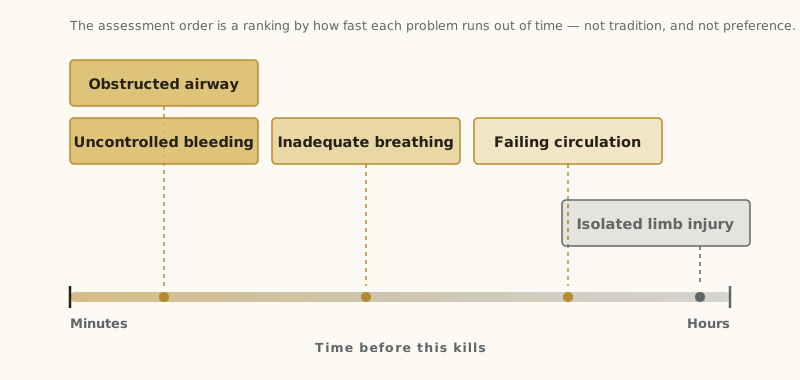
The order is ranked by time. An obstructed airway kills in a handful of minutes. Breathing that is failing kills not much more slowly. Bleeding that is arterial and uncontrolled can empty someone inside a similar window, which is why many services now look for catastrophic bleeding before anything else when the mechanism makes it likely. A broken ankle will still be broken in an hour. Your first minute goes to the problems measured in minutes, and everything else waits its turn without being forgotten.
A fixed order also protects you from what stress does to attention. Under load, attention narrows, and narrowed attention finds what it was already looking for. Walk in expecting a cardiac problem and you will find chest signs and miss the blood pooling under the trouser leg. A sequence you did not invent on the spot works as external memory: it keeps asking the questions your own mind has quietly stopped asking, and it does that best at the moment you are least able to notice the gap.
There is a third effect, and it is the one instructors see most. The sequence makes you slow down at the front. Most poor assessments are not caused by a missing fact. They are caused by someone starting treatment forty seconds before they understood the problem, then spending ten minutes defending that decision to themselves.
Why repeating it is the point
One set of observations is a photograph. It tells you what was true at that moment and nothing at all about direction, and direction is most of the clinical information available to you outside a hospital. A breathing rate of 24 means one thing if it was 24 ten minutes ago and something entirely different if it was 16. A patient who looks the same on the second pass is a different problem from one who is drifting, even when the two sets of numbers sit close together.
That is why reassessment is not tidying up at the end of a call. It is the measurement. Everything you did between the two looks, including the intervention you are pleased with, can only be judged against a second set of eyes on the same patient. If you never look again, you never find out whether you helped.
It also catches what you got wrong, and something gets got wrong on a fair number of calls, including by people who have done this for twenty years. Later on, when there is a monitor involved, the same principle scales: a rhythm on a screen is another photograph, and it is worth very little without the patient it came from and the look you took two minutes earlier. putting a name to a tracing before you are standing over one.
Why this is the part that gets you hired
A candidate with a clean assessment and thin knowledge is an easy problem to solve. You teach them the knowledge, and they already have somewhere to put it. A candidate who knows a great deal and freezes in front of a real person is a much harder problem, because composure under load is slow to teach and cannot be taught by reading. Preceptors and examiners know this, so they watch the process rather than the recall. The process is the part that carries over to every call you have not seen yet.
Knowledge still matters, and it arrives later and more easily than people expect. Once the assessment runs by itself you have spare attention, and spare attention is what lets you notice the pattern you read about last month. Study is not wasted. It is badly timed when it comes first. drilling the numbers and the calculations between classes.
One boundary, stated plainly. This is an explanation of why the assessment is shaped the way it is, so that it is easier to learn and easier to run badly lit and half asleep. It is not a substitute for hands-on training with an instructor who can watch your hands and tell you what they saw, and reading it does not certify anyone to do anything. The distance between understanding a sequence and running it on a stranger in a stairwell is much larger than it feels from here.
Quick answers
- What is the most important skill for getting hired in EMS?
- A repeatable patient assessment. Employers and preceptors watch how you gather information under pressure, because knowledge can be taught to someone with a solid process far more easily than composure can be taught to someone without one.
- Why does patient assessment follow a fixed order?
- Because the order is ranked by how fast each problem kills, and because a fixed sequence keeps working when stress narrows your attention. Improvising the order is how people miss the thing they were not expecting to find.
- How often should I reassess a patient?
- Often enough to see a direction rather than a single snapshot, and sooner if anything changes or you have just intervened. One set of observations tells you very little on its own, because the trend is where most of the information lives.