Where EMR Fits on the Road Into EMS
EMR is a real credential and a common first step, but it is not a paramedic licence in Alberta. Read the caveat before you spend the money.
Jarrett Chisholm, ACP · August 24, 2026
Where this is taught: Emergency Medical Responder, Advanced First Aid and Advanced First Aid to EMR Bridge.
Most people who ask us about getting into EMS arrive holding one acronym. EMR. They have been told it is the first step, or that it is what site work wants, or that it is how you get onto a paramedic program. Some of that is true. Some of it depends entirely on who told them, and the gap between those two costs a few thousand dollars, so it is worth an hour of your attention before you book anything.
Image needed · hero
emr-cohort-scenario-calgary-classroom.jpg
Wide shot of a Calgary training room mid-scenario: one student kneeling at the head of a person lying supine on a floor mat playing the patient, a second student at the patient's side holding a bag-valve mask, an instructor standing back with a clipboard. Natural room light, no flash, other students out of focus in the background. No real injuries, no blood, no visible branding on clothing.
Alt text ready: “An EMR student kneeling beside a scenario patient on a classroom floor while a classmate and an instructor watch”
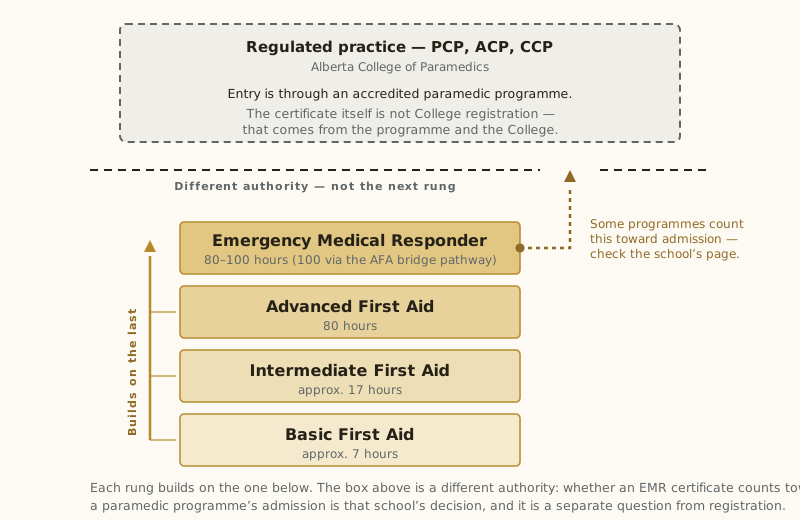
Start with what the certificate is. Emergency Medical Responder is a professional responder credential of roughly eighty classroom hours, taught to people who expect to be the first medically trained person at something bad. It sits well above the workplace first aid levels. It is the point where the training stops being about helping until an ambulance arrives and starts being about running the scene until one does, which is a different job with different habits. the multi-week responder cohort we run in Calgary.
Now the part that gets skipped, and the reason this article exists. The Canadian Red Cross EMR course we deliver is not an approved program under the Alberta College of Paramedics. Holding the certificate does not by itself make you eligible for College registration or an Alberta practice permit, and it does not make you an EMR in the licensed, regulated sense of the word. If someone has told you otherwise, they are working from old information or they have not read the difference carefully.
That caveat is not a reason to write the course off, and people swing too far the other way once they hear it. A Red Cross EMR is a nationally issued certificate and a real step up in capability. It is used every day in industrial and remote-site work, in event and security medical roles, and by people who want to find out whether they can do this work before committing two years and a tuition bill to finding out. What it is worth to you depends on which of those you are.
What the certificate is actually good for
The honest answer splits three ways. For site and remote work, EMR is often the level an employer names, though acceptance is decided by that employer and that province rather than by us, so get the requirement in writing before you pay for anything. For someone testing a career, eighty hours of being assessed in front of other people is a cheap and fairly brutal way to learn something true about yourself. For someone already in a responder-adjacent job, it raises the ceiling on what you are able to do when a shift goes wrong.
For applicants to paramedic programs the value is quieter. The course drills the assessment habits that everything above it is built on, and it puts you in front of scenario patients long before anyone hands you a licence. Whether a particular school counts it towards admission is a question for that school's current admission page and for nobody else, including us. Those pages change, and the version a friend read two years ago is not evidence.
Four things people blur into one
Four separate things get collapsed into the phrase you need your EMR. A certificate is issued by a training body. Workplace recognition is set by provincial occupational health rules. A hiring bar is set by an employer, who can ask for whatever they like. Registration eligibility is set by a regulator. Those are four different authorities, and none of them defers to the others, which is how a certificate can be entirely valid and still not be the thing a particular door is asking for.
There is also more than one road. If what you want is to be the designated responder on a site, a lower level may be the better buy, and the money you keep is real. If your target is paramedic school, the admission page may care more about your transcript and your driver's abstract than about any first aid card you hold. Work out which door you are knocking on, then buy the key that opens it. the responder certificate that sits just under EMR.
Spending the money in the right order
Get the requirement in writing before you get anything else. A job posting, an admission page, a site orientation package, an email from a hiring manager: any of those beats general advice, including this article. If the document names a course, book that course. If nothing names a course, ask the person imposing the requirement what they expect you to be able to do, because the answer usually points at a level even when it does not name one. work through a short set of questions about your goal.
If nobody has handed you a requirement at all, then you are buying training for yourself, which is a perfectly good reason to buy it. Be clear that is what you are doing. Training bought for your own reasons is money well spent when you walk out able to do something you could not do before. It is money badly spent when it was bought to clear a rule that nobody ever actually wrote down.
Quick answers
- Is a Red Cross EMR certificate the same as being a licensed EMR in Alberta?
- No. The Canadian Red Cross EMR course is not an approved program under the Alberta College of Paramedics, and the certificate does not by itself make you eligible for College registration or a practice permit. It is a training certificate, not a licence to practise.
- Do I need an EMR to get into paramedic school?
- That depends entirely on the school. Read the current admission page of the program you are applying to, and treat anything you were told second hand as a rumour until you have seen it written down by the school itself.
- Is EMR worth taking if I am not going to be a paramedic?
- Often, yes. It is a common level for industrial and remote-site work and for event and security medical roles, though acceptance is decided by the employer and the province. It is also the cheapest honest test of whether you actually like this work.