How to Tell Serious Bleeding From the Rest
Most bleeding stops on its own. This week is about the bleeding that will not, and what changes the moment it turns out to be arterial.
Jarrett Chisholm, ACP · August 17, 2026
Where this is taught: Stop the Bleed, Intermediate First Aid and Advanced First Aid.
Most bleeding you will ever see stops without you. Small vessels clamp down, the blood clots, and a bit of pressure with a dressing finishes the job. That is the ordinary case, and it is why people are relaxed about cuts. The problem is that the relaxed response is also the response people give to the bleeding that will not stop, because in the first minute the two can look much the same.
Image needed · hero
arterial-bleeding-instructor-demonstration-on-training-arm.jpg
Landscape photo, classroom floor level. An instructor in a Delta polo kneels beside a realistic wound-simulation arm laid on a mat, index finger indicating a single bleeding point. Two students in casual clothes kneel opposite, watching. Natural window light, shallow depth of field, focus on the instructor's hand and the wound. No faces of identifiable students required in focus.
Alt text ready: “An instructor kneeling beside a wound-simulation training arm, pointing out a pulsing bleeding point to two students.”
Serious bleeding is not defined by how alarming it looks. A scalp cut bleeds theatrically across a face and is rarely dangerous. A deep wound in a thigh or an upper arm can look tidy from the outside while the useful volume leaves through it. What you are judging is rate and vessel, not drama.
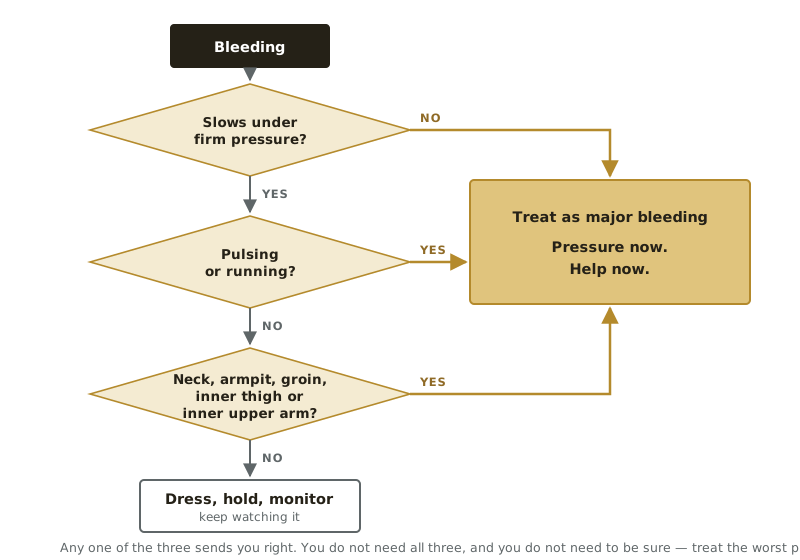
Three things separate bleeding you can dress from bleeding you have to fight. It does not slow under firm pressure. It comes in pulses, or it runs rather than wells. And it sits somewhere the body cannot help itself: a limb, the neck, the groin, the armpit. everything we run in Calgary and Leduc.
Time is the other half of it. An adult carries roughly five litres of blood, and the trouble starts well before it is all gone. Losing about a fifth is enough to make someone pale, clammy, breathless and frightened, and by the time that picture is obvious the loss has already happened. You do not get to wait and see.
What arterial bleeding actually changes
Arteries carry blood under pressure straight from the heart, and that pressure is the whole difference. A vein bleeds at low pressure, so it wells up, pools, and responds well to almost anything you hold against it. An artery bleeds at whatever pressure the heart is generating, so it sprays, pulses with the beat, and pushes back against a dressing you have only rested on the wound.
That pressure also defeats clotting. A clot needs a reasonably still surface to build on. Blood moving fast past the site keeps washing away the beginning of the clot, which is why arterial bleeding does not tail off on its own the way a scraped knee does. It is not a wound that is taking a long time. It is a wound with no mechanism to stop.
The practical consequence is that arterial bleeding is a race against a clock you cannot see. Almost everything else in first aid tolerates a few seconds of thinking. This does not, and the people who do well with it are the ones who decided in advance what their first move would be.
The signs that should move you
Bright red blood that pulses or spurts. Blood soaking through a dressing in under a minute. A pool spreading rather than a patch sitting still. A wound over the inner thigh, the inner upper arm, the armpit, the neck or the groin, where large vessels run close to the surface. Any of those, and you stop treating it as a cut.
The casualty tells you things too, and earlier than the wound does. Pale, cool, sweaty skin. A fast heart rate. Yawning, restlessness, or the odd sense of dread that people often describe afterwards as simply knowing something was badly wrong. Confusion and a falling level of response are late signs, not early ones, so do not use them as your trigger.
Watch for the two situations that hide blood loss. Heavy clothing absorbs a great deal before anything shows, so a casualty in winter layers or coveralls can look far better than they are. Blood on a wet or dark surface, or soaking into gravel or snow, also reads as much less than it is.
What you do about it, in order
Get pressure on it, and get help coming. Those two, in whichever order the people around you allow. Pressure means direct, hard, and on the exact bleeding point rather than spread across a general area, and once it is on it stays on. Wednesday's article goes into how to do that properly, because it is the skill most people believe they already have and most people do badly.
Then the decisions that follow from what you are seeing. If direct pressure is not controlling it and the wound is on a limb, that is the situation a tourniquet exists for. If it is somewhere a tourniquet cannot reach, such as the neck, the armpit or the groin, keep hard direct pressure on it until EMS takes over. Packing a wound is not part of a first aid certificate at any level. It takes separate training such as Stop the Bleed, and your employer has to approve it. Neither a tourniquet nor good pressure is difficult, but both need to have been practised on something other than a page. the longer course where bleeding control gets proper floor time.
Call for help early rather than well. In Alberta that means 911, and the dispatcher would far rather take a call that turns out to be minor than one that started five minutes late. If you are somewhere help is a long way off, the arithmetic changes and your own hands have to hold the line for much longer, which is exactly why remote and industrial settings train for this differently. work out which level of training you actually need.
Quick answers
- How do you know if bleeding is life threatening?
- Bleeding is life threatening when it does not slow under firm direct pressure, when it pulses or spurts, or when it soaks through a dressing within a minute. Location matters as well: the neck, groin, armpit, inner thigh and inner upper arm all carry large vessels close to the surface.
- What is the difference between arterial and venous bleeding?
- Arterial blood leaves under the pressure the heart is generating, so it is bright, it pulses with the heartbeat, and it clots poorly because the flow keeps washing the forming clot away. Venous blood wells up at low pressure and responds much better to a dressing and steady, firm pressure.
- How much blood can a person lose before it becomes dangerous?
- An adult carries roughly five litres, and the problems begin long before it is all gone. Losing around a fifth is enough to cause pallor, clamminess, a fast pulse and breathlessness, and by the time those signs are obvious the loss has already occurred.