
Why Pausing Chest Compressions Costs More Than You Think
The clinical answer is push hard, push fast, and stop for as little as possible. Here is the reasoning, and why the pause is the expensive part.
Jarrett Chisholm, ACP · July 30, 2026 · updated August 10, 2026 · clinically reviewed by Jarrett Chisholm, ACP
Ask most people what good CPR looks like and you will hear about depth and speed. Both matter. But the variable that separates CPR that works from CPR that merely looks busy is how little you stop, and that is the one almost nobody is taught to think about.
Image needed · hero
instructor-hands-compressing-cpr-manikin.jpg
Close crop from the side, instructor kneeling beside a manikin on the floor, arms locked straight and shoulders stacked over the heel of the hand at mid-compression. Delta classroom, natural light, no faces needed.
Alt text ready: “An instructor demonstrating chest compressions on a training manikin, arms straight and shoulders over the hands”
The clinical answer first, then the reasoning. For an adult: compress the centre of the chest at a rate of 100 to 120 per minute, deep enough to be uncomfortable to do properly, let the chest come all the way back up between compressions, and keep interruptions as short and as rare as you can manage. practise this properly on a manikin with an instructor.
The reasoning is a pressure problem. A heart in cardiac arrest is not pumping, so the only thing moving blood is your hands. What keeps the heart muscle itself alive during that time is the pressure difference across the coronary arteries, and that pressure is not there at the start of a set of compressions. It builds, compression by compression, over the first several pushes.
Why the pause is the expensive part
When you stop, that built-up pressure falls away almost immediately. It does not pause where you left it and resume when you come back. It drops, and when you start again you are climbing from near the bottom, spending the next several compressions rebuilding what you already had.
That is why a ten-second pause is not ten seconds of lost output. It is ten seconds of nothing, plus the rebuild on the other side. Two or three casual pauses across a resuscitation (swapping over, reaching for something, someone asking a question) quietly remove a large fraction of the useful work that was done.
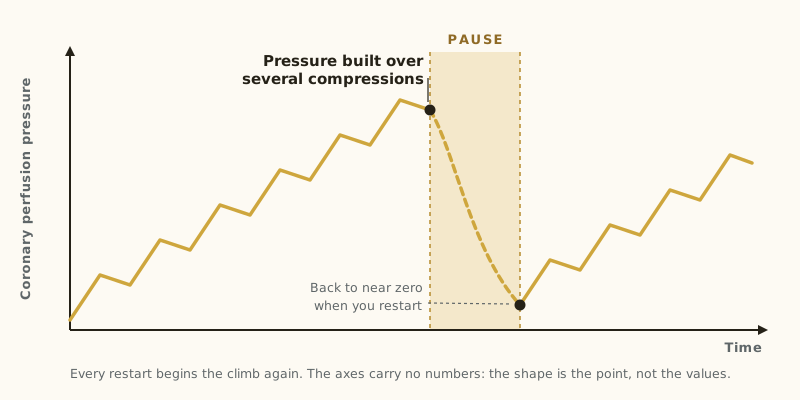
Professional crews have a name for this: chest compression fraction, the proportion of the whole arrest during which someone's hands are actually on the chest. Crews train to keep that fraction high, and resuscitation research keeps finding the same thing, that outcomes track the fraction. The bystander version of the same discipline needs no numbers at all: hands on the chest unless one of a very short list of reasons says otherwise, and that list is below.
It also explains a rule that otherwise sounds arbitrary: change the person doing compressions roughly every two minutes, and do the swap fast. The two minutes is because compressions decay as the person doing them tires, usually well before they notice. The fast swap is because the changeover is exactly the moment where the pressure you have built is easiest to throw away. Done well, a swap happens inside a couple of seconds: the incoming person kneels opposite, hands hovering, and takes over mid-rhythm.
The pauses that are worth it
Minimizing interruptions does not mean never stopping. A small number of things genuinely earn a pause, and knowing the list in advance is what stops everything else from earning one too: see what the underlying rhythms actually look like.
- The AED is analyzing or delivering a shock. Follow its prompts exactly, and put your hands back on the chest the moment it tells you to.
- Rescue breaths, if you are trained and giving them. Keep the pause brief and get back on the chest.
- The person shows obvious signs of life: moving, breathing normally, responding.
- Someone with more training and equipment is physically taking over.
- The scene has become unsafe to stay in. You cannot help anyone as the second patient.
Notice what is not on the list. Checking for a pulse repeatedly is not on it. Looking up at the person calling 911 is not on it. Attaching AED pads is not on it either: pads go on while compressions continue, and the machine will tell you when it actually needs the chest still. Everything that can happen around ongoing compressions should happen around ongoing compressions.
Full recoil is the same idea, in miniature
Leaning on the chest between compressions feels efficient and is not. The heart refills during the upstroke, and a chest that cannot come all the way back up cannot fill properly, so the next compression moves less blood, no matter how hard you push it. Come all the way off between compressions without lifting your hands away.
Nearly everyone leans once they are tired, and nearly nobody feels themselves doing it, which is why feedback manikins are so humbling: the light that says you stopped releasing turns on minutes before you would have believed it. If your course offers a feedback manikin, treat the recoil light as seriously as the depth light. They are two halves of one pump stroke.
Fatigue is the quiet interruption
Compression depth starts to fall within a couple of minutes of continuous work, and the person compressing is reliably the last to know: effort stays the same while output drops, so it feels like nothing changed. That is the real argument for the two-minute swap, and for pointing at the next person early so the changeover is planned rather than negotiated over a working chest.
If you are alone, there is no swap coming, and the guidance does not change: keep going. Tired compressions still move blood, and compressions that exist beat perfect ones that do not. The same logic backs hands-only CPR for untrained bystanders: continuous compressions without breaths, done hard and fast until help arrives, is legitimate, taught, and enormously better than hesitating over the parts you were never trained to do.
What this is and is not
This is an explanation of why the technique is what it is, so it is easier to do well under pressure: hands that understand the pressure curve stop less, because every pause has a visible price attached. It is not a substitute for hands-on training with an instructor and a manikin, and reading it does not certify anyone. If you have never done compressions on a manikin, the gap between understanding this and being able to do it at 2am is much larger than it feels right now. the full range of what we teach in Calgary and Leduc.
The reasoning above is standard resuscitation teaching, written for a reader rather than a textbook, and reviewed by the clinician named at the top of this article. Where any detail differs from what your instructor teaches you in a current course, the course is the authority: guidelines are refreshed on a cycle, and the classroom carries the current edition.
Quick answers
- How fast should chest compressions be for an adult?
- Between 100 and 120 compressions per minute, allowing the chest to recoil fully between each one.
- Why should you not stop chest compressions?
- The pressure that perfuses the heart muscle builds over consecutive compressions and falls away almost immediately when you stop. Every pause costs both the time itself and the compressions needed to rebuild that pressure afterwards.
- How often should you swap the person doing CPR?
- About every two minutes, because compression quality declines as the rescuer tires, usually before they notice. Make the changeover as quick as possible.
- Should I stop compressions to attach the AED pads?
- No. Pads go on while compressions continue. Stop only when the AED says it is analyzing or tells you to stand clear for a shock, and resume the moment it tells you to.
- Is hands-only CPR effective?
- For an untrained bystander with an adult who has collapsed, continuous hard, fast compressions without rescue breaths are a legitimate, taught approach and far better than doing nothing while waiting for help.