Improvising First Aid, or Just Hoping
Anything can be a splint until it has to work. The test that separates real improvisation from wishful thinking, and how to practise it.
Jarrett Chisholm, ACP · September 16, 2026
Where this is taught: Wilderness First Responder, Wilderness First Aid and Remote First Aid.
Improvisation has a better reputation than it has entirely earned. The photographs are appealing: a splint made from a foam pad and two poles, a sling from a jacket, a pressure dressing built out of a clean sock and a roll of tape. Some of it works very well. Some of it is a person telling themselves a story while an injury quietly gets worse.
Image needed · hero
improvised-splint-from-a-foam-sleeping-pad.jpg
Rocky alpine slope in daylight. A lower leg splinted with a blue foam sleeping pad rolled into a gutter shape around the calf and ankle, held with three webbing straps, boot left on and toes clearly exposed. Shoot at about 50mm from the side at ground level so both the padding and the exposed toes are unmistakable. No face needed, no brand marks on the pad.
Alt text ready: “A lower leg splinted with a rolled foam sleeping pad and webbing straps on a rocky slope, with the toes left exposed”
The difference is not cleverness. It is whether you started from the job or from the object. Most failed improvisation begins with the words 'I have a bandana', which is the wrong end of the problem. It should begin with a sentence about what needs to happen: firm pressure directly over this bleed, and it has to stay there while we walk out for four hours. Once the job is stated, the bandana either does it or it does not, and you can tell which.
Everything below is a way of asking that question quickly, under stress, with cold hands, in front of people who are watching you to decide something.
None of it requires a bigger kit. Most of it requires being honest about what the thing in your hands is actually doing.
Name the job, then look for the object
A splint is not a shape. It is three functions bundled together: it limits movement across the injury, it pads the parts that would otherwise be crushed against something rigid, and it holds the limb in a position the person can tolerate for a long time. Anything that does all three is a splint. A sleeping pad rolled into a gutter does it well. A straight stick lashed hard against a shin does one of the three and fails the other two, which is why it is agony within twenty minutes and gets cut off. run this with your own crew at your own site.
Do the same for the rest of it. A dressing is pressure plus a barrier. A sling is load taken off a shoulder plus an arm kept still. A shelter is a wind barrier plus a vapour barrier plus insulation from the ground, and the ground is the part people forget. Once you can name the functions, you stop hunting for the correct object and start looking for anything that performs them, which is a far easier search with a much larger answer set.
The hour test
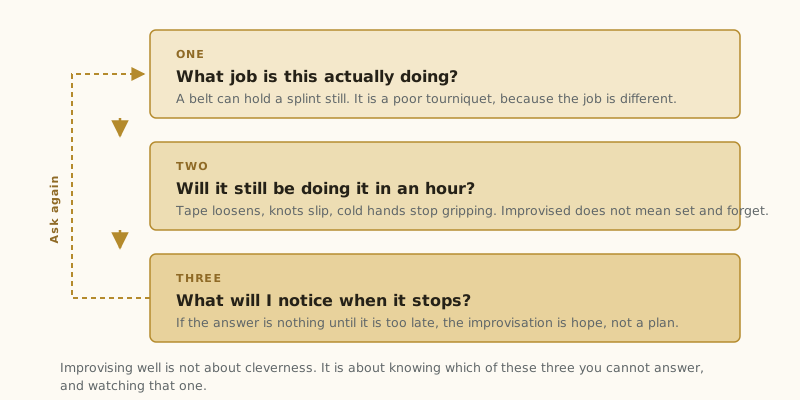
Improvised gear rarely fails at the moment you build it. It fails forty minutes later, quietly, while you are busy with something else. Tape loses its grip when it is cold and wet. Knots in slippery cord work loose with movement. Padding compresses and stops padding. A limb swells and a splint that was snug becomes a tourniquet nobody intended. Almost every improvisation failure is a slow one, which is exactly why it goes unnoticed.
So build it, then set a time to come back and check it, and check the far end of the limb every single time: warmth, colour, and whether they can feel you touching. That last part is the entire reason the check exists. A splint you have not looked at in an hour is not a splint you know anything about.
Practise the check as a habit rather than as a rule you have read once. In a training room you can put a splint on someone, walk them up and down a hall for ten minutes, and watch what happens to it. The gap between a splint that survives a walk and one that survives a photograph is obvious the moment you have seen it, and almost invisible before. the longer course where you build this and then live with it.
Where improvising ends and hoping begins
Some jobs have no substitute in the bag. There is no improvised epinephrine for anaphylaxis, no improvised defibrillator, and no arrangement of clothing that will open the airway of an unconscious person who cannot open it themselves. You can improvise around the edges of those problems, and positioning, warmth and speed are all genuinely worth doing, but the core item is either with you or it is not.
That is a planning decision, made at home, in daylight, with a list. Decide what you cannot improvise for the trip or the job you are actually doing, carry those specific things, check their dates, and know where they live in the pack without having to unpack it. Everything else you can be creative about. the supplies and kit we keep on the shelf.
Hoping looks a great deal like improvising from the outside. The tell is the missing sentence. If you cannot say what the object is doing, how long it needs to keep doing it, and what you will notice when it stops, then you are not improvising. You are waiting to find out.
Quick answers
- What makes a good improvised splint?
- A good improvised splint does three things at once: it limits movement across the injury, it pads anything rigid, and it holds the limb in a position the person can tolerate for hours. Judge it against those three functions rather than by how it looks.
- How often should you check an improvised splint?
- Check it on a set schedule rather than when you remember, and look at the far end of the limb each time for warmth, colour and sensation. Improvised gear usually fails slowly, some forty minutes after you built it, while your attention is elsewhere.
- What can you not improvise in first aid?
- You cannot improvise an epinephrine auto-injector, a defibrillator, or an airway that an unconscious person cannot maintain alone. Those are planning decisions made before you leave the house, not problems to be solved with tape and cord.