Which First Aid Course Does Your Job Actually Need?
Most people book the wrong level because a job posting was vague. Here is how to read the requirement before you spend money on a course.
Jarrett Chisholm, ACP · July 22, 2026 · updated August 10, 2026
The phrase "you need your first aid" covers at least four different certificates, at prices ranging from under a hundred dollars to well over a thousand. People book the wrong one constantly, and the money is usually not refundable once the course has run. Ten minutes of reading the requirement properly is the cheapest thing you will do all week.
Image needed · hero
reading-a-job-posting-on-a-phone.jpg
Candid, waist-up, worker in hi-vis holding a phone, brow slightly furrowed, worksite or truck cab background out of focus. Screen content must not be legible.
Alt text ready: “A worker in high-visibility clothing reading a job posting on a phone during a break”
Start with the actual document, not what someone said in passing. A job posting, a contract, a site orientation package or a program admission page will normally name the certificate. If it names one, book that one and stop reading. The specific name beats any general advice, including ours.
The problem is what to do when nothing names a certificate. That is where most of the wrong bookings come from, and where a bit of structure helps. answer a few questions about what the job involves.
The four certificates "first aid" usually means
Nearly every workplace requirement resolves to one of four courses. Knowing the shape of each one turns a vague requirement into a short list, and usually into a single answer:
| Certificate | Time it takes | Who usually asks for it |
|---|---|---|
| Basic (Emergency) First Aid | About 1 day | Lower-risk workplaces, volunteers, general preparedness |
| Intermediate (Standard) First Aid | 2 days, or about 7 hours online plus 1 class day blended | The standard workplace ask; childcare and education staff; school programs |
| Basic Life Support (BLS) | About 4 hours, renewed annually | Healthcare and dental teams, clinical students |
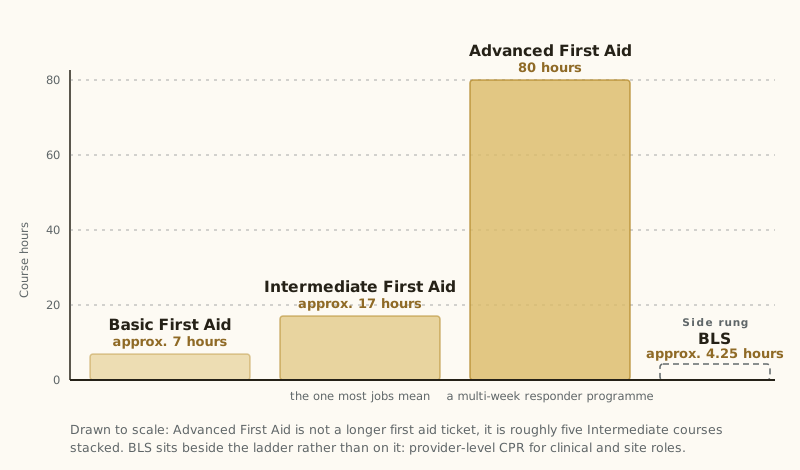
| Advanced First Aid | A multi-week cohort | Designated site responders, industrial and oilfield medic roles, fire applicants |
There is a level above these, the Emergency Medical Responder, but jobs that need it say so by name. Nobody accidentally requires EMR the way they accidentally say "first aid" when they mean a specific two-day certificate.
Decoding the wording you were given
Requirements are written by HR departments, safety officers and program coordinators, not by training providers, so the vocabulary drifts. These are the phrases we see most, and what they almost always mean:
- "Standard First Aid" or "Intermediate First Aid": the same two-day course under its old and new names. This is the default workplace certificate.
- "Emergency First Aid" or "Basic First Aid": the one-day course. Enough where the posting says so, and only where it says so.
- "CPR Level C" or "CPR-C": usually satisfied by the two-day course, which includes CPR-C. You rarely need to book CPR alone for a job requirement.
- "BLS", "CPR-HCP" or "healthcare provider CPR": the clinical four-hour course, renewed every year. A workplace first aid certificate does not substitute for it.
- "Advanced First Aid", "designated responder" or "site medic": the responder track, a different scale of commitment. Confirm before booking anything.
- "First aid ticket": industry slang, almost always the two-day workplace course, but the one phrase vague enough that confirming costs less than guessing.
The renaming in that first line trips more people than everything else combined. The Canadian Red Cross renamed Standard First Aid to Intermediate First Aid, so a posting written three years ago and a course page written this year can describe the identical certificate under two names. If the words differ but the shape matches, two days with CPR, it is the same course.
If you are weighing two interpretations, price the mistake in both directions before you pick. Booking too low means paying twice and losing the days you spent in the wrong classroom. Booking too high wastes money but at least leaves you overqualified. When neither answer is confirmable in writing, the higher course is the safer wrong answer, and a confirmed answer beats both. the designated-responder level most sites mean.
When the requirement is vague
Ask what the job expects you to do. Someone who might have to help a colleague until an ambulance arrives is being asked for a general workplace certificate. Someone expected to be the designated responder on a site, carrying oxygen and equipment, is being asked for something considerably higher. The gap between those two is thousands of dollars and several days, so it is worth one email to your supervisor to find out which you are.
That email is short. Three questions cover it:
- Which certificate, by name, does the role require? If there is a policy document, which one?
- Does it need to be current on the day I am hired, or by the day I start?
- Does the company pay for the course or the renewal, and through which provider if it has one?
Get the answers in writing, especially the renewal expectation. Certificates expire, recertification usually has to happen before expiry rather than after, and letting one lapse often means paying for the full course again rather than the shorter renewal.
While you are checking dates, check ours. In-person courses close registration at midnight before the first day, and blended courses close two days before the class day, because the online component has to be genuinely finished before you walk in. A requirement discovered on Thursday for a job starting Monday is solvable, but only if the booking happens the same day: the courses that fit tight timelines are exactly the ones that fill first. bringing an instructor to your workplace instead.
Two things worth checking before you pay
First: whether your employer pays. Many do, and many people never ask. A course that costs you nothing beats every other optimization in this article, and asking signals diligence rather than cheek: safety training is a normal line in an operating budget.
Second: whether they want the training delivered on site. If more than a handful of people need the same certificate, bringing an instructor to your workplace is usually cheaper per head than sending everyone out, nobody loses travel time, and the scenarios get run in the actual space where an incident would happen, which is worth more than any classroom simulation.
The caution that protects your money
One caution about anything that sounds regulatory. Whether a particular certificate is accepted for a particular workplace obligation depends on your province, your industry and often your specific employer or contract, and a training certificate is not the same thing as automatic recognition under any workplace rule. We will tell you exactly what a course certifies, and we will not tell you it clears a rule we have not read. Confirm the requirement with whoever is imposing it before you pay: they are the referee, and the referee's reading is the only one that counts.
This cuts the other way too. If an employer or school confirms in writing that a specific course is the one they accept, keep that writing. It is the thing that resolves any later disagreement in thirty seconds.
Still stuck? Send us the wording
If you have read the requirement twice and it still is not naming a certificate, stop guessing. Send us the exact wording you were given and we will tell you which course matches it, including when the honest answer is a shorter, cheaper course than you expected. We would rather match you to the right hundred-dollar course than sell you the wrong thousand-dollar one; wrong bookings come back as refund conversations, and nobody enjoys those.
Quick answers
- What first aid course do most Alberta workplaces ask for?
- Most general workplaces ask for the two-day course now called Intermediate First Aid, usually with CPR. Sites with a designated responder often ask for Advanced First Aid instead. Check the wording of your own requirement, because it varies by employer and industry.
- Does my employer have to pay for my first aid course?
- That depends on your employer and your industry, and it is worth asking directly. Many employers pay or reimburse, and many employees never ask.
- Is Standard First Aid the same as Intermediate First Aid?
- Yes. The Canadian Red Cross renamed Standard First Aid to Intermediate First Aid. Older job postings use the old name; it is the same two-day certificate.
- Does a workplace first aid certificate cover a BLS requirement?
- No. BLS is the clinical, provider-level CPR course, renewed annually, and requirements that name it mean it specifically. A general first aid certificate with CPR-C does not substitute for it.