
This is the short route into Advanced First Aid for people who already hold a current Canadian Red Cross First Responder certificate.
Read more about this courseShow less
Rather than sitting through the full AFA program from the beginning, you complete a multi-day bridge that covers the ground where Advanced First Aid goes further, and you finish holding the Canadian Red Cross Advanced First Aid certificate with Basic Life Support included. We run it in person in Calgary, and in Leduc for the greater Edmonton region, taught by instructors who work as paramedics, firefighters and emergency professionals. One thing before you book anything: eligibility turns entirely on what your existing certificate says and whether it is still current. Send us those details and let us confirm you qualify, rather than finding out on the first morning.
Course details
- Certificate
- Canadian Red Cross Advanced First Aid (via bridge)
- Certificate valid for
- 3 years (BLS component 1 year)
- Issued by
- Canadian Red Cross
- Duration
- 40-60 hours (CRC Program Standards 2025)
- Prerequisites
- A current Canadian Red Cross First Responder certificate
- CPR / BLS
- What is BLS?BLS is Basic Life Support CPR, also known as Healthcare Provider CPR. It covers adults, children, babies and neonates.It is a professional level CPR course, used by firefighters, nurses, paramedics, doctors and other healthcare workers.More about the ages this covers
- Recertification
- Advanced First Aid Recertification before your certificate expires
- Locations
- Leduc, AB, 4810 50th Ave, Calgary, AB, 1550 5 St SW #300
- Price
- Regular price $600.00Sale price $550.00save $50.00 + GST & applicable taxes (charged at checkout for your province)Reduced price, ends 15 October 2026 at 11:59 p.m.
How this course runs
- Traditional: three days or more, every day in person. Nothing to do online.
- How it runs
- Five days in class.
- Class times
- 9:00 a.m. to 5:30 p.m.
- Whole course
- 40-60 hours
Upcoming dates, choose your cohort
Edmonton regionOct 26 – Oct 30, 2026 · Leduc, AB, 4810 50th Ave (Sierra)
Waitlist only- Session 1: Mon, Oct 26 · 9:00 a.m. to 5:30 p.m.in class
- Session 2: Tue, Oct 27 · 9:00 a.m. to 5:30 p.m.in class
- Session 3: Wed, Oct 28 · 9:00 a.m. to 5:30 p.m.in class
- Session 4: Thu, Oct 29 · 9:00 a.m. to 5:30 p.m.in class
- Session 5: Fri, Oct 30 · 9:00 a.m. to 5:30 p.m.in class
Registration is closed for these dates.
October 2026
SMTWTFS12345678910111213141516171819202122232425262728293031Traditional: 5 class days, all in person
Traditional format(in person, no online sessions)
- 5 full days in class
Edmonton regionTraditional: three days or more, every day in person. Nothing to do online.Waitlist only. Join the waitlist and we’ll email you the moment a seat is available.
CalgaryNov 9 – Nov 13, 2026 · Calgary, AB, 1550 5 St SW #300 (Bravo)
Only 2 seats leftRemembrance Day courseall 5 sessions required
- Session 1: Mon, Nov 9 · 9:00 a.m. to 5:30 p.m.in class
- Session 2: Tue, Nov 10 · 9:00 a.m. to 5:30 p.m.in class
- Session 3: Wed, Nov 11 · 9:00 a.m. to 5:30 p.m.in class
- Session 4: Thu, Nov 12 · 9:00 a.m. to 5:30 p.m.in class
- Session 5: Fri, Nov 13 · 9:00 a.m. to 5:30 p.m.in class
Registration closes November 8, 2026.
November 2026
SMTWTFS123456789101112131415161718192021222324252627282930Traditional: 5 class days, all in person
Traditional format(in person, no online sessions)
- 5 full days in class
CalgaryTraditional: three days or more, every day in person. Nothing to do online.CalgaryDec 14 – Dec 18, 2026 · Calgary, AB, 1550 5 St SW #300 (Alpha)
Only 2 seats left- Session 1: Mon, Dec 14 · 9:00 a.m. to 5:30 p.m.in class
- Session 2: Tue, Dec 15 · 9:00 a.m. to 5:30 p.m.in class
- Session 3: Wed, Dec 16 · 9:00 a.m. to 5:30 p.m.in class
- Session 4: Thu, Dec 17 · 9:00 a.m. to 5:30 p.m.in class
- Session 5: Fri, Dec 18 · 9:00 a.m. to 5:30 p.m.in class
Registration closes December 13, 2026.
December 2026
SMTWTFS12345678910111213141516171819202122232425262728293031Traditional: 5 class days, all in person
Traditional format(in person, no online sessions)
- 5 full days in class
CalgaryTraditional: three days or more, every day in person. Nothing to do online.Edmonton regionDec 14 – Dec 18, 2026 · Leduc, AB, 4810 50th Ave (Lima)
Only 2 seats left- Session 1: Mon, Dec 14 · 9:00 a.m. to 5:30 p.m.in class
- Session 2: Tue, Dec 15 · 9:00 a.m. to 5:30 p.m.in class
- Session 3: Wed, Dec 16 · 9:00 a.m. to 5:30 p.m.in class
- Session 4: Thu, Dec 17 · 9:00 a.m. to 5:30 p.m.in class
- Session 5: Fri, Dec 18 · 9:00 a.m. to 5:30 p.m.in class
Registration closes December 13, 2026.
December 2026
SMTWTFS12345678910111213141516171819202122232425262728293031Traditional: 5 class days, all in person
Traditional format(in person, no online sessions)
- 5 full days in class
Edmonton regionTraditional: three days or more, every day in person. Nothing to do online.CalgaryJan 10 – Jan 24, 2027 · Calgary, AB, 1550 5 St SW #300 (Echo)
Only 2 seats leftWeek 1Jan 4 – Jan 10
- Session 1: Sun, Jan 10, 2027 · 9:00 a.m. to 5:30 p.m.in class
Week 2Jan 11 – Jan 17
- Session 2: Sat, Jan 16, 2027 · 9:00 a.m. to 5:30 p.m.in class
- Session 3: Sun, Jan 17, 2027 · 9:00 a.m. to 5:30 p.m.in class
Week 3Jan 18 – Jan 24
- Session 4: Sat, Jan 23, 2027 · 9:00 a.m. to 5:30 p.m.in class
- Session 5: Sun, Jan 24, 2027 · 9:00 a.m. to 5:30 p.m.in class
Registration closes January 9, 2027.
January 2027
SMTWTFS12345678910111213141516171819202122232425262728293031Traditional: 5 class days, all in person
Traditional format(in person, no online sessions)
- 5 full days in class
CalgaryTraditional: three days or more, every day in person. Nothing to do online.Edmonton regionJan 10 – Jan 24, 2027 · Leduc, AB, 4810 50th Ave (Uniform)
Only 2 seats leftWeek 1Jan 4 – Jan 10
- Session 1: Sun, Jan 10, 2027 · 9:00 a.m. to 5:30 p.m.in class
Week 2Jan 11 – Jan 17
- Session 2: Sat, Jan 16, 2027 · 9:00 a.m. to 5:30 p.m.in class
- Session 3: Sun, Jan 17, 2027 · 9:00 a.m. to 5:30 p.m.in class
Week 3Jan 18 – Jan 24
- Session 4: Sat, Jan 23, 2027 · 9:00 a.m. to 5:30 p.m.in class
- Session 5: Sun, Jan 24, 2027 · 9:00 a.m. to 5:30 p.m.in class
Registration closes January 9, 2027.
January 2027
SMTWTFS12345678910111213141516171819202122232425262728293031Traditional: 5 class days, all in person
Traditional format(in person, no online sessions)
- 5 full days in class
Edmonton regionTraditional: three days or more, every day in person. Nothing to do online.CalgaryJan 18 – Jan 22, 2027 · Calgary, AB, 1550 5 St SW #300 (Bravo)
Only 2 seats left- Session 1: Mon, Jan 18, 2027 · 9:00 a.m. to 5:30 p.m.in class
- Session 2: Tue, Jan 19, 2027 · 9:00 a.m. to 5:30 p.m.in class
- Session 3: Wed, Jan 20, 2027 · 9:00 a.m. to 5:30 p.m.in class
- Session 4: Thu, Jan 21, 2027 · 9:00 a.m. to 5:30 p.m.in class
- Session 5: Fri, Jan 22, 2027 · 9:00 a.m. to 5:30 p.m.in class
Registration closes January 17, 2027.
January 2027
SMTWTFS12345678910111213141516171819202122232425262728293031Traditional: 5 class days, all in person
Traditional format(in person, no online sessions)
- 5 full days in class
CalgaryTraditional: three days or more, every day in person. Nothing to do online.Edmonton regionJan 18 – Jan 22, 2027 · Leduc, AB, 4810 50th Ave (Oscar)
Only 2 seats left- Session 1: Mon, Jan 18, 2027 · 9:00 a.m. to 5:30 p.m.in class
- Session 2: Tue, Jan 19, 2027 · 9:00 a.m. to 5:30 p.m.in class
- Session 3: Wed, Jan 20, 2027 · 9:00 a.m. to 5:30 p.m.in class
- Session 4: Thu, Jan 21, 2027 · 9:00 a.m. to 5:30 p.m.in class
- Session 5: Fri, Jan 22, 2027 · 9:00 a.m. to 5:30 p.m.in class
Registration closes January 17, 2027.
January 2027
SMTWTFS12345678910111213141516171819202122232425262728293031Traditional: 5 class days, all in person
Traditional format(in person, no online sessions)
- 5 full days in class
Edmonton regionTraditional: three days or more, every day in person. Nothing to do online.Edmonton regionMar 1 – Mar 5, 2027 · Leduc, AB, 4810 50th Ave (Xray)
Only 2 seats left- Session 1: Mon, Mar 1, 2027 · 9:00 a.m. to 5:30 p.m.in class
- Session 2: Tue, Mar 2, 2027 · 9:00 a.m. to 5:30 p.m.in class
- Session 3: Wed, Mar 3, 2027 · 9:00 a.m. to 5:30 p.m.in class
- Session 4: Thu, Mar 4, 2027 · 9:00 a.m. to 5:30 p.m.in class
- Session 5: Fri, Mar 5, 2027 · 9:00 a.m. to 5:30 p.m.in class
Registration closes February 28, 2027.
March 2027
SMTWTFS12345678910111213141516171819202122232425262728293031Traditional: 5 class days, all in person
Traditional format(in person, no online sessions)
- 5 full days in class
Edmonton regionTraditional: three days or more, every day in person. Nothing to do online.Edmonton regionMar 29 – Apr 2, 2027 · Leduc, AB, 4810 50th Ave (Quebec)
Only 2 seats leftEaster long weekend courseall 5 sessions required
- Session 1: Mon, Mar 29, 2027 · 9:00 a.m. to 5:30 p.m.in class
- Session 2: Tue, Mar 30, 2027 · 9:00 a.m. to 5:30 p.m.in class
- Session 3: Wed, Mar 31, 2027 · 9:00 a.m. to 5:30 p.m.in class
- Session 4: Thu, Apr 1, 2027 · 9:00 a.m. to 5:30 p.m.in class
- Session 5: Fri, Apr 2, 2027 · 9:00 a.m. to 5:30 p.m.in class
Registration closes March 28, 2027.
March 2027
SMTWTFS12345678910111213141516171819202122232425262728293031April 2027
SMTWTFS123456789101112131415161718192021222324252627282930Traditional: 5 class days, all in person
Traditional format(in person, no online sessions)
- 5 full days in class
Edmonton regionTraditional: three days or more, every day in person. Nothing to do online.CalgaryMay 10 – May 14, 2027 · Calgary, AB, 1550 5 St SW #300 (Sierra)
Only 2 seats left- Session 1: Mon, May 10, 2027 · 9:00 a.m. to 5:30 p.m.in class
- Session 2: Tue, May 11, 2027 · 9:00 a.m. to 5:30 p.m.in class
- Session 3: Wed, May 12, 2027 · 9:00 a.m. to 5:30 p.m.in class
- Session 4: Thu, May 13, 2027 · 9:00 a.m. to 5:30 p.m.in class
- Session 5: Fri, May 14, 2027 · 9:00 a.m. to 5:30 p.m.in class
Registration closes May 9, 2027.
May 2027
SMTWTFS12345678910111213141516171819202122232425262728293031Traditional: 5 class days, all in person
Traditional format(in person, no online sessions)
- 5 full days in class
CalgaryTraditional: three days or more, every day in person. Nothing to do online.Edmonton regionAug 23 – Aug 27, 2027 · Leduc, AB, 4810 50th Ave (Golf)
Only 2 seats left- Session 1: Mon, Aug 23, 2027 · 9:00 a.m. to 5:30 p.m.in class
- Session 2: Tue, Aug 24, 2027 · 9:00 a.m. to 5:30 p.m.in class
- Session 3: Wed, Aug 25, 2027 · 9:00 a.m. to 5:30 p.m.in class
- Session 4: Thu, Aug 26, 2027 · 9:00 a.m. to 5:30 p.m.in class
- Session 5: Fri, Aug 27, 2027 · 9:00 a.m. to 5:30 p.m.in class
Registration closes August 22, 2027.
August 2027
SMTWTFS12345678910111213141516171819202122232425262728293031Traditional: 5 class days, all in person
Traditional format(in person, no online sessions)
- 5 full days in class
Edmonton regionTraditional: three days or more, every day in person. Nothing to do online.Edmonton regionOct 25 – Oct 29, 2027 · Leduc, AB, 4810 50th Ave (Romeo)
Only 2 seats left- Session 1: Mon, Oct 25, 2027 · 9:00 a.m. to 5:30 p.m.in class
- Session 2: Tue, Oct 26, 2027 · 9:00 a.m. to 5:30 p.m.in class
- Session 3: Wed, Oct 27, 2027 · 9:00 a.m. to 5:30 p.m.in class
- Session 4: Thu, Oct 28, 2027 · 9:00 a.m. to 5:30 p.m.in class
- Session 5: Fri, Oct 29, 2027 · 9:00 a.m. to 5:30 p.m.in class
Registration closes October 24, 2027.
October 2027
SMTWTFS12345678910111213141516171819202122232425262728293031Traditional: 5 class days, all in person
Traditional format(in person, no online sessions)
- 5 full days in class
Edmonton regionTraditional: three days or more, every day in person. Nothing to do online.CalgaryNov 8 – Nov 12, 2027 · Calgary, AB, 1550 5 St SW #300 (Charlie)
Only 2 seats leftRemembrance Day courseall 5 sessions required
- Session 1: Mon, Nov 8, 2027 · 9:00 a.m. to 5:30 p.m.in class
- Session 2: Tue, Nov 9, 2027 · 9:00 a.m. to 5:30 p.m.in class
- Session 3: Wed, Nov 10, 2027 · 9:00 a.m. to 5:30 p.m.in class
- Session 4: Thu, Nov 11, 2027 · 9:00 a.m. to 5:30 p.m.in class
- Session 5: Fri, Nov 12, 2027 · 9:00 a.m. to 5:30 p.m.in class
Registration closes November 7, 2027.
November 2027
SMTWTFS123456789101112131415161718192021222324252627282930Traditional: 5 class days, all in person
Traditional format(in person, no online sessions)
- 5 full days in class
CalgaryTraditional: three days or more, every day in person. Nothing to do online.CalgaryJan 9 – Jan 23, 2028 · Calgary, AB, 1550 5 St SW #300 (Golf)
Only 2 seats leftWeek 1Jan 3 – Jan 9
- Session 1: Sun, Jan 9, 2028 · 9:00 a.m. to 5:30 p.m.in class
Week 2Jan 10 – Jan 16
- Session 2: Sat, Jan 15, 2028 · 9:00 a.m. to 5:30 p.m.in class
- Session 3: Sun, Jan 16, 2028 · 9:00 a.m. to 5:30 p.m.in class
Week 3Jan 17 – Jan 23
- Session 4: Sat, Jan 22, 2028 · 9:00 a.m. to 5:30 p.m.in class
- Session 5: Sun, Jan 23, 2028 · 9:00 a.m. to 5:30 p.m.in class
Registration closes January 8, 2028.
January 2028
SMTWTFS12345678910111213141516171819202122232425262728293031Traditional: 5 class days, all in person
Traditional format(in person, no online sessions)
- 5 full days in class
CalgaryTraditional: three days or more, every day in person. Nothing to do online.Edmonton regionJan 9 – Jan 23, 2028 · Leduc, AB, 4810 50th Ave (Victor)
Only 2 seats leftWeek 1Jan 3 – Jan 9
- Session 1: Sun, Jan 9, 2028 · 9:00 a.m. to 5:30 p.m.in class
Week 2Jan 10 – Jan 16
- Session 2: Sat, Jan 15, 2028 · 9:00 a.m. to 5:30 p.m.in class
- Session 3: Sun, Jan 16, 2028 · 9:00 a.m. to 5:30 p.m.in class
Week 3Jan 17 – Jan 23
- Session 4: Sat, Jan 22, 2028 · 9:00 a.m. to 5:30 p.m.in class
- Session 5: Sun, Jan 23, 2028 · 9:00 a.m. to 5:30 p.m.in class
Registration closes January 8, 2028.
January 2028
SMTWTFS12345678910111213141516171819202122232425262728293031Traditional: 5 class days, all in person
Traditional format(in person, no online sessions)
- 5 full days in class
Edmonton regionTraditional: three days or more, every day in person. Nothing to do online.
What you’ll be able to do
- Run a structured patient assessment on a scene you did not choose, then reassess as the patient changes
- Manage an airway with positioning, suction and adjuncts, and recognize breathing that is inadequate rather than merely fast
- Deliver oxygen with the equipment covered in the course and choose the right device for the patient in front of you
- Control life-threatening bleeding and identify shock early enough to act on it
- Perform BLS-level CPR and use an AED inside a working team, not only as a single responder
- Immobilize and move an injured patient with the equipment and the help actually available on your site
- Take and trend vital signs and document a call clearly enough for someone else to use
- Give arriving EMS a short, ordered handover that covers what you found, what changed and what you did
What comes with your seat
Registering opens the Delta student portal: your course drawn as a step-by-step path, chapter flashcards that unlock as you finish each one, a personal weak-spots deck built from the cards you miss, and a readiness view so you walk into class knowing where you stand.
581
flashcards across 25 chapters
44
field guides & references
Includes the full decks for The Delta Model, Advanced First Aid — the material builds on itself, so you get every level under the one you registered for.
Study material is part of your enrolment and opens in your portal when you register.
Ready to take this course?$550.00 + GST & applicable taxes
What the bridge is, and what you finish holding
First Responder and Advanced First Aid are two Canadian Red Cross certificates that share a great deal of ground. The bridge exists so that someone who already holds the first one is not sent back through material they were evaluated on recently. It concentrates on the difference between them and evaluates you on it. What you finish holding is the Canadian Red Cross Advanced First Aid certificate; you simply reach it by a shorter road because you brought training with you. The Canadian Red Cross issues the certificate and sets its exact wording, so if the precise wording matters for a hiring file, ask us and we will confirm it before you register.
Basic Life Support is part of it, so you are not booking CPR separately afterwards. The two credentials run on different clocks. The Canadian Red Cross sets the validity periods, not us, and the exact expiry dates are printed on the certificates you are issued. At the time of writing that is three years on the Advanced First Aid certificate and one year on the BLS component. The BLS year is the one that catches bridging students out, because you came in already used to tracking a single expiry date.
We schedule it as a multi-day in-person program. The exact days, the daily start times and the total hours are published with the specific run you are booking, so check them against your rotation before you pay for anything. There is no advertised price on this page on purpose. Bridge fees are confirmed at registration, so ask us for the current figure for the run you want instead of working from a number you saw somewhere else.
The curriculum belongs to the Canadian Red Cross and we teach to it, so we are not going to reprint their lesson list here. If a safety manager or a hiring file needs the current official outline, ask us and we will point you at the official Red Cross course description rather than at our summary of it. What we can describe is where the bridge spends its hours: structured patient assessment, airway and breathing, serious bleeding and shock, medical and trauma presentations, moving an injured person, and a clean handover to arriving EMS. Much of that will be familiar territory from your First Responder course. On the bridge it is held to the advanced standard, and that is the standard you are evaluated against.
Who is eligible, and who is not, read this before you pay
The prerequisite for this bridge is a current Canadian Red Cross First Responder certificate. Both halves of that sentence carry weight. The issuing organization matters, and so does whether the certificate is still inside its validity period on the day the bridge starts. Neither is something we can guess for you from a course name you half remember.
The credentials people bring us are rarely as tidy as the prerequisite sounds. A first responder course run in-house by a fire service, a responder-level certificate from a different issuing organization, an occupational first aid level from another province, or an Emergency Medical Responder certificate, these come up constantly, and none of them can be answered generically over a website. Do not assume any of them transfers, and do not assume they are disqualifying either. Expiry is the one case that is not ambiguous: the prerequisite says current, so a card that expired last spring does not meet it. The way to settle any of this is to send us a photograph of the certificate, front and back if there is anything printed on the back, along with the certificate name exactly as it appears, the issue date, the expiry date, and your full legal name. You will get one of three honest answers: you are eligible and here are the next runs; you are not eligible and the full Advanced First Aid course is the purchase that actually works; or something else in the catalogue fits your situation better than either.
There is a second kind of eligibility that no certificate proves. The bridge assumes you can still do the things your First Responder training says you can do. If you certified some time ago and have not put hands on a patient or a mannequin since, you may technically qualify and still be better served by the full course. Say so when you contact us and we will be blunt with you. We would rather have that conversation now than watch someone struggle through a compressed program they were not ready for.
Why people bridge, and when they should not
The obvious reason is time. A bridge is shorter than the full Advanced First Aid program, and for a working responder the scarce resource is almost never enthusiasm, it is days away from a rotation. If you already carry First Responder and you need Advanced First Aid on paper, repeating material you were evaluated on not long ago is a poor use of a multi-week cohort.
The usual trigger is paperwork. An employer, a prime contractor or a client changes the wording of a site requirement, and the phrase Advanced First Aid appears where First Responder used to sit. We will not tell you that this course satisfies a regulation, a standard, an Alberta occupational health and safety designation or any particular employer's rule. That claim belongs to whoever wrote the rule. Send us the exact wording you were given, in the words they used, and we will tell you honestly whether this is the right course and say so plainly if it is not.
If Emergency Medical Responder is where you are actually heading, talk to us before you book the bridge. Bridging to Advanced First Aid and then bridging again to EMR is a real pathway, but be clear-eyed about what a Canadian Red Cross EMR certificate is before you plan around it: it is not a program approved by the Alberta College of Paramedics, it does not make you registrable as an EMR in Alberta, and it does not confer a practice permit. Depending on your timeline the full EMR course is sometimes the simpler route. That depends on your dates and your reasons and on the current fee for each, which is why this is a conversation rather than a table on a web page.
And if nobody has asked you for Advanced First Aid by name, and your First Responder certificate is current and still accepted where you work, you may not need this course at all. There is no prize for holding more cards than your job asks for. Ask the person who sets the requirement what they actually want before you spend on training nobody requested.
What the bridge asks of you
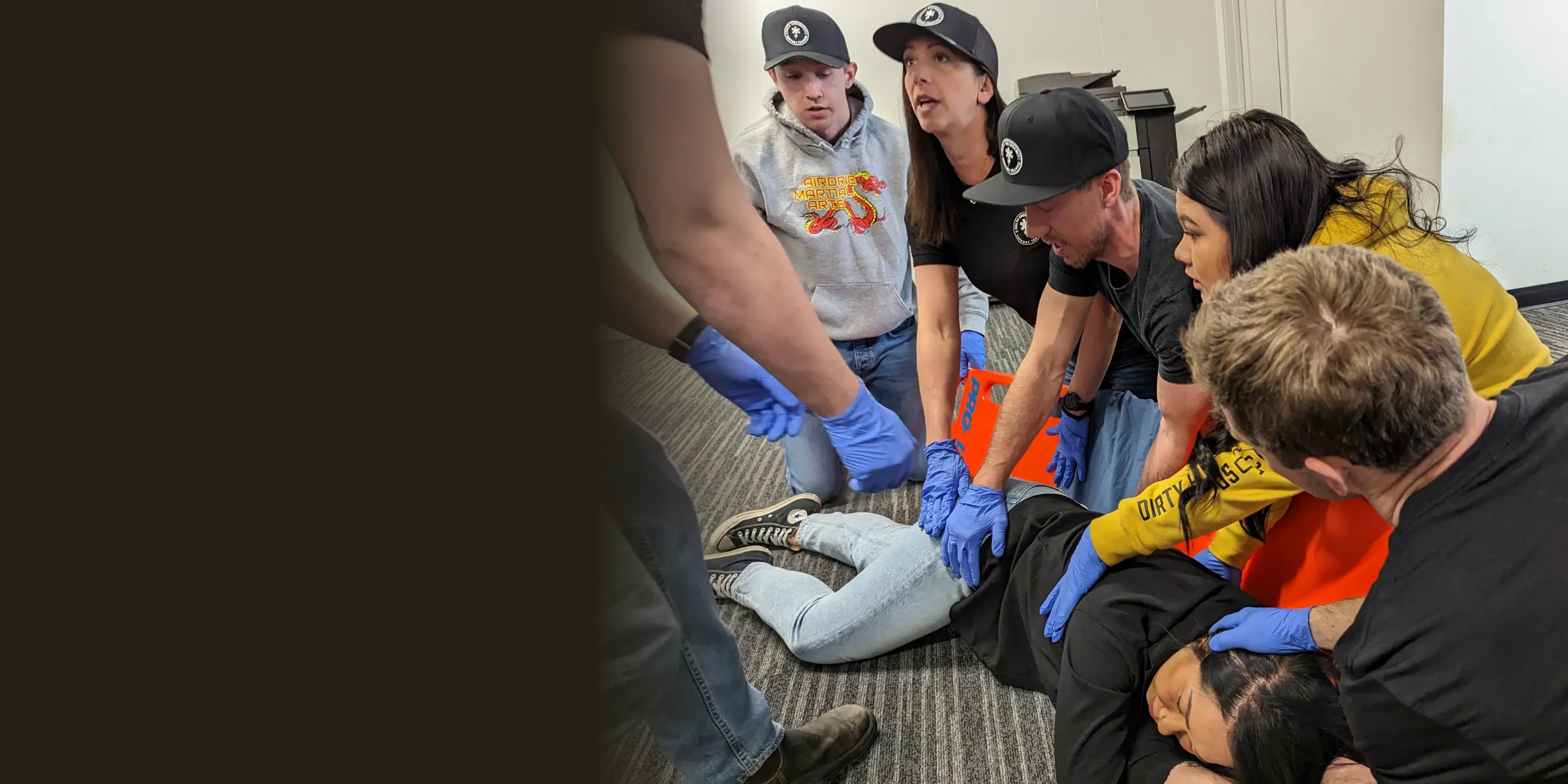
Come dressed to work. This is floor work, kneeling for long stretches, crawling, and lifting and moving people who are not helping you. Closed shoes, clothing you can move in, hair tied back, water and food for a long day, a pen and something to write in. If you have an injury, a mobility limitation, a hearing consideration or anything else that will affect how you take part, tell us before the first day rather than during it. Most things can be planned around when we know in advance.
The spine of the program is assessment, and that is where bridging students are pushed hardest. It is not enough to find the problem you were expecting. You need to arrive at a scene you did not choose, make it safe, and work a structured assessment in the order that will kill the patient first, then work it again when the picture appears to have settled. You already know the skills. What the bridge tests is whether you will run the assessment a second time when the first one looked fine.
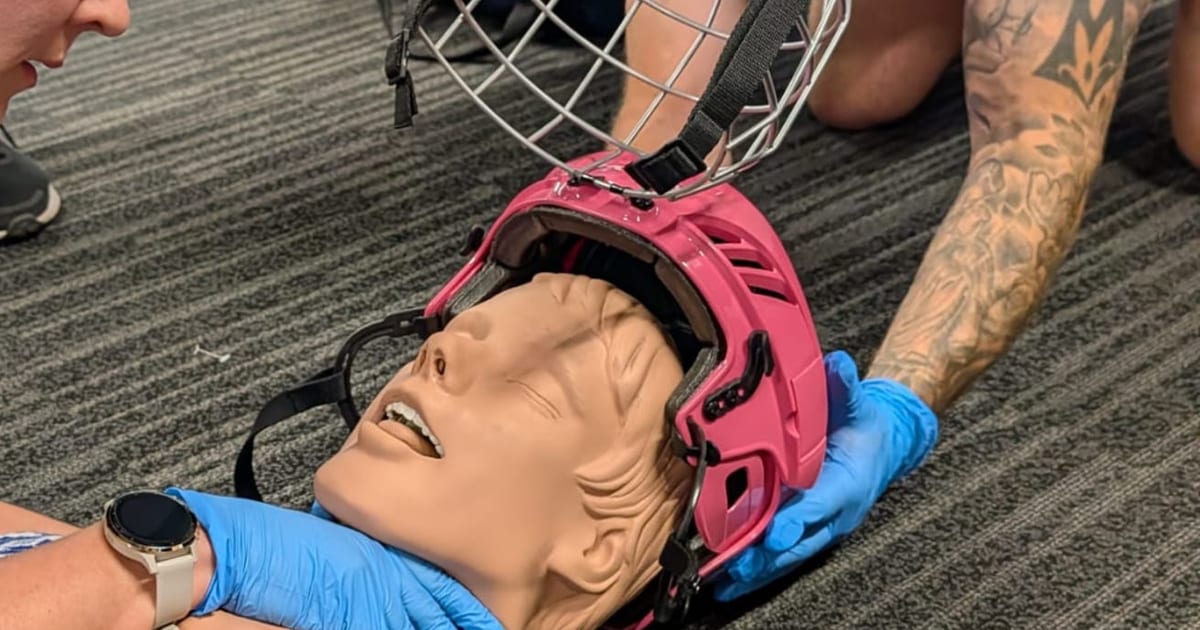
On the hands-on side, expect repeated practice with airway management and adjuncts, suction and ventilation, the oxygen delivery equipment the course covers, bleeding control and shock, immobilization and patient movement, and BLS-level CPR and AED use inside a working team rather than alone on a mannequin. Alongside those, the parts nobody advertises: delegating to untrained bystanders, keeping notes that stand up afterwards, and giving a paramedic crew the story in thirty organized seconds.
Certification is not automatic and finishing the days is not the same as passing. You have to meet the attendance requirement for the run and pass the written and practical evaluations, demonstrating each skill to standard in front of an instructor. Bringing a First Responder certificate in the door earns you a shorter course, not a softer evaluation. If you already know you will miss part of a session, tell us as early as possible, because the options on day one are much better than the options at the end.
Where we run it, and bringing it to your crew
Calgary is the primary location and where most runs are scheduled. We also deliver in Leduc for the greater Edmonton region, which saves a lot of people a three-hour drive each way for a multi-day program. Each run publishes its own dates and daily start times with its listing, so compare them against your shift schedule before you register and contact us if anything looks inconsistent.
We deliver at client worksites across Alberta for an additional fee that covers travel and setup, and we travel elsewhere in Canada and internationally on request. Onsite is the same program: the same hours, the same equipment, the same attendance requirement and the same evaluations. Where we teach it does not change what you have to prove. Contact us with your crew size, your location and the window you are aiming at, and we will tell you what is workable.
A crew bridging together is a common request, particularly where a site has a group of First Responder holders and the paperwork requirement moved for all of them at once. If that is your situation, send the certificate details for everyone at the same time. It is far easier to confirm eligibility for eight people in one pass than to discover on the first morning that two of them expired in the spring.
Use the legal-name spelling your employer already has on file for your First Responder certificate, so the two documents match when someone compares them. That spelling is what gets printed on the Advanced First Aid certificate, and it is far easier to get right at registration than to have corrected later.
After the bridge: renewal, EMR, and the honest limits
Plan the renewal cycle the week you finish. Once you hold Advanced First Aid, the certificate is normally renewed through the shorter Advanced First Aid Recertification course, which is only for a certificate that is still valid on the day of the course. The BLS component is on its own annual clock. Once a certificate has expired, the way back is the full course, so book each renewal before its expiry date.
If Emergency Medical Responder is the next step, there is an Advanced First Aid to EMR bridge for exactly that. Be clear-eyed about what a Canadian Red Cross EMR certificate is before you build a plan on it: it is not a program approved by the Alberta College of Paramedics, it does not make you registrable as an EMR in Alberta, and it does not confer a practice permit. It may meet selected admission requirements at some Primary Care Paramedic schools, and the words selected and some are doing real work in that sentence. Verify with your exact school and your exact intake, in writing, before you enrol anywhere.
The honest framing for Advanced First Aid itself is the same. It is an advanced first aid credential, not a licence to practise medicine, and it does not authorize restricted activities. What you are permitted to do at work is set by your employer, your site medical direction and any applicable regulation, not by the certificate in your wallet. What the bridge adds is the evaluated step from responder-level to advanced first aid, on paper, without repeating the ground you already covered.
Your own oxygen kit in scenarios
Oxygen is taught with equipment that is yours: a nasal cannula and a non-rebreather mask, opened from the packaging in front of you. You work with them through the course, and you wear them when you play the patient in scenarios, so nobody trains with a mask that has been on someone else's face.
They go home with you afterwards. Keep them with your kit; you have already fitted them once.
Who this course is for
- First Responder holders whose employer or prime contractor has started asking for Advanced First Aid by name
- Industrial, oilfield and construction site responders who already carry a current First Responder certificate
- Volunteer and on-call firefighters adding an advanced first aid credential to their own file
- Safety coordinators and HSE advisors who are the named first aid attendant on a site
- Security supervisors and event medical staff who reach a patient before EMS does
- Camp, remote-tourism and backcountry workers whose nearest hospital is a long way off
- Leduc and greater Edmonton First Responder holders who would rather not drive to Calgary for a multi-day course
- Responders planning to move to Emergency Medical Responder later and taking the Advanced First Aid step first
English-language requirements
This course is taught and assessed in English. Professional responder training involves extensive medical terminology, clinical abbreviations, patient assessment, rapid communication, and complex practical scenarios.
Live classroom translation is not offered for this program.
Students must be able to understand instructions, communicate effectively during practical scenarios, and complete the required assessments in English.
Contact us before registering if you have questions about the language requirements.
Where we teach this course
Public sessions run in Calgary, with dates in Leduc through the year.
We also deliver this course at your worksite for groups, useful for crews who can’t release staff to travel. Onsite delivery carries an additional fee on top of per-person pricing. Request an onsite quote.
We travel for private and group training across Canada, and internationally by arrangement. If you’re outside Alberta, tell us where you are and we’ll price it.
Your course materials
Digital access opens the moment you register. Physical manuals live in our classroom library for you to use during class. Want one of your own to keep? Buy it here at a discount.
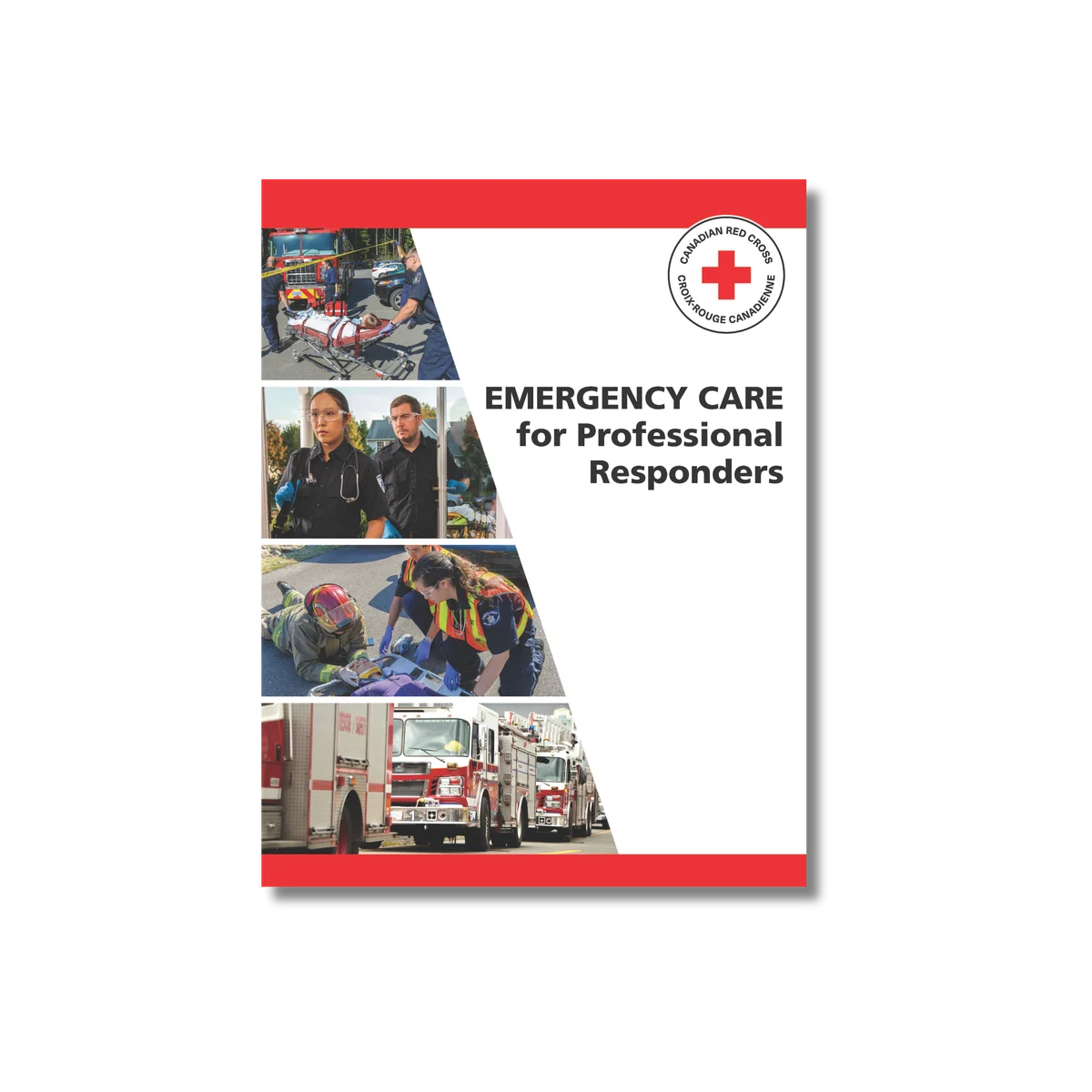
Canadian Red Cross Emergency Care for Professional Responders
$197.96 (10% off when you add it while registering)
$219.95Add it when you registerSee what this book covers
Bought on its own from the shop, it ships to you at full price. The discount exists only at registration.
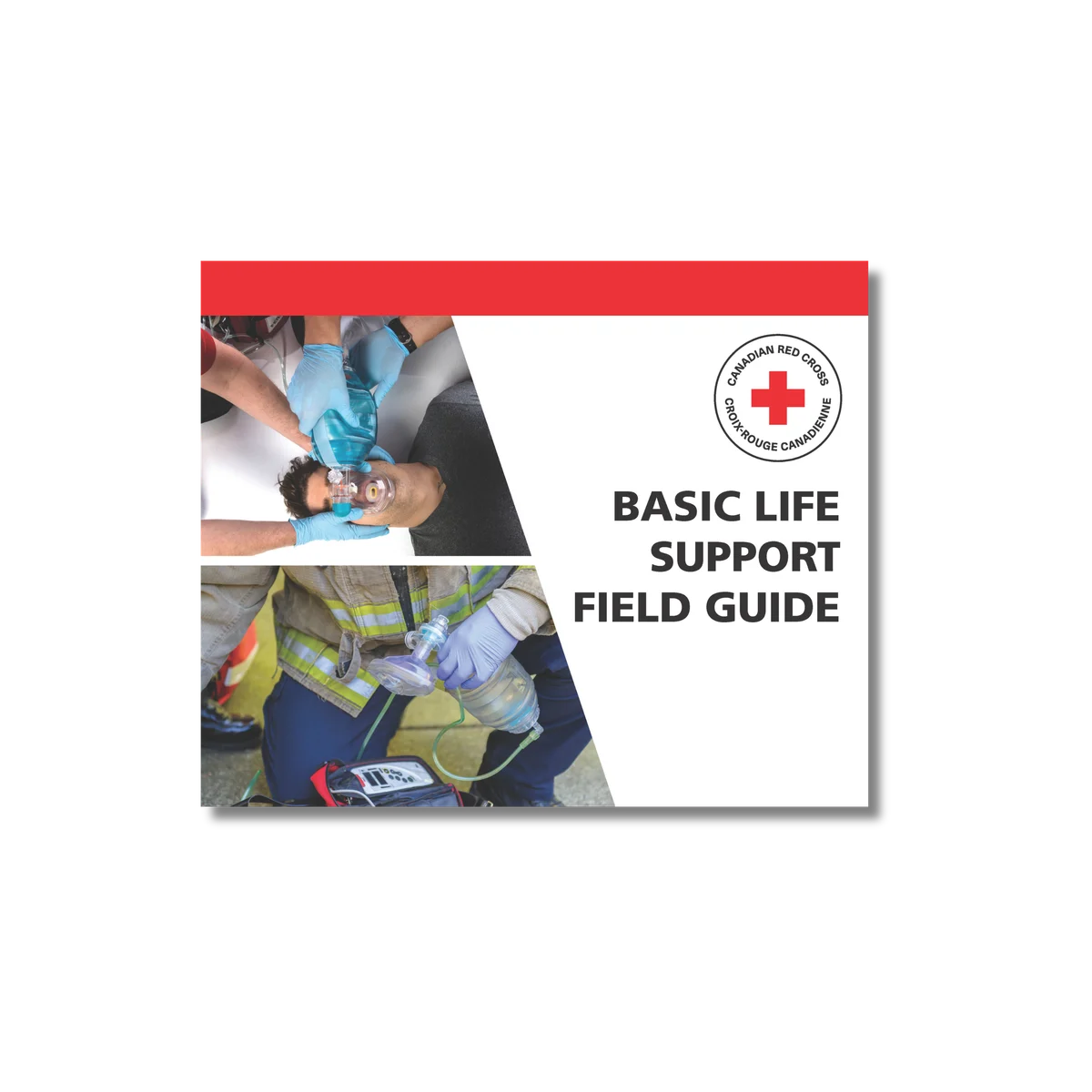
Canadian Red Cross Basic Life Support Field Guide
$35.96 (10% off when you add it while registering)
$39.95Add it when you registerSee what this book covers
Bought on its own from the shop, it ships to you at full price. The discount exists only at registration.
Ready to take this course?$550.00 + GST & applicable taxes
Common questions
- What exactly do I need to hold to take this bridge?
- A current Canadian Red Cross First Responder certificate. Both halves of that matter: the issuing organization, and whether the certificate is still inside its validity period on the day the bridge starts. A responder-level certificate from another organization is a separate question with a separate answer, and so is a card that has already run out.
- My First Responder certificate has already expired. Can I still bridge?
- The prerequisite is a current certificate, so an expired First Responder card does not meet it, however recently it expired. The full Advanced First Aid course is the way in for you. If you are not sure of your date, send us your certificate before you book and we will check it.
- My responder training came from a fire service or another organization. Does that count?
- It is not something we can answer generically, in-house fire service programs, occupational first aid levels from other provinces and certificates from other issuing organizations all differ in scope and in what the bridge route recognizes. Tell us the issuing body and the exact certificate name and you will get a yes or a no, not a maybe.
- How long is the bridge, and what does it cost?
- It runs as a multi-day in-person program, and the exact days, daily start times and hours are published with the specific run you are booking, so check those against your rotation before you commit. The fee is confirmed at registration rather than advertised here, so ask us for the current figure for the run you want.
- Is Basic Life Support included, and how long is the certificate valid?
- BLS is part of the bridge, so you are not booking CPR separately. The Canadian Red Cross sets the validity periods and the exact expiry dates are printed on the certificates you receive, currently three years on the Advanced First Aid certificate and one year on the BLS component. Track both dates, because the annual BLS clock comes around twice before the Advanced First Aid certificate is due.
- Will Advanced First Aid satisfy my employer's or my site's requirement?
- We will not promise that, and you should be wary of any provider who does. Alberta first aid requirements come from occupational health and safety rules, industry practice, prime contractors and individual employers, and they change. Send us the exact wording you were given and we will tell you honestly whether this course matches it, including if it does not.
- Does this put me on track to work as an EMR or a paramedic in Alberta?
- No. Advanced First Aid is an advanced first aid credential, not a licence to practise. Even the Canadian Red Cross EMR course is not a program approved by the Alberta College of Paramedics, does not make you registrable as an EMR in Alberta and does not confer a practice permit. It may meet selected admission requirements at some PCP schools, which you must verify directly with that school and that intake.
- Can you run the bridge at our worksite for a group of our First Responder holders?
- Yes. We deliver at client worksites across Alberta for an additional fee covering travel and setup, and we travel elsewhere in Canada and internationally on request. The onsite version is the same program with the same attendance and evaluation requirements, and the same eligibility rules apply to every person on the roster.
- What counts as a baby, a child or an adult, and which ages does this course cover?
- This course carries BLS (Basic Life Support), which covers adults, children, infants and neonates. The Canadian Red Cross 2025 standards set the age groups this way. A baby is under 1 year old. A child is 1 year old up to the onset of puberty. An adult is anyone from the onset of puberty on. Puberty does not happen on a set birthday, so you judge it on the person in front of you. A 13 year old who has started puberty gets adult CPR, and one who has not is still a child. For an AED, use child pads on a child up to the onset of puberty or under 55 pounds (about 25 kg), and baby pads on a baby if the AED has them. If baby pads are not there, use child or adult pads. If child pads are not there, use adult pads. The Red Cross says adult pads are safe on a child or a baby, so do not wait for the right size. If you are training for a specific person, tell us their age and we will tell you which course fits.
- Is live translation available for this course?
- No. This course is taught and assessed in English, without live classroom translation. You need to understand instructions, communicate during practical scenarios and complete the assessments in English. Contact us before registering if you have questions.
Where to go next
Ready to register?
Pick your cohort above, or start here and choose your dates on the registration page.
Cancellation, transfer, and refund terms are shown before payment and confirmed at registration. Not sure which course fits? Email us and we’ll help.
Sources
- On successful completion you receive a Canadian Red Cross Advanced First Aid certificate. Canadian Red Cross (verified 2026-07-23).
- The Canadian Red Cross First Aid Program Standards 2025 define a baby as newborn to 1 year of age, a child as 1 year old to the onset of puberty, and an adult as the onset of puberty and older. Canadian Red Cross (verified 2026-09-26).
- The Canadian Red Cross Comprehensive Guide for First Aid & CPR (2025) says pediatric AED pads should be used on children up to the onset of puberty or weighing less than 55 pounds, and that if pediatric pads are not available it is safe to use adult pads on a child or baby. Canadian Red Cross (verified 2026-09-26).
← All courses · Last reviewed 2026-08-23